Maintaining your professional certification requires a strategic approach to continuing medical education. The transition from the PANCE to the recurring PANRE (Physician Assistant National Recertification Exam) or the PANRE-LA (Longitudinal Assessment) necessitates high-quality, high-yield content that aligns with the NCCPA Blueprint. For many physician assistants, the challenge is not just finding the time to study, but also efficiently utilizing a CME stipend.
Our PANRE Review Course is designed to solve both problems simultaneously. We provide a rigorous clinical review while allowing you to maximize your employer-provided funds through a cme gift cards add-on program.
Course Logistics and Deliverables
Price: $499.99 (Base Course)
Duration of Access: 30 Months
Quantifiable Deliverables: 100 AAPA Category 1 CME Credits, 1,672 Practice Questions
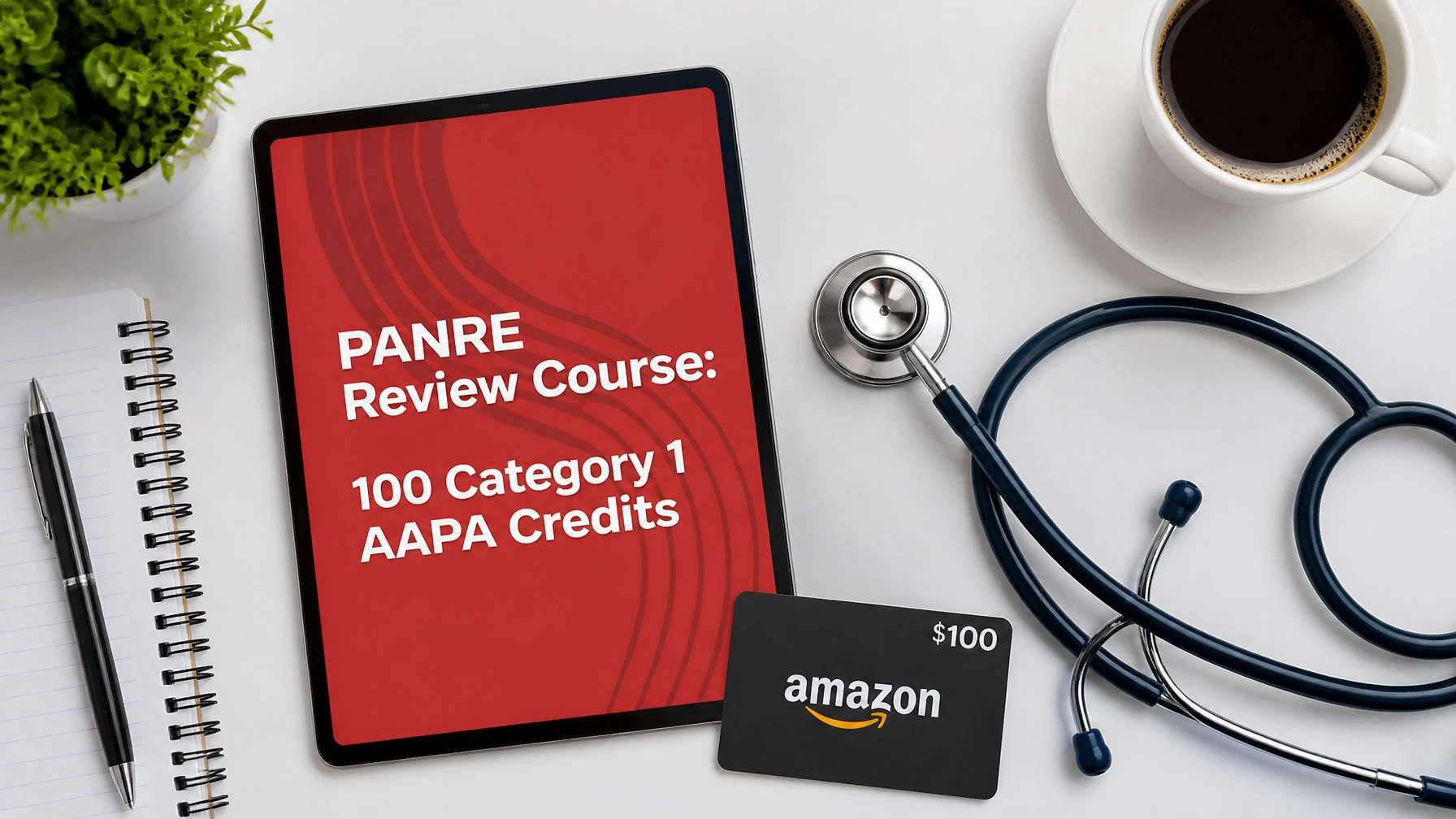
The PANRE Review Course is specifically designated for 100 hours of Category 1 AAPA Credit. This credit amount is sufficient to meet a significant portion of your state and national licensing requirements in a single purchase. While this course is authored by physician assistants for physician assistants, nurse practitioners can also claim these credits in many states, and physicians may utilize the material for Category 2 credit.
Understanding the Gift Card Add-On

A unique feature of our platform is the ability to include an Amazon or Apple Gift Card add-on to your purchase. It is important to note that these are not free gifts. These are paid add-ons ranging from $100 to $1500 that are added to the total cost of your CME package.
By selecting a CME with Gift Card package, you can streamline your educational spending. For example, a $1,500 Amazon gift card add-on allows you to purchase medical textbooks, clinical tools, or technology necessary for your practice, all within one educational transaction. This method is highly effective for PAs looking to optimize their annual CME allowance before it expires.
Clinical Review: Cardiology and the NCCPA Blueprint
Cardiology is a cornerstone of the NCCPA Blueprint, accounting for a significant percentage of the questions on both the PANCE and PANRE. Mastery of heart failure, ischemic heart disease, and valvular disorders is essential for clinical practice and exam success. Our pance prep courses break down these complex topics into matter-of-fact, high-yield points that you will encounter on exam day.
When reviewing cardiology, focus on the diagnostic gold standards and the initial management steps for acute presentations. Understanding the nuances of EKG interpretation: such as identifying ST-segment elevation in specific leads to localize an infarct: is a skill that our question bank reinforces through clinical vignettes.

Clinical Scenario: Acute Heart Failure Management
Your patient is a 68-year-old male presenting to the emergency department with progressive dyspnea and orthopnea over the last 48 hours. He has a history of hypertension and a previous myocardial infarction.
Vitals:
- HR: 112 bpm
- BP: 175/95 mmHg
- SaO2: 89% on room air
- Temp: 98.6°F
Physical Exam:
The patient is in respiratory distress, speaking in short sentences. Physical exam reveals bilateral rales halfway up the lung fields and 2+ pitting edema in the lower extremities. An S3 gallop is heard on cardiac auscultation. A chest X-ray shows cephalization of pulmonary vessels and Kerley B lines.
Practice Question 1
Which of the following is the most appropriate initial pharmacological intervention to reduce preload in this patient?
A. Metoprolol 5mg IV
B. Furosemide 40mg IV
C. Lisinopril 10mg PO
D. Morphine 2mg IV
Correct Answer: B. Furosemide 40mg IV
Explanation: In the setting of acute decompensated heart failure with volume overload, loop diuretics like Furosemide are the first-line treatment to rapidly reduce preload through diuresis and a secondary venodilatory effect. Choice A (Metoprolol) is contraindicated in acute decompensation due to its negative inotropic effects, which could worsen the patient's respiratory status. Choice C (Lisinopril) is a maintenance medication for chronic heart failure and acts too slowly for acute stabilization. Choice D (Morphine) was once used for dyspnea in pulmonary edema but is no longer recommended as a primary treatment due to increased rates of mechanical ventilation and adverse outcomes.
Practice Question 2
Your patient’s symptoms stabilize after diuresis, but his EKG shows a new-onset atrial fibrillation with a rapid ventricular response (RVR). He remains hemodynamically stable. What is the most appropriate next step for rate control in this patient with a known history of heart failure?
A. Immediate synchronized cardioversion
B. Diltiazem IV bolus
C. Digoxin IV
D. Esmolol infusion
Correct Answer: C. Digoxin IV
Explanation: In patients with acute heart failure and reduced ejection fraction, Digoxin or Amiodarone are preferred for rate control if beta-blockers are not tolerated or if the patient is in an acute flare. Choice A (Cardioversion) is reserved for patients who are hemodynamically unstable (e.g., hypotension, altered mental status). Choice B (Diltiazem) and other non-dihydropyridine calcium channel blockers should be avoided in patients with heart failure with reduced ejection fraction (HFrEF) due to their potent negative inotropic effects. Choice D (Esmolol) is a beta-blocker and, as discussed previously, should be avoided during the acute "wet" phase of heart failure.
Maximize Your Study Time with 1,672 Questions

Efficiency is the primary goal of the panre review course. Our question bank does not just test your knowledge; it teaches you how to think like an NCCPA examiner. We cover all organ systems, including:
- Internal Medicine
- Family Medicine
- Emergency Medicine
- Orthopedics
- Psychiatry and Neurology
- OB/GYN and Dermatology
Every question includes a concise, exclusionary explanation. We lead with the correct answer and explain the clinical logic behind it while dismissing distractors based on current guidelines (e.g., AHA/ACC for cardiology, GOLD for COPD).
Why the Gift Card Add-On Makes Sense
The cme gift cards add-on is a pragmatic tool for the modern clinician. We recognize that education extends beyond the screen. Whether you need a new tablet for rounding, professional attire, or medical references, the Amazon/Apple gift card options (available up to $1500) provide the flexibility to procure these items using your professional development budget.
Again, these are not free rewards. They are integrated into the total purchase price, providing a transparent and efficient way to bundle your educational needs. When you purchase the PANRE Review Course, you are getting a comprehensive board review package that carries 100 AAPA Category 1 credits, alongside the tools you need to succeed in your daily practice.
Conclusion
Staying certified should not be a logistical burden. By combining the highest number of available AAPA Category 1 credits (100 hours) with the flexibility of a gift card add-on, CME Review Courses provides the most efficient educational experience on the market. Access our pance prep courses today and ensure you are prepared for your next recertification cycle while maximizing the value of your CME stipend. And for PA students who prefer an app-based approach, PAtopia offers 11,000+ board-style questions covering the PANCE, PACKRAT, and all 7 EOR rotations. Visit cmereviewcourses.com/patopia-new-student-section/ to start your free trial.