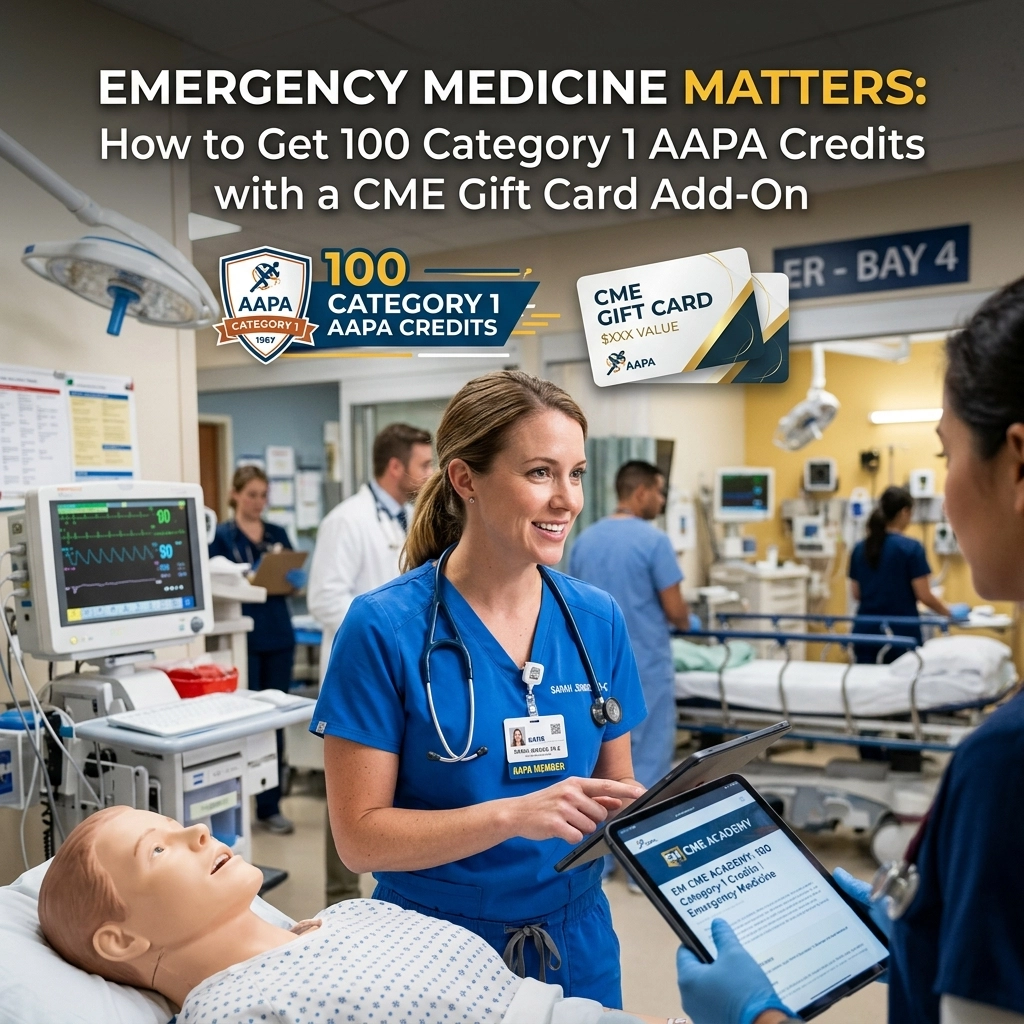
In the high-pressure environment of the Emergency Department, staying current isn't just about professional compliance, it’s about patient safety and clinical excellence. Whether you are managing a multisystem trauma or a complex metabolic derangement, your fund of knowledge is your most valuable tool. However, finding the time to accumulate credits between 12-hour shifts can be a logistical nightmare.
At CME Review Courses, we simplify this process by offering high-yield content that satisfies your certification requirements efficiently. If you are looking for a comprehensive panre review course or pance prep courses that provide a massive boost to your credit total, you are in the right place.
The Essentials: Course Logistics and Deliverables
When you invest in your education, you need to know exactly what you are getting. Efficiency and transparency are the hallmarks of our program.
- Course Title: PANRE Review Course with Gift Card
- Credit Value: 100 AAPA Category 1 CME Credits
- Price: Starting at $749.00 (Base course)
- Access: 12 months of unlimited streaming
- Deliverables: Comprehensive video lectures covering the entire NCCPA Blueprint and over 1,600 board-style practice questions.
- Add-Ons: Amazon or Apple Gift Cards ranging from $100 to $1,500.
Important Note on Gift Cards: Please be aware that the Amazon and Apple Gift Cards are add-ons to your purchase. They are NOT free gifts. The value of the gift card you select is added to the total cost of the educational package, allowing you to maximize your employer-provided CME budget in a single transaction.
Maximizing Your CME Budget with CME Gift Cards
Most PAs have an annual CME allowance that is "use it or lose it." By choosing a package that includes cme gift cards, you are essentially prepaying for clinical tools, technology, or reference materials you will need throughout the year.
Since the PANRE Review Course provides 100 hours of AAPA Category 1 credit, it often fulfills a PA's entire biennial Category 1 requirement in one go. Adding a $500, $1,000, or $1,500 gift card to the package allows you to upgrade your clinical gear: like a new iPad for charting or a high-quality stethoscope: while securing all the credits you need.

Emergency Medicine Clinical Review: The NCCPA Blueprint
Emergency medicine accounts for a significant portion of the PANCE and PANRE exams. To succeed, you must be proficient in rapid diagnosis and stabilization. Our pance prep courses focus heavily on these high-acuity areas.
Cardiovascular Emergencies: The Acute Coronary Syndrome (ACS) Spectrum
Your patient is a 58-year-old male presenting with retrosternal chest pressure that radiates to the left jaw. He is diaphoretic and nauseated.
Vitals: BP 142/90, HR 98, RR 20, SaO2 96% on room air.
The initial EKG shows 2mm ST-segment elevation in leads II, III, and aVF.
Practice Question 1:
What is the most appropriate immediate intervention for this patient?
A) Obtain a Stat CT Angiogram of the chest
B) Administer 324 mg of chewed Aspirin and activate the cardiac catheterization lab
C) Start a Heparin drip and admit to the ICU for observation
D) Administer intramuscular Epinephrine 0.3 mg
Explanation:
The correct answer is B. This patient is presenting with an inferior ST-elevation myocardial infarction (STEMI). The standard of care is immediate reperfusion. Chewed aspirin reduces mortality in the setting of ACS, and activation of the cath lab for Primary Percutaneous Coronary Intervention (PCI) is the definitive treatment for STEMI. CT Angiogram (A) is used for suspected aortic dissection or PE, not STEMI. Heparin (C) is an adjunct but does not replace the need for emergent reperfusion. Epinephrine (D) is for anaphylaxis or cardiac arrest, not an awake patient with STEMI.

Pulmonary Emergencies: Managing the Acute Breathless Patient
Respiratory distress is one of the most common reasons for an ER visit. Distinguishing between CHF exacerbation, COPD, and Pulmonary Embolism (PE) is critical.
Practice Question 2:
Your patient is a 32-year-old female, 10 days postpartum, presenting with sudden onset shortness of breath and pleuritic chest pain.
Vitals: BP 110/70, HR 124, RR 28, SaO2 89% on RA.
Physical exam reveals a swollen, tender left calf. Lung sounds are clear bilaterally.
Which of the following is the most appropriate next step in diagnosis?
A) D-dimer assay
B) Chest X-ray
C) CT Angiogram of the chest (PE Protocol)
D) Ventilation-Perfusion (V/Q) scan
Explanation:
The correct answer is C. This patient has a high clinical suspicion for Pulmonary Embolism (tachycardia, postpartum status, signs of DVT, and hypoxia). According to Wells Criteria, she is high risk. In high-risk patients, a D-dimer (A) is not useful because a negative result cannot safely rule out PE. CT Angiography is the gold standard for diagnosis in stable patients. A V/Q scan (D) is typically reserved for patients with a contraindication to IV contrast (e.g., renal failure). A Chest X-ray (B) is often normal in PE (though it may show Westermark sign or Hampton’s hump) and is not diagnostic.

Why the 100-Hour PANRE Review Course?
The PANRE Review Course is specifically designed to cover the breadth of medical knowledge required by the NCCPA. While it is titled for the PANRE, it is an excellent resource for PANCE candidates and practicing PAs who want a deep dive into multiple specialties.
By earning 100 Category 1 AAPA credits, you are not just checking a box; you are engaging in a comprehensive review of:
- Cardiology and Pulmonology
- Gastrointestinal and Genitourinary systems
- Musculoskeletal and Neurological disorders
- Emergency Medicine and Surgery
Using a panre review course that offers a high volume of credits ensures that your educational requirements are met well in advance of your recertification deadline.
Gastrointestinal Emergencies: The Acute Abdomen
Evaluating abdominal pain requires a systematic approach to rule out life-threatening surgical emergencies.
Practice Question 3:
Your patient is a 72-year-old male with a history of hypertension and tobacco use presenting with sudden, severe "tearing" abdominal pain that radiates to his back.
Vitals: BP 90/60, HR 115, RR 22.
On exam, you note a pulsatile abdominal mass.
What is the most likely diagnosis?
A) Acute Pancreatitis
B) Ruptured Abdominal Aortic Aneurysm (AAA)
C) Perforated Peptic Ulcer
D) Nephrolithiasis
Explanation:
The correct answer is B. The classic triad of a ruptured AAA includes abdominal/back pain, hypotension, and a pulsatile abdominal mass. His risk factors (age, HTN, tobacco) strongly support this. Acute pancreatitis (A) typically presents with epigastric pain radiating to the back but usually doesn't involve a pulsatile mass or sudden hemodynamic collapse unless severe. Perforated ulcer (C) presents with sudden pain and peritoneal signs (rigidity). Nephrolithiasis (D) causes severe colicky pain but does not cause hypotension or a pulsatile mass.
Professional Development and Clinical Gear
As we mentioned earlier, the ability to add cme gift cards to your course purchase is a major benefit for PAs. When you select your course, you can choose an add-on that fits your needs.
If you are a student preparing for boards, our PANCE Review Book and online materials provide the structure you need. If you are a seasoned PA in Emergency Medicine, you might prefer a package that includes a $1,000 Amazon gift card to purchase the latest clinical textbooks or upgrade your home office setup.

Closing Thoughts for the Emergency Medicine PA
Emergency medicine is a field of constant evolution. The protocols for sepsis, stroke, and trauma change as new data emerges. Utilizing a comprehensive panre review course ensures you stay at the forefront of these changes while fulfilling your professional obligations.
Don't wait until the end of your cycle to scramble for credits. Secure your 100 Category 1 AAPA credits today with our PANRE Review Course and take advantage of the cme gift cards add-on options to make your CME budget work harder for you.
Course Quick Links:
Stay sharp, stay certified, and we’ll see you in the next shift.