Course price: $499.99 for 30 months of access.
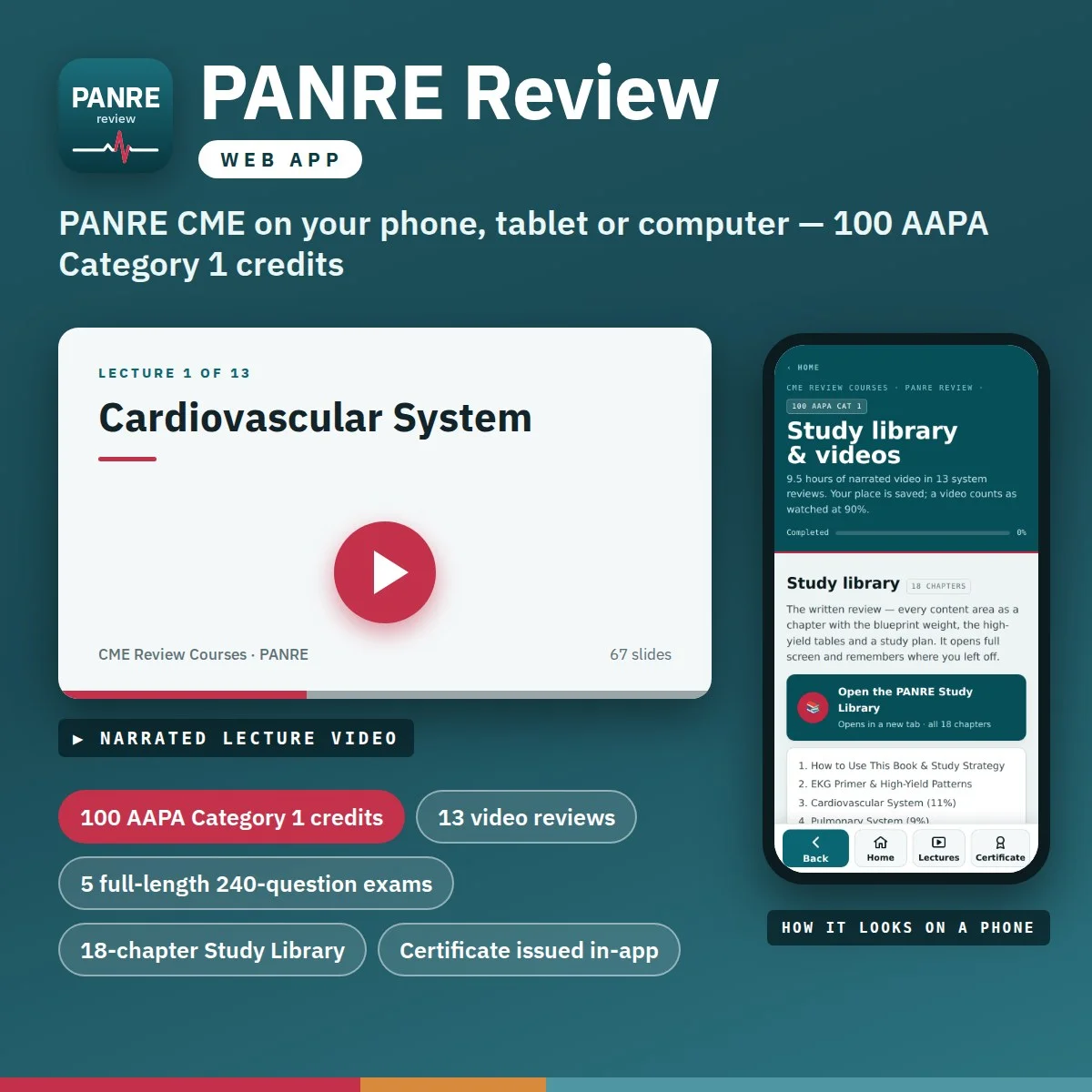
Practice questions: 2,500+ board-style questions, including 1,810 across 15 body-system modules and five full-length 240-question mock exams (1,200 questions).
Study resources: 10+ hours of high-yield video lectures with downloadable slides.
Readiness tracking: PANRE Readiness Dashboard with per-topic breakdown and an “on track to pass” indicator at 75%+.
CME: Up to 100 AAPA Category 1 CME credits for the PANRE Clinical Review Module.
Amazon and Apple Gift Card add-ons ($100–$1,500) are paid add-ons to the purchase, not free gifts.
The phrase “PAs should only claim credit commensurate with the extent of their participation” is the practical rule behind the word up to. It means your CME claim should match the activity you actually completed, not simply the maximum number advertised for the course.
For the PANRE Review Course, the certificate records the precise credit awarded to you after you meet the activity’s completion requirements. It does not automatically state 100 credits for every purchaser.
What “Commensurate With Participation” Means
AAPA Category 1 approval applies to an educational activity, but the maximum credit available is not a blanket award. You need to complete the relevant course content and requirements to earn the credit. If you complete only part of a module, don’t claim the full 100 credits. Claim only the amount awarded for your completed participation, as stated on your certificate.
That’s why the course is described as offering up to 100 credits. The certificate is individualized to reflect the credit you earned; it should not be treated as a generic certificate showing the maximum available to every learner.
To earn credit for the PANRE Clinical Review Module, review all module content, complete the post-test with a score of 70% or higher, and complete the activity evaluation. You may retake missed post-test questions to reach the passing score. Once you meet the requirements, a certificate is issued stating your precise credit.
The Record You Should Be Able to Produce in 30 Seconds
A clean CME record makes follow-up straightforward. Save the certificate PDF and keep a simple log with:
- Activity title: Comprehensive Clinical Review for Practicing PAs, 2026–27 Enduring CME Activity, PANRE Clinical Review Module
- AAPA reference number: CME-2016187
- Completion date
- Precise credits claimed, matching the certificate
- Post-test score and confirmation that you completed the evaluation
- Certificate PDF
Put the certificate and details in a named folder, on your computer or in a cloud drive, rather than relying on memory or searching through old email. For this activity, for example, a folder named “CME, PANRE Clinical Review, 2026” is easy to locate and understand.
Keep Category 1 CME documentation for at least as long as the credit needs to be verifiable for your certification cycle, and honestly, longer than that is easier. A certificate you saved is a two-minute answer years later; a certificate you never downloaded is an afternoon of email archaeology. Keeping records across several cycles costs you nothing but a folder. Your state licensing board or employer may have their own retention rules, so check those too.
The NCCPA CME requirements page spells out what you need to log for certification maintenance and how verification works. Read it once with your own reporting habits in mind.
Download your certificate the same day you finish. The course can remain available for months, but that does not make the certificate easier to find later. Save it when it is issued, while the activity and completion details are still fresh.
Category 1 Documentation vs. a Category 2 Line Item
AAPA Category 1 credit has been reviewed and approved by the AAPA Review Panel. After completing the activity requirements, you receive a certificate identifying the activity and your awarded credit. The paper trail exists because a third party approved the activity up front.
Category 2 is different: it is generally self-directed and self-reported. It can count toward applicable NCCPA CME requirements, but it does not have the same provider-issued Category 1 certificate attached to the activity. Neither category is morally “better”; they are different credit types. If someone asks you to verify a Category 1 activity, having the certificate ready makes the response simple.
This distinction can also matter if you need documentation for state license renewal, employer CME reimbursement, or credentialing. Requirements vary, so confirm what the requesting organization accepts and keep the certificate as your supporting record.
The Calendar Deadline Is Separate From Your Access Period
The activity’s AAPA approval is valid through August 26, 2027. The course purchase includes 30 months of access, but that access period is not the same as the activity’s approval window. If you finish the course after August 26, 2027, you cannot claim this activity’s credit. Schedule time to complete the post-test and evaluation well before the approval expiration date.
That’s a documentation-and-calendar issue, not a study problem: leave enough time to complete the requirements, receive the certificate, and save it before the approval period ends.
Paid Gift Card Add-Ons: A Different Timeline
Amazon and Apple gift cards are paid add-ons in $100–$1,500 tiers, selected at checkout. Their cost is added to the purchase price. They are emailed within 2–3 business days of purchase, not after you finish the course. Gift card purchases are nonrefundable, and CME Review Courses is not affiliated with Amazon or Apple. Check your employer’s CME policy before choosing an add-on.


The gift card arrives in days while your CME record accumulates over months: two very different timelines in one purchase.
Practice Question: Psychiatry
You are evaluating a 34-year-old patient taking sertraline who was recently started on linezolid for a resistant infection. The patient develops agitation, diaphoresis, hyperthermia, tremor, inducible clonus, hyperreflexia, and dilated pupils. HR is 122/min, BP is 148/86 mm Hg, temperature is 39.2°C, RR is 22/min, and SaO₂ is 98%. What is the most likely diagnosis and immediate medication-management step?
Correct answer: serotonin syndrome; stop the serotonergic agents.
A. Neuroleptic malignant syndrome; continue sertraline and stop linezolid only if rigidity develops
B. Anticholinergic toxicity; administer an anticholinergic agent
C. Sepsis or meningitis; pursue an infectious workup as the only immediate action
D. Serotonin syndrome; stop the serotonergic agents
The combination of serotonergic medications and clonus with hyperreflexia supports serotonin syndrome. Neuroleptic malignant syndrome typically follows dopamine antagonist exposure and features lead-pipe rigidity and bradyreflexia, often developing over days. Anticholinergic toxicity more often causes dry skin and does not produce clonus. An infectious evaluation may be appropriate based on the clinical picture, but it does not address the medication interaction.
Exam note: Clonus plus hyperreflexia is a discriminator exam writers love. In real practice, the medication list is often the fastest diagnostic tool. The Psychiatry module includes 67 questions.
Review the Course and Keep the Record
If you’re comparing pance prep courses or looking for a PANRE resource that also offers CME, review the course details and verify the completion requirements that apply to your credit. You can try the free test drive before deciding.
- View the PANRE Review Course and paid cme gift cards
- Try the free PANRE Review Course test drive
- Review NCCPA CME requirements
Nurse practitioners: Acceptance of AAPA Category 1 credit for NP renewal varies by state. Verify with your state board of nursing. Physicians: This activity meets AAPA Category 1 requirements for PAs; for physicians’ own reporting, it counts as Category 2 CME.
Author: Jeremy Boroff, MPAS, PA-C, Emergency Medicine PA with 24 years of clinical experience, PA educator, author, and CME developer. Sole faculty; no relevant financial relationships to disclose.