
Start With the Course Logistics
If you want one resource to support both recertification preparation and your CME plan, the PANRE Review Course with Gift Card includes:
- Price: $499.99 without a gift card add-on
- Access: 30 months
- Practice: More than 2,500 board-style practice questions
- Five full-length 240-question practice exams: 1,200 full-length exam questions
- Detailed rationales and cited references
- Up to 100 hours of AAPA Category 1 CME
- Online, self-paced, and mobile-friendly
The 100 hours of AAPA Category 1 CME apply to the PANRE Review Course only. They are not attributed to the Pharmacology Course.
The CME Cycle Should Drive Your Exam Plan
NCCPA certification maintenance is organized around five two-year CME cycles within a 10-year certification period. During each two-year cycle, you must earn and log the required CME and complete the appropriate recertification pathway by the end of the 10-year period.
The exam format you choose changes when and how you prepare, but it does not eliminate the need to plan CME independently. You must continue meeting CME requirements whether you select traditional PANRE or PANRE-LA.
The practical question is not simply, “Which exam is easier?” It is:
Which assessment format fits your work schedule, study habits, and CME budget over the next several years?
Traditional PANRE: Concentrated Preparation in Years 9 or 10
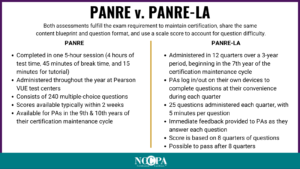
The traditional PANRE is a single, proctored examination administered at a Pearson VUE testing center. You may take it in year 9 or year 10 of your certification maintenance cycle.
Key logistical details include:
- Four 60-question blocks
- 60 minutes for each block
- 240 questions total
- Closed-book testing environment
- Pearson VUE test center administration
- $350 NCCPA application fee
This format concentrates the assessment into one testing event. Your preparation may also become concentrated: many PAs begin a structured review several months before the exam, then use practice exams to evaluate pacing, endurance, and knowledge gaps.
The financial advantage is predictability. You pay the NCCPA application fee and separately plan for review resources and CME. The disadvantage is that the exam is close to the end of the 10-year cycle, so delaying preparation can create avoidable pressure.
For a traditional PANRE candidate, a 30-month course-access period can cover the final portion of year 8, year 9, and much of year 10. That allows you to complete CME during an active two-year cycle while also building toward the exam.
PANRE-LA: Ongoing Assessment Beginning in Year 7
PANRE-LA is an online longitudinal assessment completed through the NCCPA portal. You apply in year 6 and begin participation in year 7.
Its structure is distributed over time:
- 25 questions per quarter
- Five minutes per question
- Open-book use of printed or online references
- A minimum of eight completed quarters
- Up to 12 quarters available
- Final performance based on the best eight quarters
- Immediate feedback, explanations, and references
- $350 NCCPA application fee
The assessment is administered across years 7 through 9. You must still participate in at least one quarter in year 7 and one quarter in year 8. If you do not pass by the end of the available PANRE-LA quarters, NCCPA provides a pathway to take traditional PANRE in year 10.
PANRE-LA also awards Category 1 Self-Assessment CME for completed quarters. That credit is separate from the up to 100 hours of AAPA Category 1 CME earned through the PANRE Review Course. Do not treat PANRE-LA self-assessment credit and course CME as the same activity.
How to Build the Budget Around Each Format
If You Choose Traditional PANRE
A practical budget may include:
- The $350 PANRE application fee in year 9 or 10.
- A review course purchased during the final 30 months before the exam.
- CME completed during the applicable two-year cycle.
- Travel or scheduling costs associated with the Pearson VUE appointment, if applicable.
The PANRE Review Course can consolidate the education portion of this plan. It provides up to 100 hours of AAPA Category 1 CME, more than 2,500 practice questions, five 240-question practice exams, detailed rationales, and cited references.
You do not need to wait until year 9 to use it. Starting earlier allows you to distribute practice questions across several quarters rather than attempting to complete the material in a short period.
If You Choose PANRE-LA
A PANRE-LA budget should account for:
- The $350 PANRE-LA application fee in year 6.
- CME needs during years 7, 8, and 9.
- A longitudinal study system that can support quarterly review.
- Continued clinical reading and practice between assessment windows.
Because PANRE-LA provides immediate feedback and references, it functions partly as an assessment and partly as a learning activity. However, it does not replace a comprehensive review plan. The PANRE Review Course can provide the broader clinical review needed across cardiovascular, pulmonary, GI, neurologic, infectious disease, endocrine, musculoskeletal, psychiatric, reproductive, and other NCCPA Blueprint categories.
The course’s 30-month access period is useful for PANRE-LA candidates because it overlaps multiple quarters. You can use the question bank to identify weak areas before a quarter begins, then review rationales and references after completing the NCCPA questions.
Planning Around Paid CME Gift Card Add-Ons
The PANRE Review Course is available without an add-on for $499.99. At checkout, you may choose a paid Amazon or Apple Gift Card add-on from $100 to $1,500.
These are not free gifts. The selected gift card amount is added to the purchase price. For example, a $100 add-on produces a total course purchase of $599.99 before any applicable taxes or other charges.
The add-on does not increase the CME awarded. The PANRE Review Course remains eligible for up to 100 hours of AAPA Category 1 CME, based on completion requirements and actual participation.
The purpose of the option is to direct part of an available CME allowance toward educational technology and clinical references. Depending on your employer’s policy, an Apple add-on may support a tablet or mobile study workflow, while an Amazon add-on may be used toward books, clinical references, or other approved professional resources. Confirm eligible expenses with your employer.

Clinical Practice Question
Your patient is a 42-year-old woman who presents to the emergency department with sudden pleuritic chest pain and dyspnea. She is five days status post total knee arthroplasty. She has mild right calf swelling and no history of chronic lung disease.
Vital signs:
- HR: 118 bpm
- BP: 132/78 mmHg
- RR: 26/min
- SaO2: 88% on room air
- Temp: 37.1°C
She is alert and has no active bleeding. Her creatinine is normal.
Which is the most appropriate next diagnostic step?
A. D-dimer assay
B. CT pulmonary angiography
C. Bilateral lower-extremity radiographs
D. Immediate outpatient follow-up
E. Sputum culture
Correct answer: B. CT pulmonary angiography.
Explanation: CT pulmonary angiography is the appropriate next diagnostic test for a hemodynamically stable patient with a high clinical suspicion for pulmonary embolism and no contraindication to iodinated contrast. A D-dimer is not useful when pretest probability is high. Lower-extremity imaging may identify DVT but does not directly evaluate the suspected pulmonary embolus. Outpatient management and sputum culture are inappropriate for this presentation.
Study Tip: Use Short, Repeated Review Sessions
Whether you select PANRE-LA or traditional PANRE, use active recall instead of passive rereading. A practical weekly routine is:
- Complete a defined set of board-style questions.
- Review every incorrect answer and every answer reached by guessing.
- Record the diagnosis, next best step, and key exclusion point.
- Revisit the topic several days later.
- Complete a timed block periodically to monitor pacing.
For additional PA exam practice, use PAtopia on the web, the PAtopia iOS app, or the PAtopia Android app. The same active-recall approach used in PANCE prep courses applies to PANRE preparation: answer first, then study the rationale.
Bottom Line
Traditional PANRE is a concentrated, closed-book assessment in years 9 or 10. PANRE-LA is an open-book, quarterly assessment beginning in year 7 after application in year 6. Both require continued CME planning, and both use the same broad NCCPA clinical content framework.
The PANRE Review Course gives you 30 months of access, more than 2,500 practice questions, five full-length practice exams, cited rationales, and up to 100 hours of AAPA Category 1 CME. That makes it useful whether you are budgeting for a single traditional exam or building a multi-quarter PANRE-LA study plan.
Review the PANRE Review Course with paid Amazon or Apple Gift Card add-ons.
Physicians can use the clinical content, but AAPA Category 1 credit is not automatically Category 1 physician CME. Nurse practitioners should confirm acceptance with their state board and employer before purchasing.
About the Author
Jeremy Boroff, MPAS, PA-C, has 24 years of Emergency Medicine experience and works as a PA educator, author, and CME developer. He is the founder of CME Review Courses and develops clinical review content for PANRE, PANCE, EOR, and specialty CME education.
Educational content is provided for exam preparation and professional education. Verify current certification, CME, and examination requirements directly with NCCPA and your licensing or certifying organization.