Course price: $499.99
Access: 30 months
CME: 100 hours of AAPA Category 1 Self-Assessment CME through the PANRE Review Course
Deliverables: 2,500+ PANRE practice questions, 3 full-length 240-question mock exams, detailed explanations, NCCPA Blueprint-mapped review content, readiness tracking, and downloadable slides
Gift card options: Optional Amazon or Apple Gift Card add-ons from $100 to $1,500. These are paid add-ons added to the purchase price and are not free gifts.
Choosing between PANRE-LA and the traditional PANRE depends on how you prefer to prepare, test, and manage your recertification timeline. Both options assess the same core medical knowledge and both require you to maintain your CME obligations.
The important point is that your exam choice does not eliminate the need for CME. The PANRE Review Course can help you prepare for either path while earning 100 hours of Category 1 AAPA credit through the PANRE course itself.
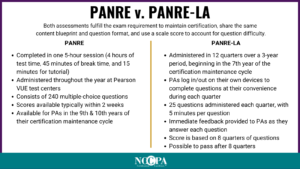
PANRE-LA vs Traditional PANRE: The Main Differences
| Feature | Traditional PANRE | PANRE-LA |
|---|---|---|
| Testing format | Proctored exam at a Pearson VUE testing center | Online longitudinal assessment |
| Timing | Available during years 9 or 10 | Apply in year 6; assessment begins in year 7 |
| Question volume | 240 questions in one examination | 25 questions per quarter |
| Testing schedule | Four 60-question blocks | Complete each quarterly set by the deadline |
| References | Closed book | Printed and online references permitted |
| Scoring | Single exam result | Final score based on the best 8 of 12 quarters |
| Feedback | Results typically available within two weeks | Immediate feedback after each question |
| CME | Does not replace regular CME requirements | Two Category 1 Self-Assessment credits per completed quarter, with NCCPA weighting applied according to current policy |
The NCCPA certification maintenance page confirms that both pathways use the same core content and that PAs must continue meeting their CME requirements while participating in PANRE-LA.
Budget note: The Amazon and Apple Gift Card add-ons remain optional paid additions of $100 to $1,500. They are added to the purchase price and are not free gifts, regardless of which exam pathway you choose.
When Traditional PANRE May Fit Better
Traditional PANRE is appropriate if you prefer a defined preparation period followed by one examination. It is administered at a Pearson VUE testing center during the ninth or tenth year of your certification maintenance cycle.
The exam includes:
- Four blocks of 60 questions
- 60 minutes for each block
- A total of 240 questions
- Approximately five hours for testing, tutorial, and breaks
- Up to four total attempts, subject to NCCPA rules and timing restrictions
This format rewards concentrated preparation, timed practice, and the ability to sustain attention during a long testing session. The PANRE Review Course includes three full-length 240-question mock exams so you can practice pacing and identify whether your performance declines during the final blocks.
A traditional PANRE study plan should include:
- A baseline full-length exam.
- Review of missed questions by organ system.
- Targeted study of high-weight systems such as cardiovascular, gastrointestinal, and pulmonary medicine.
- Additional timed question blocks.
- At least two more full-length simulations before test day.
PANCE prep courses may provide useful general medical review, but they are not automatically designed for the needs of an experienced PA preparing for recertification. Your clinical practice may be narrow, while the PANRE evaluates core knowledge across multiple specialties.
Budget note: If you purchase the PANRE Review Course for traditional PANRE preparation, any Amazon or Apple Gift Card amount from $100 to $1,500 is a paid add-on added to the course price: not a free gift.
When PANRE-LA May Fit Better
PANRE-LA is designed for PAs who prefer smaller assessments distributed over time. According to NCCPA, you apply during the sixth year of your certification maintenance cycle and begin the assessment in the seventh year.
Each quarter includes 25 questions, and you have five minutes to answer each question. You may use printed or online references, but you may not consult other people. The assessment provides immediate feedback, including the correct answer, explanation, and references.
The final score is based on your best eight quarters out of 12. You may skip up to four quarters, but you must participate in at least one quarter during years seven and eight. If you do not successfully complete PANRE-LA, NCCPA provides opportunities to take the traditional PANRE during year 10.
PANRE-LA may be a better fit if you:
- Prefer open-book testing.
- Learn effectively from immediate feedback.
- Want to distribute preparation across several years.
- Prefer studying in shorter sessions.
- Can maintain consistent engagement with quarterly deadlines.
The main disadvantage is that PANRE-LA requires long-term organization. Delaying every quarter until the deadline creates unnecessary pressure and reduces the educational value of the feedback. Use the assessment as a recurring learning activity rather than treating each quarter as an isolated test.
The PANRE Review Course can function as a searchable reference while you prepare. Its 100 hours of Category 1 AAPA credit apply to the PANRE Review Course, not to a separate pharmacology course.
Budget note: The optional Amazon and Apple Gift Card add-ons are available from $100 to $1,500, but the selected amount is added to the purchase price and is not a free gift.
CME Implications: Both Paths Still Require Planning
NCCPA certification maintenance is divided into five two-year CME cycles within the 10-year certification period. During each two-year cycle, you must earn and log 100 CME credits and meet the applicable Category 1 requirements.
PANRE-LA can produce additional Category 1 Self-Assessment CME for completed quarters. However, PANRE-LA does not replace your regular CME requirements. You must continue completing and logging CME while participating.
The PANRE Review Course is designed to combine exam preparation with CME fulfillment:
- 100 hours of AAPA Category 1 Self-Assessment CME
- 2,500+ practice questions
- Three 240-question mock exams
- Coverage of all major systems in the current NCCPA PANRE/PANRE-LA Content Blueprint
- 30 months of access
- Self-paced online study
NCCPA may apply its 50% weighting policy to eligible Self-Assessment CME when credits are logged for certification maintenance. Confirm current requirements in your NCCPA account and claim only the credit commensurate with your participation.
Budget note: The course is $499.99, while the optional Amazon or Apple Gift Card add-on is separately priced from $100 to $1,500. The add-on is not free and increases the total purchase price.
Maximize Your CME Budget With Paid Gift Card Add-ons
Many PAs receive an annual employer CME allowance. If funds expire at the end of the fiscal year, a course that supports both exam preparation and CME can be a more efficient purchase than buying disconnected resources.
The PANRE Review Course with Gift Card allows you to select an Amazon or Apple Gift Card add-on when you check out. The selected amount is added to the total price and processed as part of the order. Gift cards are generally delivered by email within two to three business days.

Use these steps before purchasing:
- Confirm your employer’s CME reimbursement policy.
- Verify whether bundled purchases and gift-card add-ons are permitted.
- Select an amount that fits your available CME balance.
- Confirm that the course’s CME designation meets your professional requirements.
- Track your course completion and CME documentation separately from the gift card.
The add-on can help you use an approved CME allowance for a professional education purchase, but it should not be treated as a discount, rebate, or free promotional item. Amazon and Apple Gift Card add-ons from $100 to $1,500 are paid additions to the course price and are not free gifts.
Common PANRE Review Mistakes
1. Relying only on PANCE prep courses
PANCE prep courses are usually designed for students and new graduates. PANRE preparation should address the broad core knowledge expected of practicing PA-Cs and should be organized around the current NCCPA Blueprint.
2. Studying passively
Reading slides without answering questions does not adequately test clinical reasoning. Use active recall. For each missed question, identify the diagnosis, the management principle, and why the distractors are incorrect.
3. Avoiding full-length simulations
Short quizzes do not test endurance or pacing. Complete full-length 240-question exams under timed conditions before your actual PANRE.
4. Studying every topic equally
Use your baseline performance and the NCCPA content percentages to prioritize. Cardiovascular content represents approximately 12% of the examination, while gastrointestinal and pulmonary content each represent approximately 10%. Weak performance in these areas should receive focused attention.
5. Separating CME from exam preparation
Buying one resource for PANRE preparation and another for Category 1 credit can increase cost and administrative work. The PANRE Review Course provides 100 hours of Category 1 AAPA credit while you review for recertification.
Budget note: Any Amazon or Apple Gift Card add-on selected with the course costs an additional $100 to $1,500, is added to the purchase price, and is not a free gift.
PANRE Practice Question
Your patient is a 72-year-old woman with atrial fibrillation who presents with sudden severe abdominal pain that began two hours ago. The pain appears disproportionate to the mild abdominal tenderness on examination. She is restless and diaphoretic. Vital signs are BP 156/92 mmHg, HR 118/min and irregular, RR 24/min, and SaO2 97% on room air. Serum lactate is elevated.
Which of the following is the most appropriate diagnostic study?
A. Abdominal ultrasound
B. CT angiography of the abdomen and pelvis
C. Colonoscopy
D. Plain abdominal radiography
E. Upper endoscopy
Correct answer: B. CT angiography of the abdomen and pelvis
CT angiography is the preferred initial diagnostic study for suspected acute mesenteric ischemia in a hemodynamically stable patient. This patient has atrial fibrillation, abrupt severe abdominal pain, pain out of proportion to the examination, and an elevated lactate, suggesting an arterial embolic event involving the mesenteric circulation.
Abdominal ultrasound is limited by bowel gas and operator dependence. Colonoscopy and upper endoscopy do not evaluate the full mesenteric arterial circulation and may delay definitive management. Plain radiography has poor sensitivity for early mesenteric ischemia.
Immediate surgical and vascular consultation is also appropriate. Avoid delaying imaging when the patient is stable enough for CT, because bowel infarction carries substantial morbidity and mortality.
Make Your Daily CME Plan More Efficient
Whether you select PANRE-LA or traditional PANRE, use a study system that combines broad medical review, question practice, and CME planning.
The PANRE Review Course provides:
- $499.99 purchase price
- 30 months of access
- 100 hours of Category 1 AAPA Self-Assessment CME
- 2,500+ practice questions
- Three full-length mock exams
- NCCPA Blueprint-mapped content and explanations
Optional cme gift cards from Amazon or Apple are available from $100 to $1,500. They are paid add-ons added to the purchase price, not free gifts. Review your employer’s policy before selecting an add-on.
For additional PA exam preparation, use the PAtopia web version, or download the PAtopia iOS app or PAtopia Android app. PAtopia is designed primarily for PANCE preparation, while the PANRE Review Course is the relevant CME and recertification resource for practicing PA-Cs.
Review the PANRE Review Course with optional CME gift card add-ons
Important: AAPA Category 1 credit acceptance for nurse practitioners varies by state and employer. Physicians may find the clinical content useful, but the activity generally counts as Category 2 CME for physicians. Verify requirements with your licensing board or credentialing organization.
About the Author
Jeremy Boroff, MPAS, PA-C, is a practicing Emergency Medicine physician assistant with 24 years of clinical experience as a PA-C, along with seven years of prior experience as a Registered Respiratory Therapist. He is a PA educator, CME developer, author, and founder of CME Review Courses. Jeremy creates PANRE, PANCE, EOR, pharmacology, and specialty review content focused on clinical reasoning, practical management, and efficient exam preparation.