Price: $499.99 for 30 months of course access
Question bank: 2,500+ board-style questions, including five 240-question mock exams
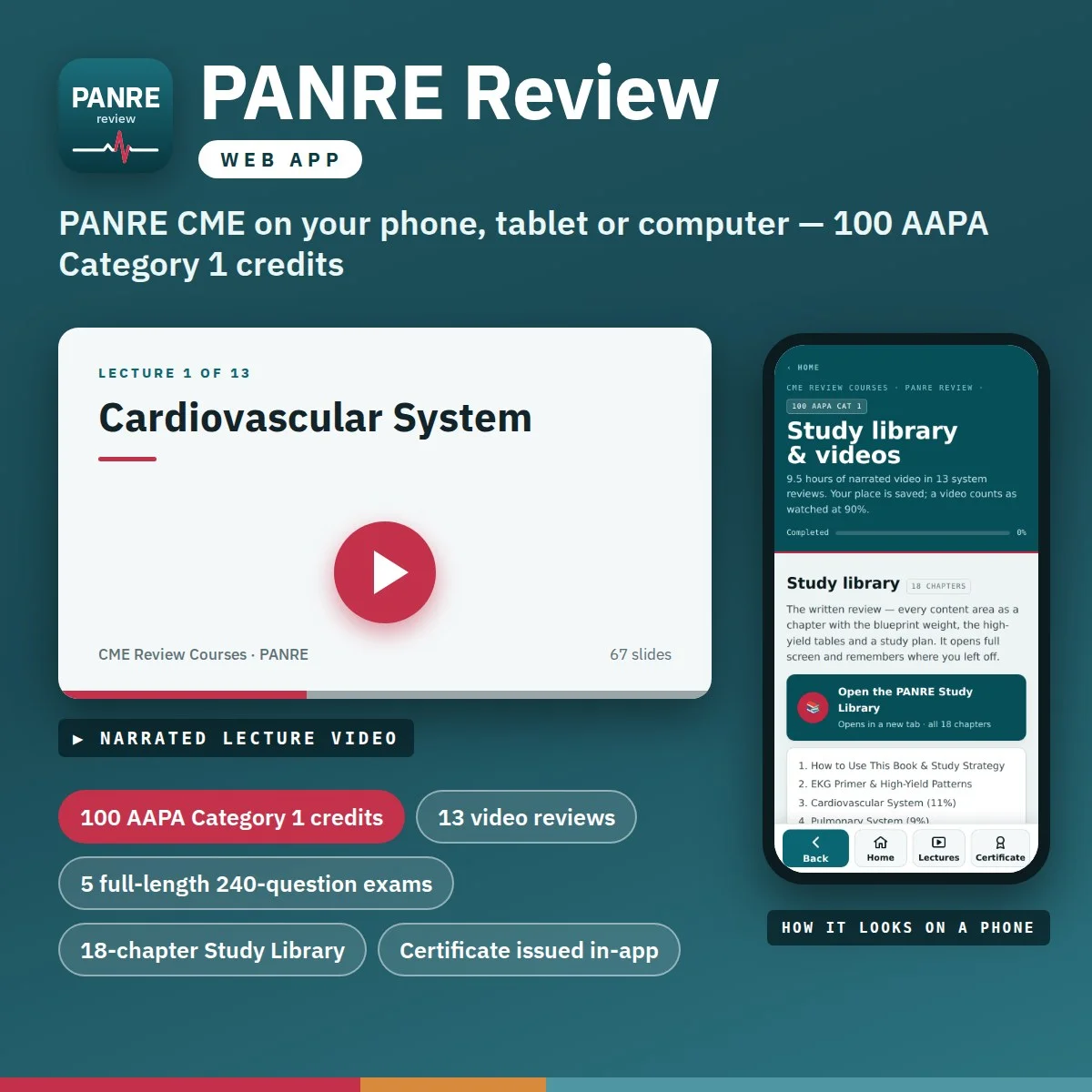
CME: Earn up to 100 AAPA Category 1 CME credits through the PANRE Clinical Review Module
Gift card note: Amazon and Apple gift cards are paid add-ons, not free gifts. Choose a $100–$1,500 option at checkout.
PANRE-LA works in quarters, not one exam-day block
If you work rotating shifts, PANRE-LA’s quarterly schedule can make assessment more manageable than preparing for a single sitting, but only if you treat every window as its own deadline.
Each of the 12 PANRE-LA quarterly windows includes 25 questions and lasts approximately 10 weeks. You need to complete at least 8 of the 12 quarters. References are permitted while answering. That flexibility can help when your ER, hospitalist, or urgent care schedule is unpredictable: you can choose when within the open window to answer rather than setting aside a full exam day.
The tradeoff is that one quarter does not roll into the next. A brutal month may leave you less time to answer, but “I’ll catch up next quarter” uses one of your four opportunities to skip. Missing a window reduces your margin for another disruption. Before you commit to a quarter-skipping strategy, read the current participation requirements and window dates on the NCCPA key dates page rather than working from memory — the details matter and they are the source of truth.
The practical move is to put each window on your calendar when it opens, then check it against your posted shifts. A quarter’s 25 questions are easier to place around several shifts than a traditional PANRE’s 240-question exam sitting, but a window still needs a spot on your calendar.
Put the window dates beside your shift schedule
For an ER PA, a stretch of nights, a run of high-acuity shifts, or an unexpected staffing change can disrupt plans. Hospitalist and urgent care schedules bring their own busy periods. The window model gives you options within each quarter; it does not guarantee that the last few days will be convenient.
When a new window opens:
- Add its closing date to your calendar alongside your shifts and other fixed commitments.
- Identify a realistic time to complete the questions within that specific window, not at the end of the quarter by default.
- Set a reminder before the final week. This gives you a chance to adjust if a shift change, illness, or personal commitment intervenes.
- Check NCCPA guidance on references and test security. References are allowed, but that is not permission to consult another person or share test items.
The result is a calendar decision, not a promise that every quarter will be easy. Quarterly flexibility can absorb a rough stretch; it cannot recover a window that has closed.
Use the quarterly cadence alongside PANRE review and CME
The PANRE Review Course with Gift Card provides 30 months of access, which can span multiple PANRE-LA windows. You can use the course to review content as your assessment unfolds and complete its CME activity on a separate schedule that fits your workload.
The course includes 15 question modules mapped to the NCCPA PANRE blueprint, with 1,810 system-based questions, plus five full-length 240-question mock exams-1,200 questions total. Questions include rationales and cited sources, and the answer explanations have been revised to reflect 2023–2025 clinical guidelines. You also get system lectures with downloadable slides and a readiness dashboard for tracking attempted and correct answers by topic, flagging questions, and retaking them. Its “on track to pass” indicator begins at 75% or higher.
The course’s 30-month access period and the CME activity’s approval period are different dates. The PANRE Clinical Review Module is approved from August 26, 2026, through August 26, 2027. Plan to complete the CME requirements within that approval period.
To earn up to 100 AAPA Category 1 credits through this PANRE Review Course, review all module content, earn at least 70% on the post-test, and complete the activity evaluation. You may retake missed questions. Your certificate states the precise credit earned; claim only credit commensurate with your participation. These 100 credits apply to the PANRE Review Course, not the Pharmacology course.
Nurse practitioners should verify with their state board of nursing whether AAPA Category 1 credit is accepted for renewal. For physicians, the activity meets AAPA Category 1 requirements, which count as Category 2 for physician reporting.
Clinical review: diffuse ST elevation or territorial ST elevation?
The course’s Cardiovascular module is its largest system module, with 211 questions. Consider this exam-style vignette:
Your 48-year-old patient reports pleuritic chest pain that improves when leaning forward. Temperature is 38.0°C, HR 108, BP 124/78, RR 18, and SaO₂ 98%. The lungs are clear. ECG shows diffuse ST elevation across multiple vascular territories and PR-segment depression.
Correct answer: Acute pericarditis
A. Acute pericarditis
B. STEMI
C. Pulmonary embolism
D. GERD or esophageal spasm
Acute pericarditis is the best answer. The positional, pleuritic pain, low-grade fever, diffuse ST elevation, and PR depression fit the presentation.
- STEMI: ST elevation is typically territorial, with reciprocal changes, rather than diffuse across multiple territories.
- Pulmonary embolism: Pleuritic pain and tachycardia may occur, but they do not explain this diffuse ST elevation and PR-depression pattern.
- GERD or esophageal spasm: These may cause chest pain but do not account for the ECG findings or the positional pattern.
Exam note: Use the distribution of ST elevation as a discriminator. Diffuse changes with PR depression favor pericarditis; territorial ST elevation with reciprocal changes raises concern for STEMI.
CME gift cards: two timelines


The CME activity and the gift card follow different timelines. Your CME progress accumulates as you complete the required course content and post-test; the gift card is emailed within 2–3 business days of purchase. You do not need to finish the course first.
At checkout, select an Amazon or Apple add-on in $100 increments from $100 to $1,500. The add-on is paid, and its cost is included in the total package price so the entire purchase runs through CME funds in one transaction. Gift card packages are nonrefundable once the card has been emailed. CME Review Courses is not affiliated with or sponsored by Amazon or Apple. Check your employer’s CME policy before purchasing. If you buy two or more CME courses, 20% is deducted from each course automatically; gift card add-ons remain at face value.
Explore the course and confirm your dates
If you’re comparing pance prep courses, check whether the material matches your exam needs and whether the CME credit applies to the specific course you plan to complete.
- View the PANRE Review Course with Gift Card and choose a gift card add-on at checkout.
- Try the free PANRE Review test drive.
- Confirm PANRE-LA participation dates on the NCCPA key dates page.
Author
Jeremy Boroff, MPAS, PA-C is an Emergency Medicine PA with 24 years of clinical experience, a PA educator, author, and CME developer. He is the sole faculty member for this activity and has no relevant financial relationships to disclose.