Navigating the transition from clinical rotations to the PANCE, or maintaining your certification through the PANRE/PANRE-LA, requires a strategic approach to both education and financial management. Psychiatry remains a core component of the NCCPA blueprint, often accounting for approximately 7% of exam content. For the Physician Assistant, mastering this section is not just about memorizing DSM-5 criteria; it is about recognizing the nuances between similar clinical presentations while efficiently utilizing your annual CME allowance.
At CME Review Courses, we provide an integrated solution that maximizes your learning and your professional budget.
The Logistics: Course Deliverables and Pricing
Before diving into the clinical high-yields, it is essential to understand how to optimize your purchase. Our programs are designed to be the most efficient use of your employer-provided CME funds.
- PANRE/PANCE Review Course Price: $499.99 (Base Course).
- AAPA Category 1 Credit: 100 Hours of Category 1 AAPA Credit are awarded upon completion of the PANRE Review Course.
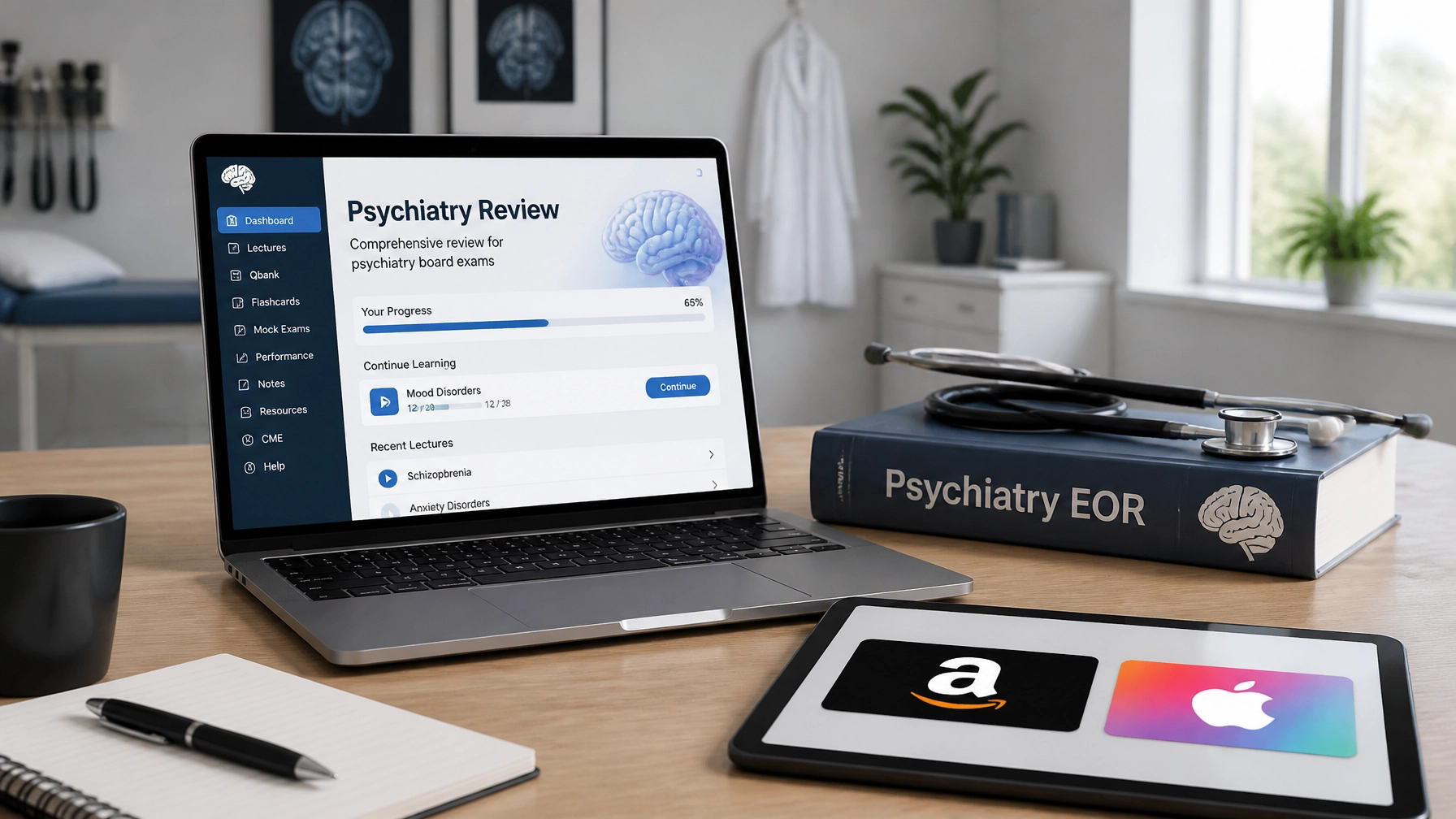
- CME Gift Card Add-Ons: You have the option to add an Amazon or Apple Gift Card to your purchase. Options range from $100 to $1,500.
- Important Note: These are NOT free gifts. The value of the gift card is added to the total cost of the CME package, allowing you to use your CME allowance to acquire educational tools like iPads, medical reference books, or high-end stethoscopes through Amazon or Apple.
- Access Duration: 30 Months of unlimited access to all course materials and practice question banks.
- Deliverables: Over 2,000 practice questions, comprehensive clinical study guides, and content authored by experienced PAs for PAs.
Mastering the Psychiatry Blueprint
The Psychiatry & Behavioral Science portion of the exam focuses heavily on mood disorders, anxiety, and psychotic spectrum disorders. Whether you are preparing for a Psychiatry End of Rotation (EOR) exam or your 10-year PANRE, the following topics are high-yield and frequently tested.
Mood Disorders: MDD vs. Bipolar Spectrum
Major Depressive Disorder (MDD) requires the presence of at least five "SIGECAPS" symptoms for a minimum of two weeks, with at least one symptom being depressed mood or anhedonia. When reviewing for exams, always look for the "switch" to mania. If a patient is started on an SSRI and suddenly presents with pressured speech, decreased need for sleep, and grandiosity, the diagnosis shifts from MDD to Bipolar I.
Bipolar I requires at least one manic episode (1 week duration, significant impairment), while Bipolar II requires a hypomanic episode (4 days duration, no hospitalization/psychosis) and at least one major depressive episode.
The Psychotic Spectrum
Schizophrenia is defined by at least six months of symptoms, including at least one month of active-phase symptoms (delusions, hallucinations, or disorganized speech). If the symptoms last more than one month but less than six, the diagnosis is Schizophreniform Disorder. If they last less than one month, it is a Brief Psychotic Disorder.

Anxiety and Trauma-Related Disorders
Generalized Anxiety Disorder (GAD) is characterized by excessive worry about various life events for at least six months. This differs from Panic Disorder, which involves recurrent, unexpected panic attacks and at least one month of persistent concern about future attacks.
Post-Traumatic Stress Disorder (PTSD) involves intrusive symptoms, avoidance, and hyperarousal following a traumatic event, with symptoms lasting more than one month. If the timeframe is between three days and one month, the correct diagnosis is Acute Stress Disorder.
The Strategic Value of CME Gift Cards
One of the most common questions we receive is how to maximize a $2,000 or $2,500 annual CME budget. By choosing our cme gift cards option, you can combine your 100-hour panre review course with a gift card add-on.
For example, if you have a $2,000 allowance, you can purchase the PANRE Review Course and add a $1,400 Amazon Gift Card. Your total invoice will reflect a $1,995 educational purchase. This allows you to stay compliant with your 100 hours of AAPA Category 1 CME while also having the funds to purchase a new laptop or medical textbooks to further enrich your education.
We offer this flexibility because we know that PAs and NPs need more than just "credits": they need the tools to stay current in a rapidly evolving clinical landscape.
Personality Disorders: The Clusters
Personality disorders are frequently tested via clinical vignettes.
- Cluster A (Odd/Eccentric): Paranoid, Schizoid (loner, happy being alone), Schizotypal (magical thinking).
- Cluster B (Dramatic/Emotional): Antisocial (disregard for rights of others), Borderline (unstable relationships, self-harm), Histrionic (attention-seeking), Narcissistic.
- Cluster C (Anxious/Fearful): Avoidant (desires relationships but fears rejection), Dependent, Obsessive-Compulsive Personality Disorder (perfectionism, ego-syntonic).

Clinical Assessment: Psychiatry Practice Questions
In every pance prep courses module, we emphasize the use of high-quality clinical vignettes. Practice the following questions to test your knowledge of the Psychiatry blueprint.
Question 1
Your patient is a 24-year-old male brought to the emergency department by his roommate. The roommate states the patient has been "acting strange" for the past three weeks. The patient believes the local news anchor is sending him coded messages through the television. On examination, the patient is disheveled and speaks in a disorganized manner. Vital signs: BP 122/80, HR 78, RR 16, SaO2 99% on room air. The patient has no prior psychiatric history and a urine drug screen is negative.
What is the most likely diagnosis?
A. Schizophrenia
B. Schizoaffective Disorder
C. Schizophreniform Disorder
D. Brief Psychotic Disorder
Explanation:
The correct answer is C. Schizophreniform Disorder. This patient presents with hallmark psychotic symptoms (delusions and disorganized speech) that have persisted for three weeks. Because the duration is more than one month but less than six months, Schizophreniform is the appropriate diagnosis. Schizophrenia (A) requires symptoms to last at least six months. Schizoaffective Disorder (B) requires a concurrent mood episode. Brief Psychotic Disorder (D) is used when symptoms last less than one month.
Question 2
Your patient is a 19-year-old female who is brought to the clinic by her mother due to concerns about weight loss. The patient's BMI is 16.2 kg/m². She reports an intense fear of gaining weight and mentions that she "feels fat" despite her current weight. Physical exam reveals fine, downy hair on her arms and back, and a heart rate of 48 bpm.
Which of the following is the most appropriate next step in management?
A. Start Fluoxetine 20mg daily
B. Hospitalization for nutritional rehabilitation
C. Cognitive Behavioral Therapy (CBT) as an outpatient
D. Referral for a dental consultation
Explanation:
The correct answer is B. Hospitalization for nutritional rehabilitation. This patient meets criteria for Anorexia Nervosa, and her physical findings (BMI <17, bradycardia at 48 bpm, and presence of lanugo) indicate medical instability. Hospitalization is required for patients with severe malnutrition or hemodynamic instability to monitor for refeeding syndrome. Fluoxetine (A) is not effective in the acute treatment of Anorexia and is only used once weight is restored for comorbid conditions. Outpatient CBT (C) is inappropriate given the physical instability. Dental consultation (D) is more relevant for Bulimia Nervosa, where tooth enamel erosion is common.
Question 3
Your patient is a 45-year-old male who presents with a history of recurrent, unexpected episodes of intense fear accompanied by palpitations, sweating, and shortness of breath. These episodes peak within 10 minutes. He admits he has stopped going to the grocery store for the past two months because he is afraid he will have an episode and be unable to escape or get help.
What is the first-line long-term pharmacologic treatment for this patient?
A. Alprazolam
B. Sertraline
C. Propranolol
D. Buspirone
Explanation:
The correct answer is B. Sertraline. The patient has Panic Disorder with Agoraphobia. SSRIs like Sertraline are the first-line long-term treatment for Panic Disorder due to their safety profile and efficacy in preventing future attacks. Alprazolam (A) is a benzodiazepine that may be used for acute symptoms but is not recommended for long-term management due to the risk of dependence. Propranolol (C) is primarily used for performance-related social anxiety. Buspirone (D) is indicated for GAD but is not effective for Panic Disorder.

Maximizing Your CME Investment
Whether you are deep in your Psychiatry EOR review or looking for a comprehensive panre review course to secure your next 10 years of certification, the quality of your prep materials matters. We focus on providing PA-authored content that cuts through the fluff and delivers the clinical facts you need.
By utilizing our cme gift cards add-on, you ensure that every dollar of your CME money is working for you. Adding an Amazon or Apple Gift Card to your purchase is a savvy way to equip yourself for another year of clinical excellence while fulfilling the requirement for 100 hours of AAPA Category 1 Credit.
Remember, these gift cards are not "free": they are a powerful way to customize your CME package to meet your professional needs.