Let’s be honest: your employer-provided CME stipend is essentially a "use it or lose it" professional high-five. If you don’t spend it by the end of the fiscal year, that money doesn’t roll over into your 401(k), and it certainly doesn't show up as a bonus in your December paycheck. It just… vanishes.
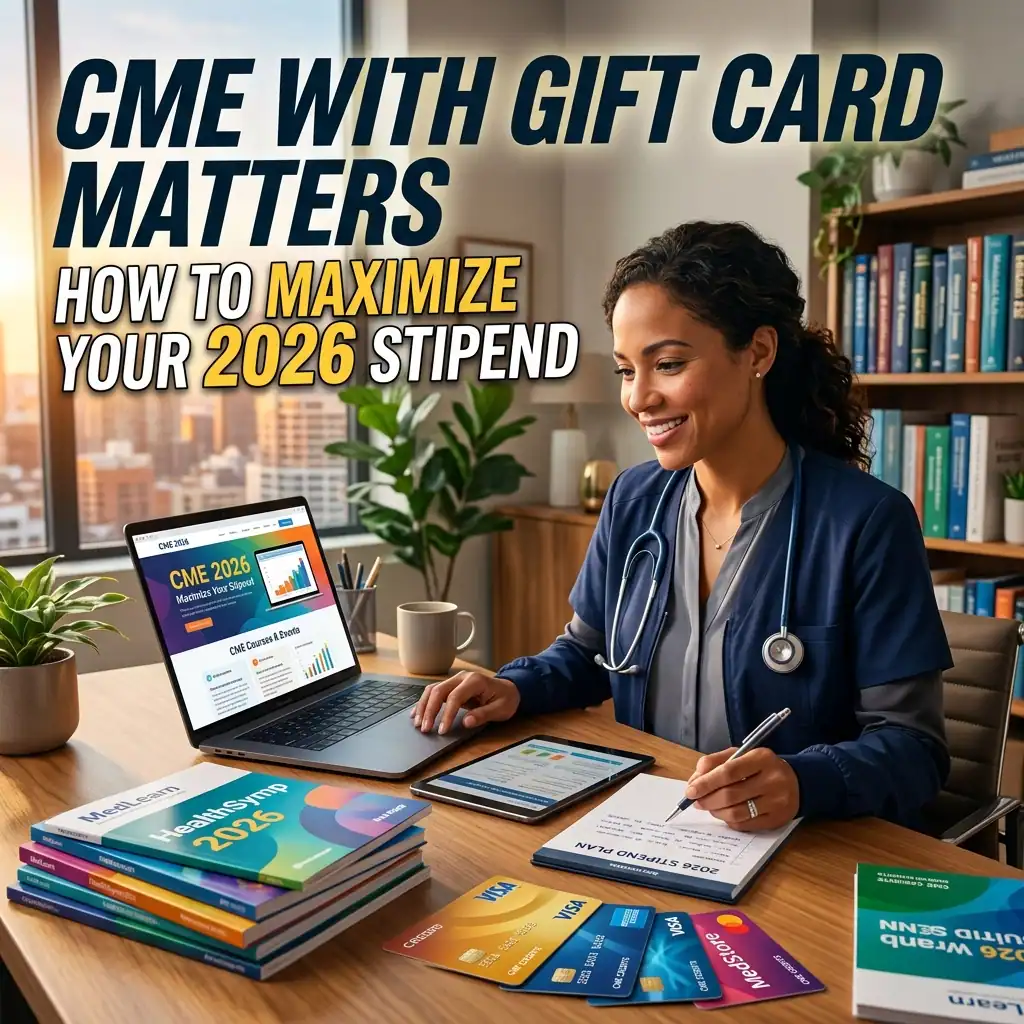
As we move through 2026, the strategy for the savvy Physician Assistant remains the same: maximize the value of every dollar allocated to your professional development. This isn't just about getting your 100 AAPA Category 1 Credits; it’s about making the most efficient use of your allowance. Enter the world of CME with Gift Card packages.
The Efficiency of the CME Gift Card Model
Why settle for just a stack of clinical PDFs when you can refresh your medical knowledge and refresh your home office (or your tech drawer) at the same time? When you choose a CME with Amazon gift card or a CME with Apple gift card option, you are essentially bundling your educational requirements with a tangible rebate.
At CME Review Courses, we’ve designed our packages to fit the specific needs of PAs preparing for the PANCE or PANRE. You can secure up to a $1,500 gift card as an add-on to your review course. Whether you need a new MacBook to stream your board review or you want to clear out your Amazon "Save for Later" list, this is the most efficient way to utilize your 2026 stipend.
Key Deliverables:
- Course Title: PANRE Review Course
- Credits: 100 AAPA Category 1 Credits
- Gift Card Options: Amazon or Apple (up to $1,500)
- Access: Comprehensive review of the NCCPA Blueprint
- Format: Efficient, high-yield content delivery

Strategic Spend: Why $1,500 Matters
Most healthcare organizations provide a CME allowance ranging from $1,500 to $3,000 annually. If you purchase a standard review course for $600, you have a significant amount of "trapped" value remaining. By opting for a CME with Gift Card package, you can scale the cost of the course to match your remaining stipend.
For example, our Orthopedics CME Package with Gift Card allows you to tailor the purchase to your specific budget. This isn't just "buying a gift card"; it’s investing in a high-level educational product that happens to come with a significant incentive. It satisfies the administrative requirements of your hospital’s reimbursement policy while providing you with personal utility.
High-Yield Prep for the PANRE-LA and Traditional PANRE
The NCCPA has shifted the landscape with the PANRE-LA, but the demand for high-yield, blueprint-specific knowledge hasn't changed. Our review covers the essential NCCPA Blueprint Content Areas, ensuring that you aren't just earning credits, but actually preparing for clinical practice and board examinations.
The 100 AAPA Category 1 Credits offered with our PANRE Review are vital for maintaining your certification. We focus heavily on the heavy hitters: Cardiology, Pulmonology, and GI, while ensuring you don't lose points on the "smaller" categories like Endocrine or Infectious Disease.

Clinical Assessment: PANRE Practice Questions
The following questions reflect the style and depth of the NCCPA blueprint. Test your knowledge on these high-yield topics.
Question 1: Cardiology
Your patient is a 64-year-old male with a history of hypertension and tobacco use who presents to the emergency department with sudden onset substernal chest pain radiating to his left jaw. He appears diaphoretic. His vitals are: HR 102, BP 154/92, SaO2 96% on room air. An EKG reveals ST-segment elevation in leads II, III, and aVF.
Which of the following is the most appropriate next step in management?
A) Immediate administration of thrombolytics
B) Referral for emergent percutaneous coronary intervention (PCI)
C) Order a stat CT angiography of the chest
D) Administer high-dose oral beta-blockers
Correct Answer: B) Referral for emergent percutaneous coronary intervention (PCI)
Explanation: This patient is presenting with an inferior wall ST-elevation myocardial infarction (STEMI). The gold standard for treatment is primary PCI within 90 minutes of first medical contact. Thrombolytics are indicated only if PCI is not available within 120 minutes. CT angiography is used for suspected aortic dissection or PE, and beta-blockers should be avoided in the acute phase if there are signs of heart failure or low output.
Question 2: Pulmonology
Your patient is a 28-year-old female with a history of mild intermittent asthma who presents with increased shortness of breath and wheezing over the last three days. she is currently using her albuterol inhaler four times daily with minimal relief. On physical exam, there is diffuse expiratory wheezing and a prolonged expiratory phase. Her peak expiratory flow (PEF) is 65% of her predicted personal best.
According to the current GINA guidelines, what is the most appropriate addition to her regimen?
A) Oral Prednisone for 5 days
B) Increase albuterol frequency to every 2 hours
C) Start a long-acting beta-agonist (LABA) as monotherapy
D) Add an inhaled corticosteroid (ICS) or switch to a formoterol-ICS combination
Correct Answer: D) Add an inhaled corticosteroid (ICS) or switch to a formoterol-ICS combination
Explanation: Modern asthma guidelines have shifted away from SABA monotherapy. For a patient experiencing an exacerbation or increased symptoms, adding an ICS (or using a SMART therapy approach with formoterol-ICS) addresses the underlying inflammation. Oral steroids (Choice A) are reserved for more severe exacerbations or if there is no response to inhaled therapy. LABA monotherapy (Choice C) is contraindicated in asthma due to increased risk of death.
Question 3: Infectious Disease
Your patient is a 19-year-old college student who presents with a 2-day history of headache, fever, and a stiff neck. On physical exam, the patient is lethargic and has a positive Brudzinski sign. A petechial rash is noted on the lower extremities. Lumbar puncture is performed.
Which of the following CSF findings is most consistent with the suspected diagnosis?
A) Increased glucose, decreased protein, increased lymphocytes
B) Decreased glucose, increased protein, increased neutrophils
C) Normal glucose, normal protein, increased monocytes
D) Decreased glucose, decreased protein, normal WBC count
Correct Answer: B) Decreased glucose, increased protein, increased neutrophils
Explanation: The clinical presentation is classic for bacterial meningitis (likely Neisseria meningitidis given the petechial rash). Bacterial meningitis characteristically shows "low-high-high": low glucose (bacteria consuming it), high protein (inflammation/blood-brain barrier breakdown), and high neutrophils (leukocytosis). Viral meningitis typically presents with normal glucose and a lymphocytic pleocytosis.

Maximizing Your Professional Development
When you are looking for a CME with Apple gift card or an Amazon equivalent, you are looking for more than just a transaction. You are looking for a way to streamline your life as a busy clinician. By choosing a comprehensive review course, you are hitting three birds with one stone:
- Fulfilling your 100 AAPA Category 1 Credit requirement.
- Ensuring you are prepared for the NCCPA Blueprint Content Areas.
- Utilizing your full stipend to receive a tool (via gift card) that helps you in your daily life.
Tax and Reimbursement Tips for 2026
While we provide the education and the incentive, keep these logistics in mind:
- Documentation: Always keep your itemized receipt. Our receipts are designed to meet standard employer reimbursement requirements.
- Employer Policy: Check if your employer has specific caps on gift card values. Most allow for standard "CME Packages" that include educational materials and incentives.
- Efficiency: Use our Purchasing Instructions to ensure a smooth transaction.
Why CME Review Courses?
We aren't just another content mill. We focus on the high-yield information you actually need to know. Whether you are diving into the Psychiatry and Behavioral Health CME Package or refreshing your knowledge with a Pharmacology Review, our goal is clinical excellence.
Don't let your 2026 CME stipend go to waste. Maximize your allowance, get your gift card, and knock out those 100 credits in one go. It’s the smartest move you’ll make for your career: and your wallet: this year.

Ready to get started? Explore our full list of CME packages and pick the one that fits your budget and your clinical needs today.