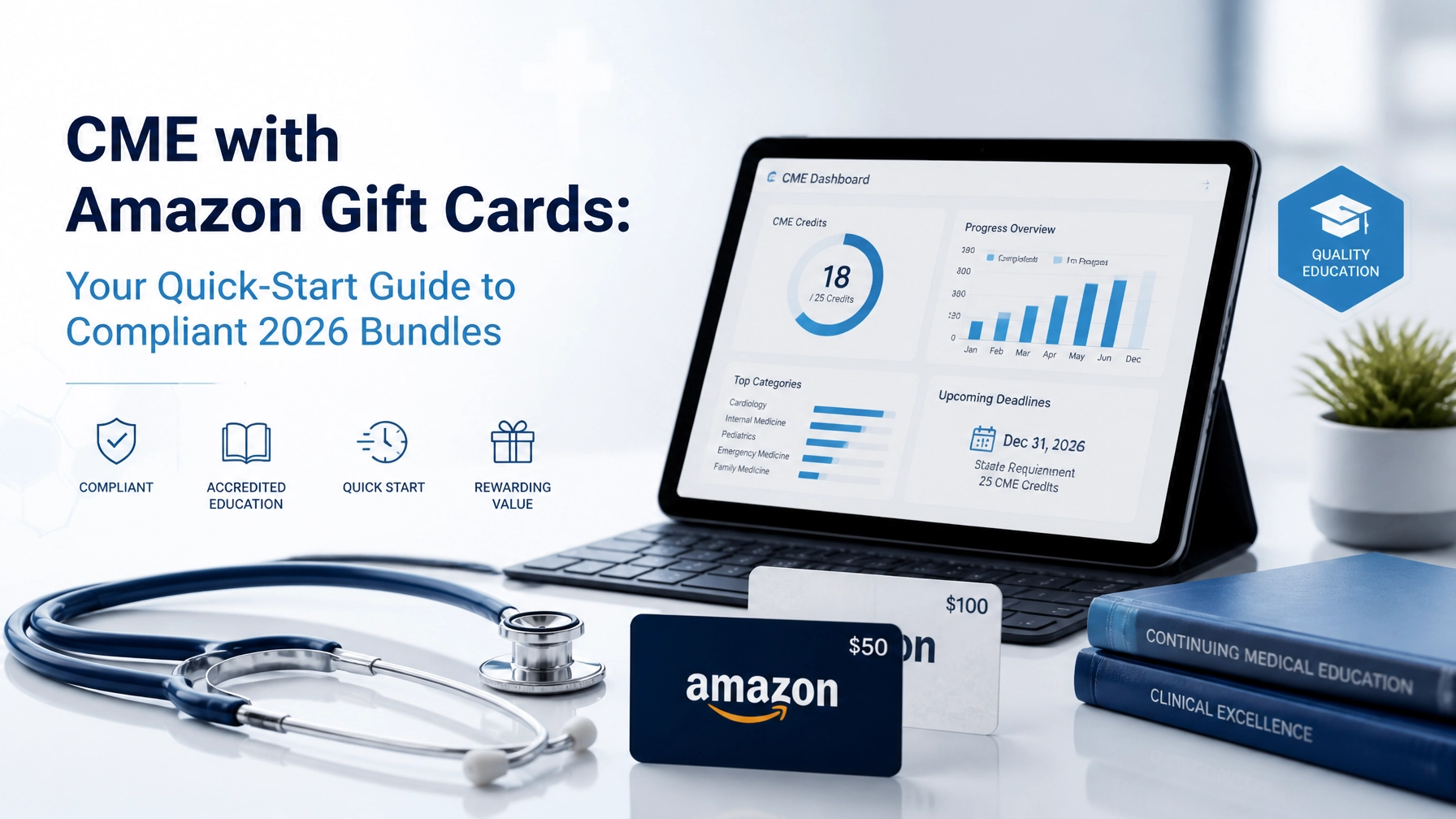
Navigating the landscape of continuing medical education (CME) requires a balance of high-yield clinical content and efficient budget management. For Physician Assistants (PAs) and Nurse Practitioners (NPs), maximizing the value of employer-provided CME allowances has often involved "CME with gift card" bundles. However, the regulatory environment transitioned significantly in April 2026.
This guide provides the logistical details of our current high-value courses and explains the latest ACCME standards to ensure your professional development remains compliant.
Core CME Course Logistics
- Price: $499.99
- Access Duration: 30 months
- Deliverables: 100 Category 1 AAPA Self-Assessment Credit Hours
- Content: 1,672 Board-Style Questions with detailed explanations and 17 hours of comprehensive video review.
- NCCPA Weighting: Automatically weighted at 150 credits toward maintenance requirements.
- Price: $499.99
- Access Duration: 30 months
- Deliverables: 12 Category 1 AAPA Credit Hours (Pharmacology specific)
- Content: 120 Pharmacology-focused questions and video lecture modules.
Understanding the April 2026 ACCME Prohibition
As of April 2026, the Accreditation Council for Continuing Medical Education (ACCME) implemented a strict prohibition regarding personal remuneration tied to the purchase of accredited CME.
The Ruling: Accredited providers may no longer offer personal gift cards (such as Amazon or Apple gift cards) or cash equivalents as an incentive or "add-on" that results in personal financial gain for the individual learner when the purchase is reimbursed by an employer or third party.
Why the Change? The ACCME aims to maintain the integrity and independence of medical education. When a clinician receives a personal gift card as part of a CME bundle paid for by a hospital or clinic, it creates a potential conflict with the Standards for Integrity and Independence.
What This Means for You:
While the search for "CME with Amazon gift card" remains common, the way these bundles are structured must now focus on professional utility rather than personal remuneration. At CME Review Courses, we have shifted our focus to high-value content bundles and institutional discounts that provide the best ROI for your CME budget without violating these new standards.

Maximizing Your 2026 CME Budget Compliantly
To stay within the bounds of the 2026 regulations while still maximizing your education allowance, consider the following strategies:
1. Focus on High-Credit Content Bundles
The most efficient use of your budget is a course that covers multiple requirements simultaneously. Our PANRE Review Course offers 100 Category 1 AAPA credits. Because these are "Self-Assessment" credits, the NCCPA applies a 1.5x multiplier, giving you 150 credits for a single purchase. This effectively covers a significant portion of your recertification cycle in one step.
2. Multi-Year Access
Rather than buying a single-year subscription, look for courses offering extended access. Our packages provide 30 months of access, ensuring you have the resources available through two full years and into your next cycle, providing a better long-term value than annual renewals.
3. Institutional and Group Discounts
The ACCME allows for price adjustments and discounts to the payer. If you are part of a large group or practice, we offer discounts for groups of 15 or more. This allows your employer to save on the total educational cost while providing you with premium review material.
Clinical Practice Assessment
In keeping with our commitment to high-yield clinical review, test your knowledge with the following vignettes.
Clinical Vignette 1: Cardiology
Scenario: Your patient is a 64-year-old male presenting with a 2-hour history of substernal chest pressure radiating to the left jaw. He appears diaphoretic. Vital signs are: BP 105/60 mmHg, HR 112 bpm, RR 22 bpm, SaO2 94% on room air. An EKG is performed immediately.
EKG Findings: ST-segment elevation of 2mm in leads II, III, and aVF, with reciprocal ST-segment depression in leads I and aVL.
Question: Which of the following is the most appropriate next step in management for this patient?
A) Immediate administration of a 500mL normal saline bolus.
B) Emergent Cardiology consultation for percutaneous coronary intervention (PCI).
C) Administration of 0.4mg sublingual Nitroglycerin.
D) Urgent CT Angiography of the chest to rule out aortic dissection.
Explanation: The correct answer is B) Emergent Cardiology consultation for percutaneous coronary intervention (PCI). The patient’s EKG shows evidence of an inferior wall ST-elevation myocardial infarction (STEMI). The standard of care for STEMI is immediate reperfusion therapy, ideally via PCI within 90 minutes of arrival at a PCI-capable facility. Option C (Nitroglycerin) should be avoided or used with extreme caution in inferior wall MI, as it can cause significant hypotension due to right ventricular involvement and preload dependency. Option A is secondary to reperfusion. Option D is incorrect as the EKG is diagnostic for STEMI.
Clinical Vignette 2: Pharmacology
Scenario: Your patient is a 45-year-old female with a history of Type 2 Diabetes Mellitus and newly diagnosed Hypertension. Her current HbA1c is 7.2% on Metformin 1000mg BID. Her BP is consistently 148/92 mmHg. You decide to initiate an ACE inhibitor (Lisinopril).
Question: Which of the following electrolyte abnormalities must you monitor for most closely after starting this medication?
A) Hypokalemia
B) Hypernatremia
C) Hyperkalemia
D) Hypocalcemia
Explanation: The correct answer is C) Hyperkalemia. ACE inhibitors (and ARBs) interfere with the renin-angiotensin-aldosterone system (RAAS) by inhibiting the production of Angiotensin II, which in turn leads to a decrease in aldosterone secretion. Reduced aldosterone causes the kidneys to retain potassium and excrete sodium. Therefore, serum potassium levels should be checked within 1-2 weeks of initiating or increasing the dose of an ACE inhibitor, particularly in patients with pre-existing renal impairment or those on other potassium-sparing medications.
Efficient Professional Training
Our courses are designed by PAs for PAs, focusing on the core areas of the NCCPA Blueprint, including Internal Medicine, Family Medicine, and specialty areas like Orthopedics and Dermatology.

Whether you are preparing for the PANRE, PANRE-LA, or simply looking to expand your clinical knowledge in Pharmacology, our mobile-friendly platform allows you to study on your own schedule.
Conclusion
While the 2026 ACCME regulations have changed the availability of personal gift card incentives, the value of high-quality, high-credit CME remains unchanged. By focusing on courses that offer the most credits per dollar: like the 100-hour PANRE Review: and taking advantage of long-term access, you can ensure your CME budget is spent wisely and compliantly.
For more information on our compliant 2026 bundles or to start your review, visit our CME Review Courses Product Page.