
Price: $499.99
Duration of Access: 30 Months
Deliverables: 100 Hours of AAPA Category 1 CME Credit, 1,672 Practice Questions, 17 Hours of Content Review
The transition from the traditional high-stakes testing center to the longitudinal PANRE-LA (Longitudinal Assessment) has fundamentally changed how Physician Assistants approach recertification. Instead of a single, five-hour marathon, you are now faced with a series of 25-question quarters spread over three years. While the open-book format and remote delivery reduce immediate testing anxiety, the five-minute per-question timer and the requirement for consistent performance across multiple quarters demand a strategic, clinical approach.
Preparation for the PANRE-LA requires more than just clinical experience; it requires an organized system to navigate the NCCPA Blueprint and a reliable repository of practice questions to sharpen diagnostic speed.
Mastering the 5-Minute Timer
The primary challenge of the PANRE-LA is the strict five-minute timer per question. Once a question is opened, the countdown begins, and you must submit an answer before the timer expires. While you are permitted to use medical references, five minutes is insufficient time to learn a new topic from scratch.
To ace your next 25-question quarter, you must differentiate between “knowing” and “finding.” You should know the first-line treatments for common conditions like Hypertension, Asthma, and Type 2 Diabetes. You should use your references to “find” specific dosages, rare contraindications, or the latest secondary management guidelines.
Our PANRE Review Course is designed to build this foundational knowledge so you spend less time searching and more time confirming. With 1,672 practice questions, you can simulate the 25-question blocks and train yourself to move through the NCCPA Blueprint topics with efficiency.

The 100-Hour AAPA Category 1 CME Advantage
One of the most efficient ways to manage your professional development is to combine your PANRE-LA preparation with your mandatory CME requirements. The PANRE Review Course offers 100 hours of AAPA Category 1 credit. This is a significant deliverable, as it satisfies the entire Category 1 requirement for a single two-year cycle in one comprehensive package.
While the PANRE-LA quarters themselves provide a small amount of self-assessment credit, they do not provide the volume needed to maintain your license and certification. By utilizing our course, you gain access to 17 hours of clinical review covering every organ system in the NCCPA Blueprint. This includes Cardiology, Pulmonology, Gastroenterology, and more, ensuring that no matter which system appears in your next 25-question quarter, you are prepared.
Strategic Preparation for Every Quarter
The NCCPA allows you to skip up to four quarters over the three-year cycle. However, consistent participation is the best way to ensure you hit the passing scaled score. Before you begin a quarter, you should review the content areas you struggled with in previous blocks. The PANRE-LA system often repeats topics where you previously answered incorrectly, giving you a chance to demonstrate mastery and improve your score.
Using a structured review system allows you to:
- Identify weak points in your clinical knowledge.
- Practice with a timer to improve speed.
- Organize your external references (textbooks, guidelines, and digital resources) for rapid retrieval.
CME with Gift Cards: Enriching Your Education
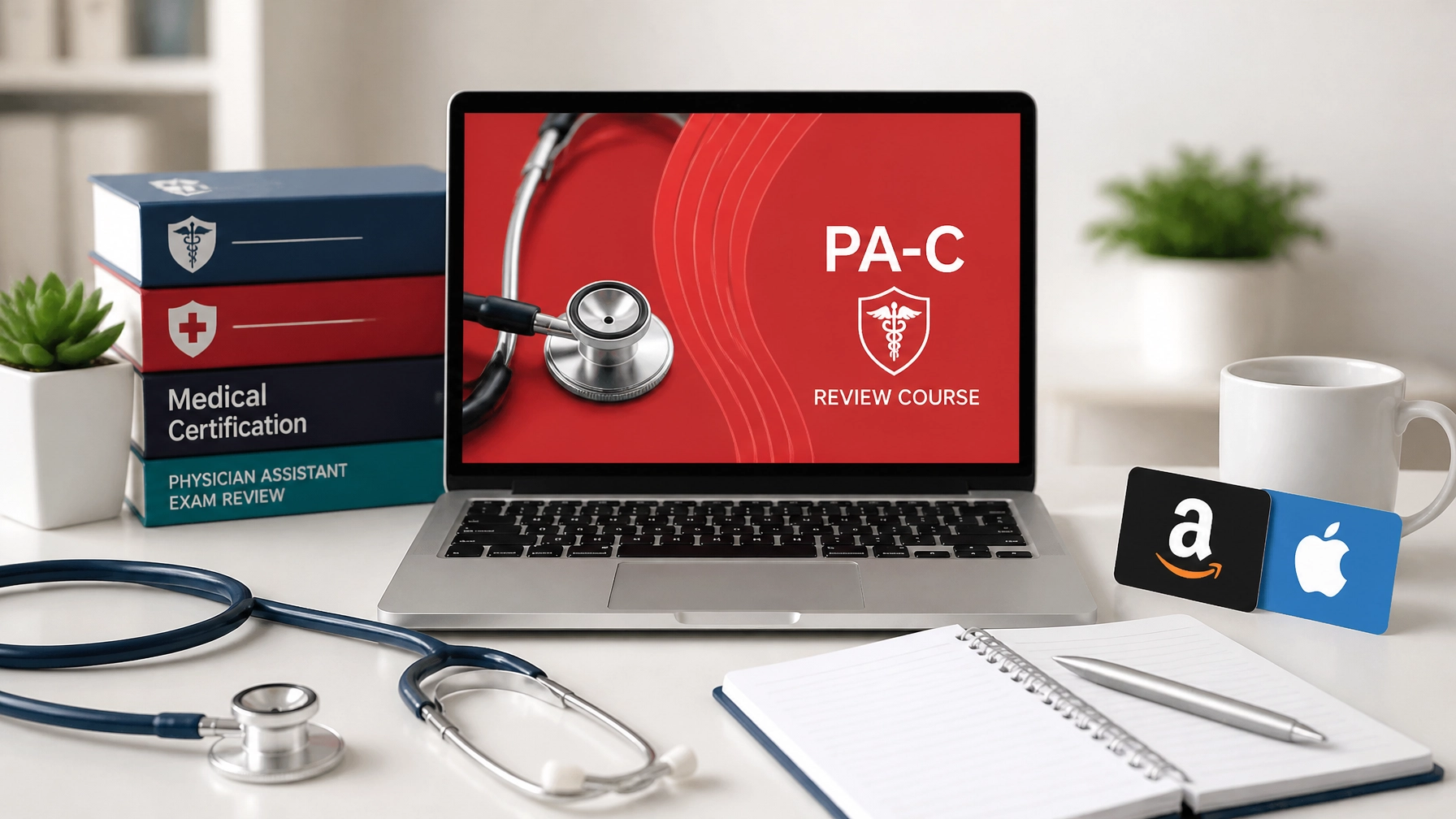
We understand that PAs often have a dedicated CME budget from their employers. To help you further enrich your professional resources, we offer . You can add a gift card ranging from $100 to $1,500 to your purchase.
These gift cards are a pragmatic way to use your CME money to purchase additional medical equipment, new reference textbooks, or updated hardware like a tablet or laptop to take your PANRE-LA. The total package price includes the CME course and the gift card, making it an efficient use of your professional funds.

Clinical Vignettes: Test Your Knowledge
To prepare for your next quarter, review the following clinical scenarios. These are designed to mimic the format and difficulty of the questions you will encounter on the PANRE-LA.

Scenario 1
Patient: 64-year-old male.
Symptoms: Progressive shortness of breath, orthopnea, and paroxysmal nocturnal dyspnea.
Vital Signs: HR 112, BP 155/95, SaO2 91% on RA.
Physical Exam: 3+ bilateral pitting edema to the mid-calf, JVD, and bibasilar crackles.
Question: Which of the following is the most appropriate initial medication to improve the patient’s symptoms?
A) Lisinopril
B) Furosemide
C) Metoprolol Succinate
D) Spironolactone
Scenario 2
Patient: 28-year-old female.
Symptoms: Acute onset of pelvic pain and vaginal spotting.
Vital Signs: HR 118, BP 92/58, Temp 98.6°F.
Physical Exam: Severe adnexal tenderness and peritoneal signs.
Laboratory: Positive urine pregnancy test.
Question: What is the most appropriate next step in the management of this patient?
A) Quantitative hCG level
B) Transvaginal ultrasound
C) Immediate surgical consultation
D) Methotrexate administration
Scenario 3
Patient: 52-year-old female.
Symptoms: Polyuria, polydipsia, and blurred vision over the past three weeks.
Vital Signs: HR 88, BP 138/86, BMI 34.
Laboratory: Random blood glucose of 285 mg/dL.
Question: According to the NCCPA Blueprint standards for Type 2 Diabetes management, which medication is recommended as first-line therapy?
A) Sitagliptin
B) Glipizide
C) Metformin
D) Empagliflozin
Explanations and Rationales
Scenario 1 Answer
Correct Answer: B) Furosemide
Explanation: Your patient is presenting with an acute exacerbation of Congestive Heart Failure (CHF). The presence of bibasilar crackles, JVD, and 3+ edema necessitates immediate volume reduction. Furosemide (a loop diuretic) is the first-line treatment to reduce preload and alleviate pulmonary congestion.
Distractors: Lisinopril (ACE inhibitor) and Metoprolol Succinate (Beta-blocker) are vital for long-term mortality benefit but are not the initial choice for acute symptomatic relief of fluid overload. Metoprolol should be used with caution in the acute decompensated phase if the patient is not yet euvolemic. Spironolactone is used for long-term management in NYHA Class II-IV heart failure.
Scenario 2 Answer
Correct Answer: C) Immediate surgical consultation
Explanation: Your patient is presenting with signs of a ruptured ectopic pregnancy, evidenced by hypotension (BP 92/58), tachycardia (HR 118), and peritoneal signs. This is a surgical emergency. In a hemodynamically unstable patient with a positive pregnancy test and signs of hemoperitoneum, immediate surgical consultation for laparoscopy/laparotomy takes precedence over further imaging or lab work.
Distractors: Transvaginal ultrasound (TVUS) and quantitative hCG are diagnostic for stable patients. Methotrexate is only indicated for stable, unruptured ectopic pregnancies meeting specific criteria (e.g., hCG < 5000, no fetal heart tones).
Scenario 3 Answer
Correct Answer: C) Metformin
Explanation: The patient meets the diagnostic criteria for Diabetes Mellitus with a random glucose > 200 mg/dL and classic symptoms. Metformin remains the first-line pharmacological treatment for Type 2 Diabetes due to its efficacy, safety profile, and weight-neutral effects.
Distractors: Sitagliptin (DPP-4 inhibitor), Glipizide (Sulfonylurea), and Empagliflozin (SGLT2 inhibitor) are all valid secondary agents but are generally not initiated before or instead of Metformin unless there is a specific contraindication, such as advanced renal failure (GFR < 30).

Conclusion
Success in the PANRE-LA quarters is a result of clinical preparedness and resource organization. By utilizing the 1,672 practice questions in the CME Review Courses PANRE Package, you ensure that your diagnostic skills remain sharp and your ability to navigate the NCCPA Blueprint is unmatched.
Secure your 100 hours of AAPA Category 1 CME Credit today and take advantage of our Amazon, Apple gift card add-ons to further your medical education. Whether you are a Physician Assistant in Family Medicine, Internal Medicine, or Emergency Medicine, our course provides the efficient, comprehensive review you need to ace your next 25-question quarter.