Course Title: Pharmacology Review Course
Price: Starting at $499.99 (Base Course) up to $1,999.99 (with Gift Card add-on)
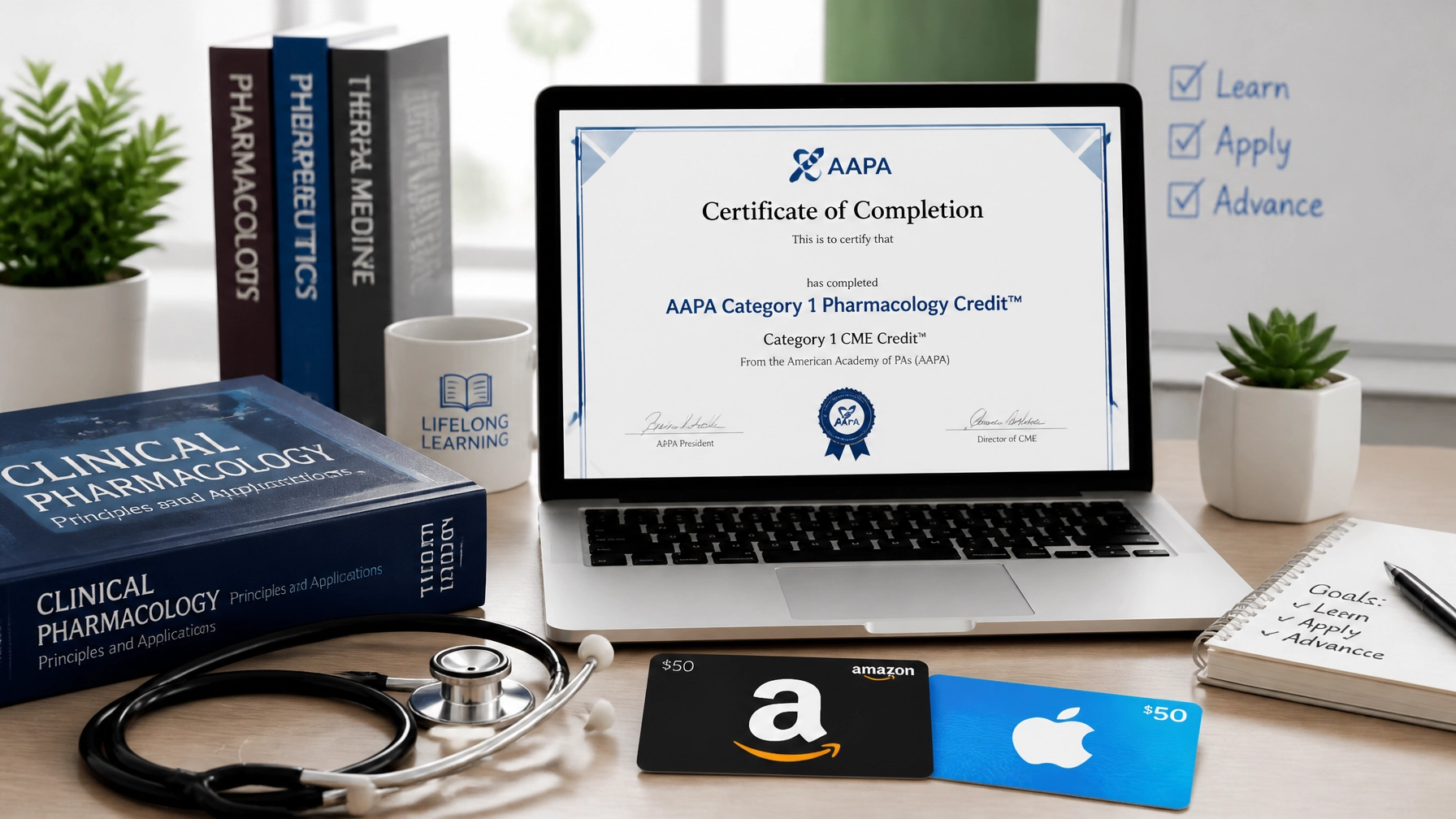
Deliverables: 12 Hours of AAPA Category 1 Pharmacology Credit, Practice Questions, 30-Month Access
Gift Card Options: $100 to $1,500 Amazon or Apple Gift Cards available
Navigating the landscape of continuing medical education (CME) can be complex, particularly when you are balancing clinical duties with the need to meet specific state and national requirements. For physician assistants and nurse practitioners, pharmacology-specific credits often represent a bottleneck in license renewal and certification maintenance. This guide simplifies the process, explaining what AAPA Category 1 Pharmacology credit is and how to fulfill your requirements efficiently.
What is AAPA Category 1 Pharmacology Credit?
AAPA Category 1 CME credit is the gold standard for physician assistants. It is accredited by the American Academy of Physician Associates and is recognized by the NCCPA for certification maintenance. While most Category 1 credits can be earned through general medical review, "pharmacology credit" refers specifically to content focused on drug mechanisms, pharmacokinetics, therapeutic uses, and adverse effects.
Our Pharmacology Review Course provides 12 hours of this specialized credit. This is distinct from our PANRE Review Course, which offers 100 hours of AAPA Category 1 credit but is designed for general exam preparation. The pharmacology course is targeted at those who need to satisfy specific prescriptive authority mandates or enhance their clinical knowledge of therapeutics.

State-Specific Pharmacology Requirements
While the NCCPA requires 50 hours of Category 1 CME every two years, they do not mandate a specific number of pharmacology hours. However, state licensing boards frequently do.
- Maryland: PAs must complete 50 hours of Category 1 CME every two years, and at least 8 of those hours must be pharmacology-related.
- Massachusetts: PAs with prescriptive authority are required to complete at least 4 hours of pharmacology CME per cycle.
- Ohio: PAs are required to complete 12 hours of pharmacology CME from a board-recognized institution.
Failing to meet these state-specific requirements can lead to delays in license renewal or administrative penalties. Our 12-hour pharmacology package is designed specifically to meet the most stringent state requirements, such as those in Ohio, in one single course.
The Nurse Practitioner Perspective
Although these credits are accredited by the AAPA, they are highly valuable for Nurse Practitioners (NPs). The American Nurses Credentialing Center (ANCC) and the American Association of Nurse Practitioners (AANP) often accept AAPA Category 1 CME as continuing education hours.
For NPs, national certification renewal typically requires 25 hours of pharmacology-specific CE. While you should always verify with your state nursing board, many NPs use our pharmacology course to fulfill half of their national requirement in a single, high-yield program.
Maximizing Your CME Budget
One of the most efficient ways to manage your professional development stipend is by utilizing CME with gift card add-ons. At CME Review Courses, we understand that your education doesn't stop at the screen. You need hardware, clinical tools, and resources to stay current.
When you purchase our Pharmacology Review or PANRE Review packages, you have the option to add an Amazon or Apple Gift Card ranging from $100 up to $1,500. This allows you to utilize your employer-provided CME money to its fullest extent, acquiring the tools you need: such as a new iPad for clinical use or medical reference books: while simultaneously earning the 12 hours of pharmacology credit required for your license.

Why 30-Month Access Matters
Medical knowledge evolves rapidly, but your access to your study materials shouldn't expire before you've had a chance to master them. We provide 30 months of access to our Pharmacology Review Course. This duration is significantly longer than many competitors, ensuring that you can revisit complex topics like anticoagulant management or advanced antimicrobial stewardship whenever a challenging case arises in the clinic.
This content is written by physician assistants for physician assistants. We focus on the practical, clinical application of pharmacology: the "what to do" and "why we do it" at the bedside.
Clinical Content and Practice Questions
The following clinical scenarios represent the type of practical, evidence-based content found within our Pharmacology Review Course.
Clinical Scenario 1: Cardiovascular Management
Your patient is a 64-year-old male with a history of heart failure with reduced ejection fraction (HFrEF) and hypertension. He presents for a routine follow-up. He is currently taking Lisinopril 20mg daily and Carvedilol 12.5mg twice daily.
Vitals:
- BP: 152/88 mmHg
- HR: 78 bpm
- SaO2: 96% on room air
- Weight: Stable, no peripheral edema.
The patient remains symptomatic (NYHA Class II) with an Ejection Fraction of 35%. You decide to optimize his regimen by switching his ACE inhibitor to an Angiotensin Receptor-Neprilysin Inhibitor (ARNI), specifically Sacubitril/Valsartan.
Question:
What is the mandatory washout period required after discontinuing the Lisinopril before the patient can safely initiate Sacubitril/Valsartan?
A) 12 hours
B) 24 hours
C) 36 hours
D) 48 hours
Explanation:
The correct answer is C) 36 hours. When transitioning a patient from an ACE inhibitor to an ARNI, a 36-hour washout period is strictly required to minimize the risk of angioedema. Both ACE inhibitors and neprilysin inhibitors inhibit the breakdown of bradykinin; simultaneous administration can lead to excessive bradykinin levels and life-threatening airway compromise. This washout period is not required when switching from an Angiotensin Receptor Blocker (ARB) to an ARNI.

Clinical Scenario 2: Endocrine Pharmacology
Your patient is a 52-year-old female with Type 2 Diabetes Mellitus, currently managed with Metformin 1000mg twice daily. Her latest HbA1c is 8.2%. She has a history of atherosclerotic cardiovascular disease (ASCVD), specifically a prior myocardial infarction two years ago.
Vitals:
- BP: 134/82 mmHg
- HR: 72 bpm
- BMI: 31 kg/m²
Question:
According to current clinical guidelines for patients with T2DM and established ASCVD, which class of medication should be prioritized as the next addition to her regimen?
A) Sulfonylureas (e.g., Glipizide)
B) DPP-4 Inhibitors (e.g., Sitagliptin)
C) GLP-1 Receptor Agonists (e.g., Semaglutide)
D) Thiazolidinediones (e.g., Pioglitazone)
Explanation:
The correct answer is C) GLP-1 Receptor Agonists. For patients with Type 2 Diabetes and established ASCVD, both GLP-1 receptor agonists and SGLT2 inhibitors have demonstrated significant cardiovascular benefits beyond glucose lowering. Guidelines specifically recommend these agents to reduce the risk of major adverse cardiovascular events (MACE). Sulfonylureas (Choice A) and DPP-4 inhibitors (Choice B) do not provide the same cardiovascular protection. Pioglitazone (Choice D) should be used with caution in patients with a history of heart failure, which often co-occurs with ASCVD.
Clinical Scenario 3: Infectious Disease
Your patient is a 28-year-old female presenting with symptoms of an uncomplicated urinary tract infection (UTI), including dysuria and urinary frequency. She has no fever or flank pain. She has a documented "severe" allergy to Penicillin, which resulted in anaphylaxis ten years ago.
Vitals:
- BP: 118/76 mmHg
- HR: 80 bpm
- Temp: 98.6°F
Question:
Which of the following is the most appropriate first-line treatment for this patient’s uncomplicated UTI, considering her allergy profile?
A) Cephalexin
B) Amoxicillin-Clavulanate
C) Nitrofurantoin
D) Ciprofloxacin
Explanation:
The correct answer is C) Nitrofurantoin. Nitrofurantoin is a first-line agent for uncomplicated cystitis and does not share cross-reactivity with the penicillin class. Amoxicillin-Clavulanate (Choice B) is a penicillin and is absolutely contraindicated given her history of anaphylaxis. Cephalexin (Choice A) is a cephalosporin; while cross-reactivity is low (often cited as <1%), it is generally avoided in patients with a history of IgE-mediated anaphylaxis to penicillin if other first-line options are available. Ciprofloxacin (Choice D) is no longer considered first-line for uncomplicated UTI due to the risk of significant adverse effects and the need to preserve fluoroquinolones for more serious infections.

Conclusion
Mastering your pharmacology requirements doesn't have to be a source of stress. By choosing a course that provides high-yield clinical content, generous access times, and the flexibility of gift card add-ons, you can fulfill your professional obligations while improving your clinical practice. Whether you are a PA preparing for the PANRE or an NP looking to satisfy your 25-hour pharmacology requirement, our courses provide the structure and quality you need.
Invest in your education and your clinical tools today. Explore our Pharmacology Review Course and take the first step toward mastering your 2026 CME requirements.