
Course price: $499.99 for 30 months of access
Practice: 2,500+ board-style questions, including five 240-question mock exams
CME: Up to 100 AAPA Category 1 credits through the PANRE Review Course
Gift card add-ons: Paid add-ons of $100–$1,500; they are not free gifts
PANRE-LA’s quarterly format can do more than break an assessment into smaller sessions. Used intentionally, each window can give you a regular opportunity to notice what is sticking and what keeps slipping. Across the assessment cycle, your notes can become a practical weakness map, and a guide for choosing what to study next.
That’s different from treating PANRE preparation as a last-minute review. Instead of repeatedly revisiting material you already know, use each quarter to identify the systems and topics that need attention. The traditional PANRE concentrates the assessment experience on one test day; PANRE-LA gives you repeated check-ins to inform your study plan.
Why quarterly windows can reveal patterns
PANRE-LA is completed in 12 quarterly windows of 25 questions. At least 8 of the 12 quarters must be completed, and references may be used while answering. Check the NCCPA key dates page for current window dates and deadlines.
A single quarter is a limited snapshot. A pattern across quarters is more useful: perhaps a topic feels unfamiliar more than once, or a system you expected to handle well continues to take extra effort. Those repeated signals can help you decide where to focus.
The goal is not to overinterpret one difficult question or assume that a quarterly result provides a complete diagnosis of your knowledge. It is to treat each window as a prompt to reflect. Record what challenged you, compare it with your previous notes, and choose a targeted next step.
Turn each window into a simple study log
After each quarterly window, take a few minutes to record the areas you want to revisit. Keep the format simple enough to maintain throughout the cycle.
- Window: Note which quarter you completed.
- System and topic: Be specific. For example, record “Musculoskeletal: joint aspiration and synovial fluid interpretation,” not just “MSK.”
- What challenged you: Note a knowledge gap, uncertainty, or reasoning step you want to strengthen.
- Next action: Choose a focused review, a set of practice questions, or a short return to the relevant reference.
- Follow-up: Revisit the entry after your next practice session or quarterly window. Mark whether the topic feels more secure or still needs work.
Use your own notes alongside any available feedback. Don’t turn the list into a record of every question; the point is to identify recurring themes and make your study time more deliberate.
For example, if a cardiovascular question exposed uncertainty about a treatment decision, note the decision point, not merely the diagnosis. Then target that topic in your review and check whether you can explain the rationale when you encounter a similar question later. If the same area appears in your log again, keep it on the priority list. If it no longer causes difficulty, shift attention to the next weakness.
Match your weakness map to a structured review
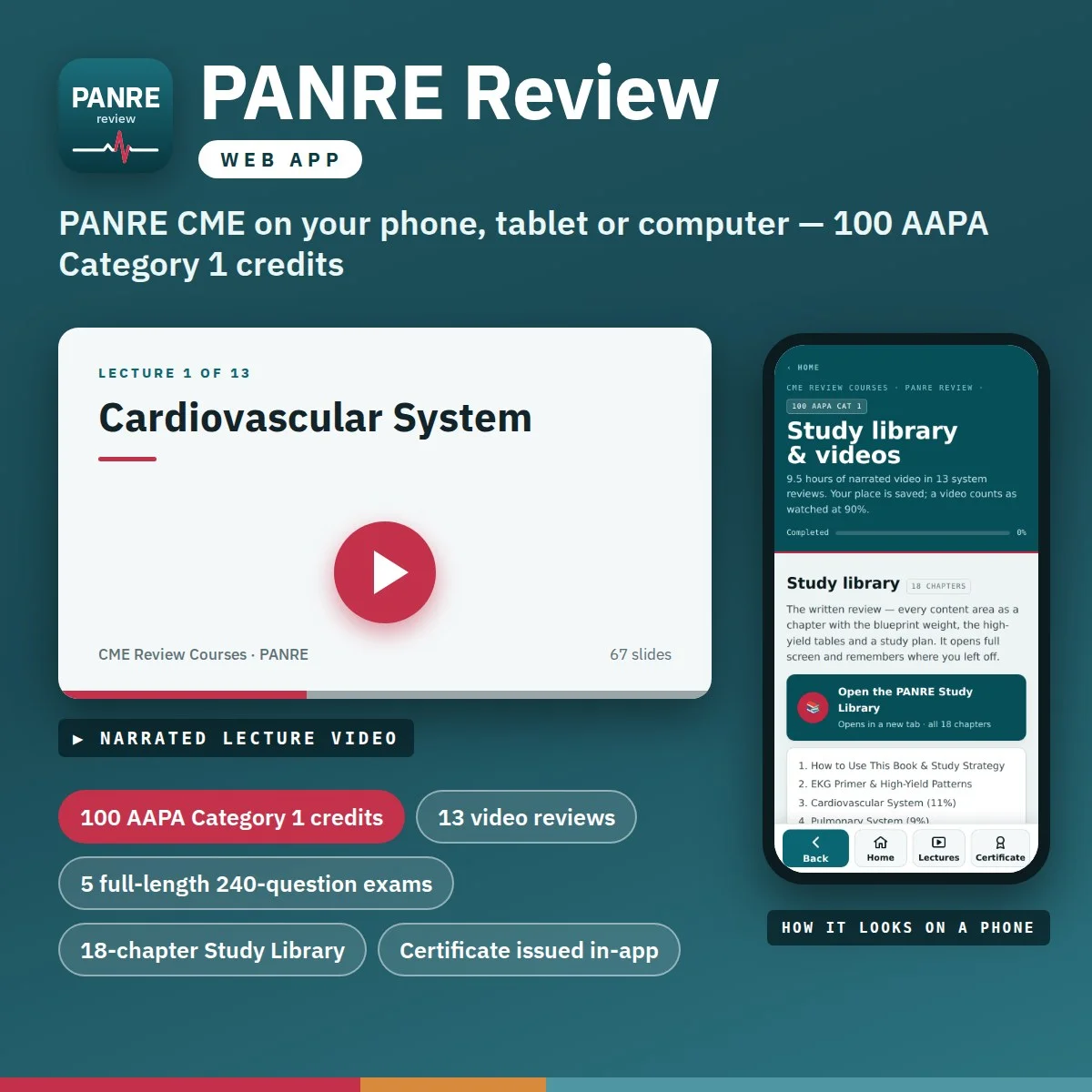
The PANRE Review Course is organized to support focused review as well as broader exam preparation. It includes 2,500+ board-style questions across 15 body-system question modules mapped to the NCCPA PANRE blueprint. The modules include Cardiovascular, Dermatology, EENT, Reproductive, GI/Nutrition, Musculoskeletal (130 questions), Pulmonary, Neurology, Genitourinary, Renal, Emergent Topics, Infectious Disease, Psychiatry, Hematology, and Endocrine.
Use your log to select a matching module rather than automatically restarting from the beginning. If your notes point to a specific gap, work through questions in that area, read the explanations, and return to questions you flagged for another attempt.
The course also includes five full-length 240-question mock exams, with a rationale and cited sources for each question. Treat these as checkpoints in your broader preparation: review your performance, note topics that still need work, then use the module questions to target those areas. The PANRE Readiness Dashboard tracks attempted versus correct questions, provides a per-topic performance breakdown, allows question flagging and unlimited retakes, and includes an “on track to pass” indicator at 75% or higher.
The course is a web app, so lectures, post-test, evaluation, and certificate are available on a phone, tablet, or computer without a download. Its explanations have been updated to current 2023–2025 clinical guidelines and individually cited. Use those explanations to check your reasoning, not just to memorize the correct option.
Connect your study plan to the CME requirements
The PANRE Review Course awards up to 100 AAPA Category 1 CME credits through the PANRE Clinical Review Module (Enduring Material), part of Comprehensive Clinical Review for Practicing PAs: 2026–27 Enduring CME Activity. The AAPA reference number is CME-2016187, with approval valid from August 26, 2026, to August 26, 2027.
To earn credit, review all module content, complete the post-test with a score of 70% or higher, and complete the activity evaluation. Missed post-test questions may be retaken. Your certificate states your precise credit; claim only the credit commensurate with your participation.
These credits apply to the PANRE Review Course only, not the Pharmacology course. If you are an NP, verify acceptance of AAPA Category 1 credit with your state board of nursing. For physicians, the activity meets AAPA Category 1 requirements, which counts as Category 2 CME for physician reporting.
Understand the paid gift card add-ons
At checkout, you can choose a paid Amazon or Apple gift card add-on from $100 to $1,500 in $100 tiers. These are not free gifts: the add-on cost is added to the course price and included in the total package price, allowing the full purchase to run through CME funds in one transaction. Gift cards are emailed within 2–3 business days; you do not need to finish the course first.
Gift card packages are nonrefundable, and CME Review Courses is not affiliated with Amazon or Apple. Check your employer’s CME policy before purchasing. If you buy two or more CME courses, a 20% discount applies automatically to each course; gift card add-ons remain at face value and are not discounted.


Practice question: septic arthritis or crystal arthropathy?
You are evaluating a 58-year-old man with a hot, swollen right knee, fever, and a recent history of gout. He has marked pain with passive range of motion. Which is the best next step?
Correct answer: B) Perform urgent arthrocentesis for synovial cell count, Gram stain, culture, and crystal analysis.
A) Treat presumptively for gout with an intra-articular corticosteroid.
B) Perform urgent arthrocentesis for synovial cell count, Gram stain, culture, and crystal analysis.
C) Order an MRI before deciding whether to aspirate the joint.
D) Start an oral NSAID and reassess in several days.
Why B is correct: Fever and an acutely inflamed joint require evaluation for septic arthritis, even with a history of gout. Synovial fluid analysis helps distinguish infection from crystal arthropathy.
- A is incorrect: Steroids before obtaining synovial fluid can delay appropriate treatment of a joint infection.
- C is incorrect: MRI does not replace timely aspiration and fluid analysis in this presentation.
- D is incorrect: Symptomatic treatment and delayed reassessment risk missing a time-sensitive infection.
Real-world exam note: Arthrocentesis with crystal analysis, cell count, and Gram stain is the decision-maker. Fever plus a hot joint should keep septic arthritis high on your list; crystals alone do not rule out infection. Avoid steroids before cultures.
Choose your next step
See the PANRE Review Course and choose your paid cme gift cards add-on at checkout, or try the free PANRE Review test drive. For PANRE-LA window dates and deadlines, refer to the NCCPA key dates page.
If you are earlier in training and comparing pance prep courses, look for a review resource that fits your current learning needs and study schedule.
About the author
Jeremy Boroff, MPAS, PA-C, is an Emergency Medicine PA with 24 years of clinical experience, a PA educator, author, and CME developer. He is the sole faculty member for this activity and has no relevant financial relationships to disclose.