







A student fails an End of Rotation exam on Friday. By Monday you need a plan that is specific enough to help, light enough to run alongside the next rotation, and documented well enough to stand up later. Many programs rebuild that plan from scratch each time. It does not have to be that way.
Start from the score report
The report shows performance by content area and task area. Use it to sort the student into one of two groups. The first missed narrowly across the board and usually needs pacing and volume. The second has one or two content areas far below the rest and needs targeted review. The assignment should look different for each.
Assign work you can see
“Review your weak areas” is not an assignment. A workable plan names the practice tests, the dates, and the target. For example: one full-length practice exam this week as a baseline, focused questions in the two weakest areas, a second full-length exam at the midpoint, and a third before the retake, with 75% as the goal.
Monitor without chasing
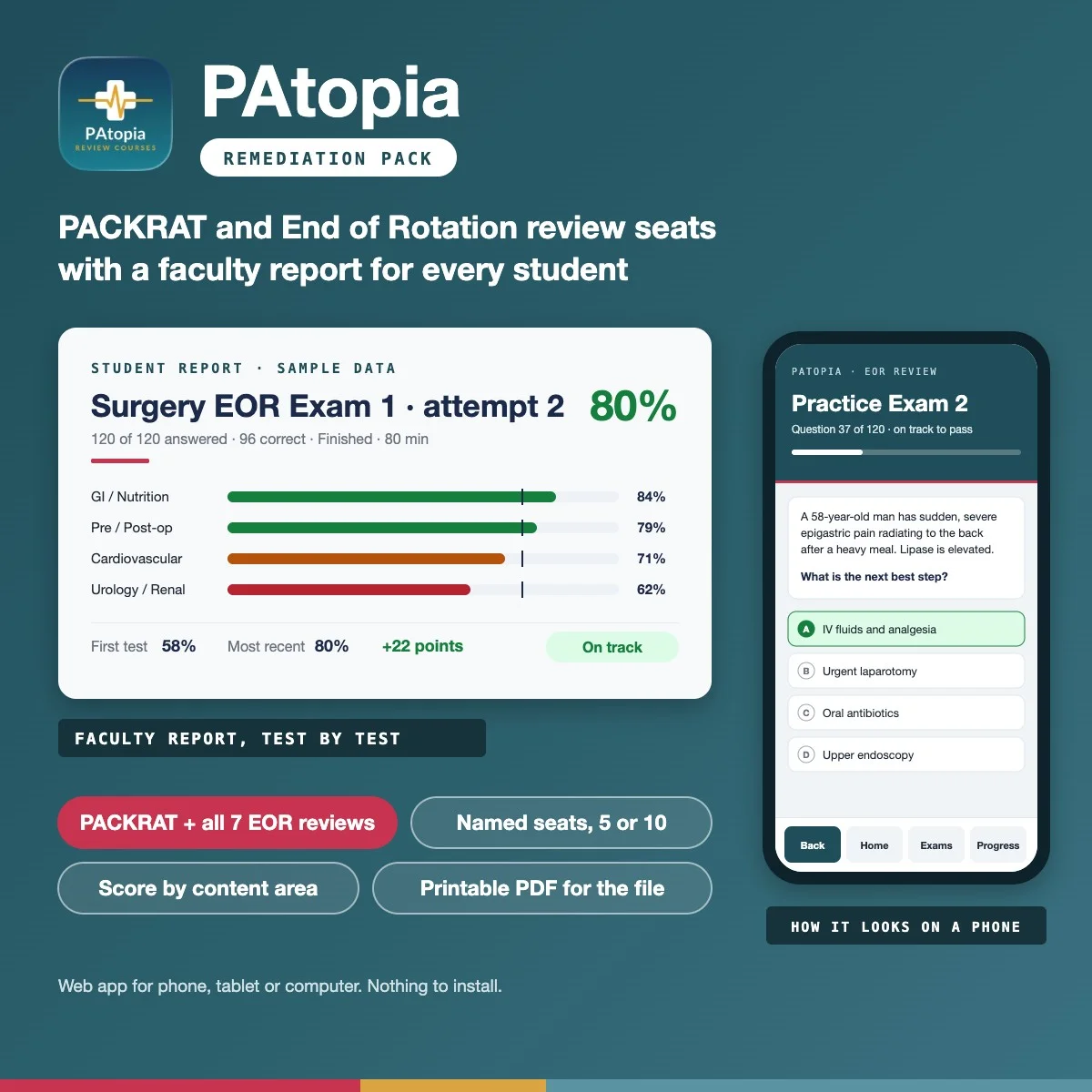
The plan fails when faculty have to ask the student for screenshots. You need to be able to open one page and see whether the student has started, how many tests are finished, and whether the weak areas are moving. If that takes more than a minute, it will not happen during a busy week.

Document as you go
Accreditation standards expect programs to have remediation policies and to document what was done. The record should show what was assigned, what the student completed, and the result. A one-page report per student, dated and signed by the reviewing faculty member, covers that.
Fit the plan to the clinical schedule
The student is on a new rotation with a new preceptor and another exam at the end of it. A plan that needs three hours a night will be abandoned in a week. One to two hours on weekdays and one longer weekend block is realistic. Full-length practice tests belong on the weekend block, and targeted questions in the weak areas belong on weekdays. Say this out loud in the advising meeting, so the student does not try to do everything and finish nothing.
Decide the retake date with the data
If your policy allows any flexibility on timing, use the second practice exam to set the date. A student whose weak areas have moved toward the goal is ready. One whose numbers have not changed is better served by another week and a revised assignment than by a second failure on the record.
Close the loop
Meet once at the midpoint and once before the retake. Both meetings go faster when you and the student are looking at the same numbers. If the second practice exam has not moved, change the plan then, not after the retake.
Seats for the students who need them
The PAtopia Remediation Pack gives a PA program 5 named seats for $999 or 10 for $1,799. Each seat covers the PACKRAT review and all 7 End of Rotation reviews for 12 months from the day it is assigned. A set of 10 single-rotation retake seats is $399. Faculty get a dashboard and a test-by-test report for every student, and the dashboard link arrives in the order confirmation email.
PACKRAT® and End of Rotation™ are trademarks of the Physician Assistant Education Association (PAEA). CME Review Courses and PAtopia are not affiliated with or endorsed by PAEA. Practice scores are not official exam results. Your program’s own policies decide what counts as passing and what remediation requires.