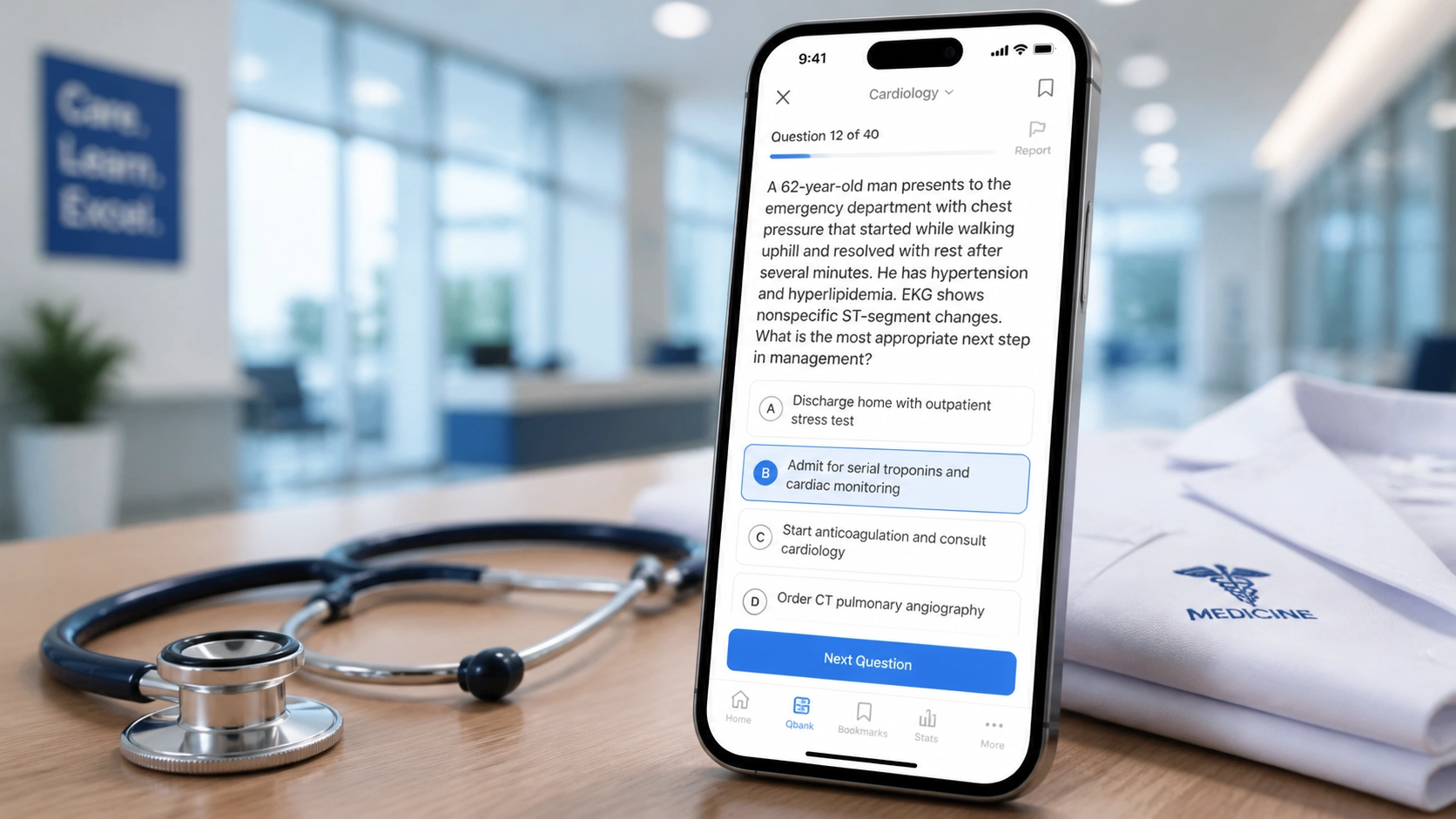
Preparing for the Emergency Medicine (EM) End of Rotation (EOR) exam requires a strategy that balances high-yield content review with active question practice. The Emergency Medicine EOR Review app, developed by Jeremy Boroff, PA-C, provides a streamlined, mobile-first solution for PA students navigating the demands of a busy clinical rotation. This app is designed to align with the core topics frequently tested on the EM EOR and PANCE.
Logistics and Deliverables:
- Price: $9.99 (One-time purchase)
- Platform: iOS (iPhone and iPad)
- Content: 120 Board-style practice questions
- Educational Materials: 13 Video lessons and a 12-chapter high-yield reading library
- Access: Permanent access with no recurring subscription fees
You can download the app directly from the Apple App Store here: Emergency Medicine EOR Review.
A Distraction-Free Study Experience
The primary challenge of clinical rotations is finding dedicated time for pance prep courses and EOR study. The Emergency Medicine EOR Review app addresses this with a distraction-free design. Unlike many web-based platforms that are cluttered with ads or complex navigation, this app focuses entirely on the medical content. The interface is clean, allowing you to move quickly between the practice exam, the video library, and the high-yield reading chapters.

Core Features: Practice, Video, and Reading
The app is structured into three primary pillars to ensure comprehensive preparation:
120-Question Practice Examination
The practice exam features 120 board-style multiple-choice questions. These questions are randomized in both order and answer choices every time you start a new session. This prevents rote memorization of patterns and forces you to rely on clinical reasoning. As you progress, the app provides live score tracking and a tally of your performance, concluding with a detailed summary.
High-Yield Reading Library
Organized into 12 chapters by organ system, the reading library covers the essential topics found on the NCCPA Blueprint. Whether you are reviewing Cardiovascular emergencies, Pulmonology, or Orthopedics, the content is condensed into readable sections ideal for quick reference between patient encounters in the ED.
Concise Video Lessons
The 13 video lessons are categorized by system: including neurologic, gastrointestinal, renal, endocrine, and dermatologic: to provide a visual and auditory review of complex topics. These lessons emphasize the "must-know" information for the exam without unnecessary filler.

Clinical Scenarios and Practice Questions
To succeed on the EM EOR, you must be able to identify the "best next step" in an acute setting. Use the following clinical vignettes to test your knowledge.
Question 1
Your patient is a 58-year-old male with a history of hypertension and hyperlipidemia. He presents to the ED with crushing substernal chest pain radiating to his left arm, accompanied by diaphoresis and nausea for 45 minutes. His vitals are: BP 150/90, HR 96, RR 18, and O2 sat 98% on room air. An ECG is performed and shows 2 mm ST-segment elevation in leads II, III, and aVF.
What is the most appropriate immediate next step in the management of this patient?
A. Obtain a stat chest X-ray
B. Activate the cardiac catheterization lab for emergent PCI
C. Administer IV thrombolytics
D. Order a serum troponin level
Answer: B. Activate the cardiac catheterization lab for emergent PCI.
Explanation: This patient is presenting with an inferior ST-segment elevation myocardial infarction (STEMI). The definitive treatment for STEMI is reperfusion therapy. Percutaneous coronary intervention (PCI) is the preferred method if it can be performed within 90 minutes of medical contact. While aspirin and other adjunct treatments are necessary, activating the cath lab is the priority for life-saving intervention. Stat X-rays (Choice A) and lab results (Choice D) should not delay reperfusion in the setting of a clear STEMI. Thrombolytics (Choice C) are reserved for cases where PCI is not available within the recommended timeframe.
Question 2
Your patient is a 32-year-old female who presents with sudden onset pleuritic chest pain and shortness of breath. She underwent a laparoscopic appendectomy five days ago. Her vitals are: HR 118, RR 26, BP 122/76, and O2 sat 91% on room air. Her lung exam is clear to auscultation bilaterally.
What is the most likely diagnosis, and what is the best initial imaging study?
A. Pneumonia; Chest X-ray
B. Spontaneous pneumothorax; Ultrasound (FAST)
C. Pulmonary embolism; CT pulmonary angiography (CTPA)
D. Myocardial infarction; ECG
Answer: C. Pulmonary embolism; CT pulmonary angiography (CTPA).
Explanation: The patient’s recent surgery, tachycardia, and sudden onset of pleuritic pain and hypoxia are highly suggestive of a pulmonary embolism (PE). In a hemodynamically stable patient, CTPA is the gold standard and best initial imaging study for diagnosis. Pneumonia (Choice A) is less likely given the sudden onset and clear lung exam. While pneumothorax (Choice B) is a differential, the surgical history points more strongly toward venous thromboembolism. Myocardial infarction (Choice D) is less common in this age group without significant risk factors.

Comprehensive CME and PANRE Solutions
For those who have moved beyond EOR exams and are preparing for recertification or looking to maximize their CME budget, we offer specialized courses tailored for the practicing clinician.
Our PANRE Review Course provides 100 hours of AAPA Category 1 Credit, offering an efficient and thorough way to prepare for the NCCPA recertification exam. We also provide a dedicated Pharmacology CME Course which is also approved for Category 1 AAPA Credit.
To help you further enrich your professional resources, we offer CME with Gift Card packages. These allow you to add an Amazon or Apple Gift Card ($100 – $1500) to your purchase, effectively utilizing your employer-provided CME funds. This is a pragmatic way to get the high-quality Pharmacology CME Review you need while also securing the tools necessary for your practice.
Whether you are a student using the Emergency Medicine EOR Review app or a seasoned PA-C taking our PANRE prep courses, our content is written by PAs, for PAs, ensuring clinical relevance and educational efficiency.