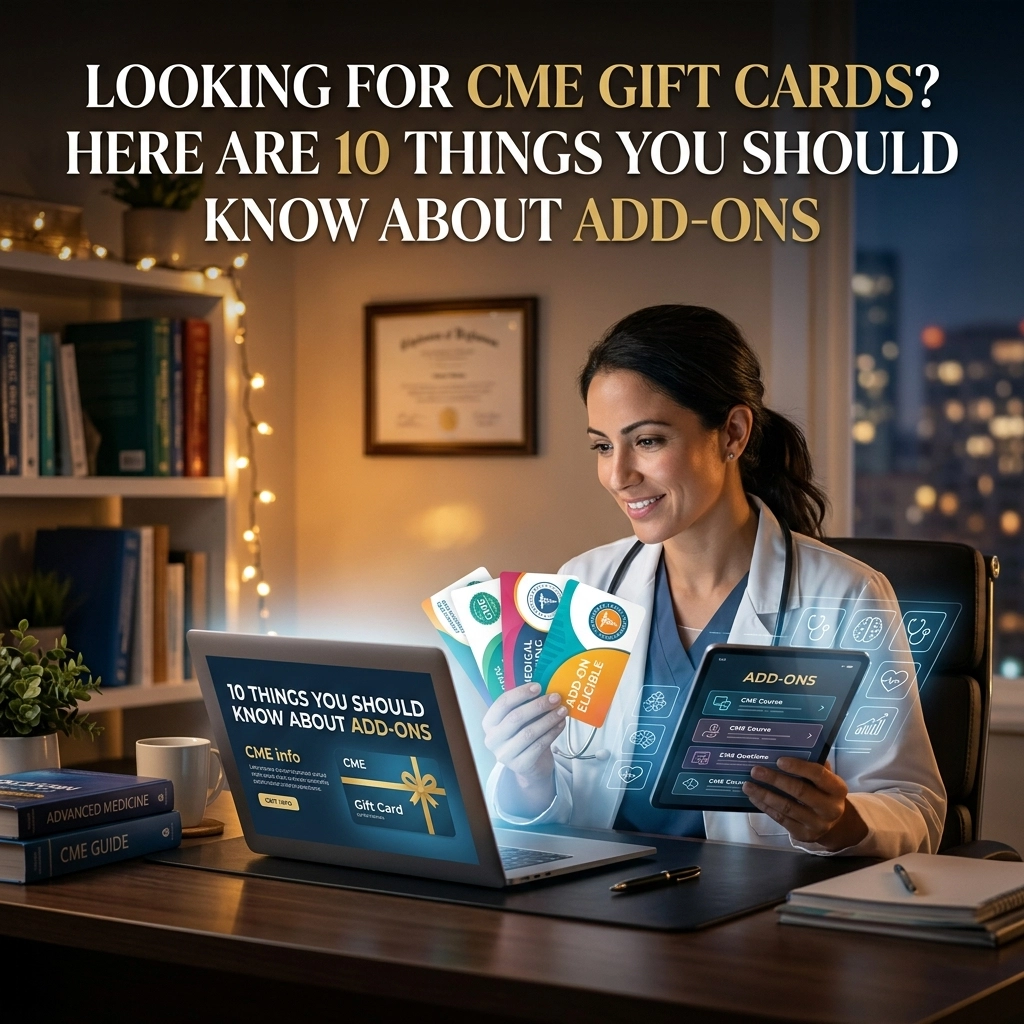
Navigating the world of Continuing Medical Education (CME) can be complex, especially when you are trying to balance clinical hours, board preparation, and maximizing your annual employer-provided CME allowance. One of the most popular ways to streamline this process is by utilizing cme gift cards as part of your educational purchase. At CME Review Courses, we provide comprehensive solutions that allow you to master clinical content while utilizing your professional development funds effectively.
If you are a Physician Assistant (PA) preparing for the PANRE or a Nurse Practitioner looking for high-yield review, understanding how gift card add-ons work is essential. Here are 10 things you need to know about CME gift card add-ons.
1. Gift Cards Are Add-Ons, Not "Free Gifts"
It is a common misconception in the industry that gift cards are "free" bonuses. At CME Review Courses, we maintain transparency: Amazon and Apple Gift Card add-ons ($100-$1500) are options that can be added to your purchase. They are not free gifts but are integrated into the total cost of the educational package. This allows you to utilize your CME budget for both high-quality educational materials and a gift card that can be used for clinical tools, technology, or other professional needs.
2. You Can Earn 100 Category 1 AAPA Credits
When you choose our panre review course, you aren't just getting study materials; you are earning 100 hours of Category 1 AAPA credit. This is a significant portion of your certification maintenance requirements. By bundling these credits with a gift card add-on, you ensure that you are meeting your professional obligations while also getting the most value out of your allotted funds.
3. Multiple Gift Card Retailers Are Available
Flexibility is key for busy clinicians. We offer options for both cme with amazon gift card and cme with apple gift card. Whether you need to stock up on medical reference books and clinical gear through Amazon or upgrade your diagnostic tablet or phone via Apple, these add-ons provide the flexibility to choose what best supports your practice.
4. Tailored for Major Specialties
Our courses are designed to be relevant across various clinical settings. Whether you are searching for emergency medicine cme or family medicine cme, the content is high-yield and evidence-based. The add-on gift cards remain available regardless of the specialty focus you choose for your review.

5. High-Yield PANCE and PANRE Preparation
If you are currently in your recertification cycle, our pance prep courses and PANRE review options focus on the NCCPA Blueprint. The goal is to provide a "one-and-done" study experience. By utilizing the panre review course, you can focus your energy on the most heavily weighted topics, such as Cardiology, Pulmonology, and GI, while securing your credits and gift card add-on in a single transaction.
6. Maximizing Your Annual CME Allowance
Most healthcare institutions provide a yearly CME budget that expires if not used. Many PAs and NPs find themselves with remaining funds at the end of the fiscal year. Adding an Apple or Amazon gift card to your CME purchase is a strategic way to ensure that your full allowance is utilized toward professional growth and necessary clinical resources.
7. Gift Card Values Range from $100 to $1,500
We offer a wide range of add-on values to fit different budget levels. Depending on your available funds, you can select an add-on ranging from $100 up to $1,500. This tier-based system ensures that whether you have a modest allowance or a more substantial one, there is a package that fits your needs.
8. Streamlined Digital Delivery
In the modern clinical environment, speed is essential. Once your purchase of a course like our internal medicine cme is complete, the gift card add-ons are typically delivered electronically. This allows you to start using your credits and your gift card balance almost immediately.
09. Content Access and Duration
When you invest in a review course, you need time to digest the information. Our courses generally offer one year of access, allowing you to review the clinical vignettes and practice questions at your own pace. This is particularly useful for those working in high-volume environments like Emergency Medicine who may only have small pockets of time to study.
10. Educational Excellence is the Priority
While the gift card add-on is a convenient feature, the core value of our program is the education. Our courses are built to help you pass your boards and improve clinical outcomes. The integration of cme gift cards is simply a way to make the administrative side of your education as rewarding as the clinical side.
Course Logistics and Deliverables
Price: Variable based on gift card add-on selection ($100 – $1,500 add-ons available).
Credits: 100 Hours of Category 1 AAPA Credit (specifically for the PANRE Review Course).
Access: 12 Months of online access.
Format: High-yield clinical modules and practice question banks.
Deliverables: Instant access to course materials and electronic delivery of selected gift card add-ons.
Clinical Case Study: Emergency Medicine Focus
To demonstrate the type of high-yield content found in our panre review course, consider the following clinical scenario often encountered in the Emergency Department or Urgent Care setting.
Scenario:
Your patient is a 58-year-old male with a history of hypertension and tobacco use (30 pack-years) who presents to the Emergency Department complaining of sudden-onset, severe chest pain that radiates to his back. He describes the pain as "tearing" in nature. On physical exam, his heart rate (HR) is 105 bpm, and his blood pressure (BP) is 185/110 mmHg in the right arm and 160/95 mmHg in the left arm. A new Grade II/VI diastolic murmur is noted at the right sternal border.
Question:
Which of the following is the most appropriate next step in the diagnostic workup for this patient?
A) Emergent Transthoracic Echocardiogram (TTE)
B) Computed Tomography Angiography (CTA) of the chest and abdomen
C) D-dimer and Chest X-ray
D) Troponin and 12-lead EKG
Correct Answer:
B) Computed Tomography Angiography (CTA) of the chest and abdomen
Explanation:
The patient’s presentation: sudden "tearing" chest pain radiating to the back, hypertension, and a blood pressure discrepancy between arms: is highly suggestive of an Aortic Dissection. A new diastolic murmur suggests aortic regurgitation, which can occur if the dissection involves the aortic valve. CTA of the chest and abdomen is the gold standard for diagnosis in stable patients because it is highly sensitive and specific, and it helps define the extent of the dissection (Stanford Type A vs. Type B).
- A) TTE is often insufficient to visualize the descending aorta; a Transesophageal Echocardiogram (TEE) would be more appropriate if the patient were hemodynamically unstable.
- C) D-dimer is non-specific and should not delay definitive imaging when clinical suspicion is high. Chest X-ray may show a widened mediastinum but is not diagnostic.
- D) Troponin and EKG should be performed to rule out myocardial infarction (which can coexist if the dissection involves the coronary ostia), but they are not the definitive diagnostic steps for a suspected dissection.

Clinical Case Study: Family Medicine Focus
Scenario:
Your patient is a 32-year-old female who presents to your Family Medicine clinic for a routine follow-up. She complains of increased fatigue, cold intolerance, and unintentional weight gain over the last four months. On physical exam, you note a palpable, non-tender thyroid enlargement (goiter) and delayed relaxation of the deep tendon reflexes. Laboratory results reveal an elevated Thyroid Stimulating Hormone (TSH) of 14.5 mIU/L and a low Free T4.
Question:
What is the most likely underlying etiology for this patient's condition?
A) Graves' Disease
B) Hashimoto’s Thyroiditis
C) Subacute Thyroiditis (de Quervain's)
D) Pituitary Adenoma
Correct Answer:
B) Hashimoto’s Thyroiditis
Explanation:
The patient presents with classic signs of hypothyroidism (fatigue, cold intolerance, weight gain, delayed reflexes). The laboratory findings of an elevated TSH and low Free T4 confirm primary hypothyroidism. In iodine-sufficient regions like the United States, Hashimoto’s Thyroiditis (chronic lymphocytic thyroiditis) is the most common cause of primary hypothyroidism. It is an autoimmune condition characterized by the destruction of the thyroid gland.
- A) Graves' Disease typically presents with hyperthyroidism (low TSH, high Free T4) and symptoms like heat intolerance and weight loss.
- C) Subacute Thyroiditis usually presents with a painful, tender thyroid gland, often following a viral infection, and typically has a triphasic course (hyperthyroidism, then hypothyroidism, then recovery).
- D) Pituitary Adenoma would result in secondary hypothyroidism, characterized by a low Free T4 and a low or inappropriately normal TSH.
Why Choose CME Review Courses?
Choosing the right provider for your pance prep courses or pa-cme is about more than just checking a box. It is about ensuring you have the clinical knowledge to provide excellent patient care while navigating the requirements of the NCCPA.
Our CME Review Courses are designed by clinicians for clinicians. We understand that your time is valuable. That is why our PANRE Review course offers the full 100 hours of Category 1 AAPA credit in a format that is accessible and efficient.
When you add an Amazon or Apple gift card to your purchase, you are making a smart financial decision that aligns with your professional development goals. You get the credits you need, the knowledge you want, and the gift card add-on that helps you equip your practice for success.
Whether you are looking for internal medicine cme with gift card or family medicine cme with gift card, we have the options to help you succeed. Don't let your CME allowance go to waste: invest in a course that gives you back more than just a certificate.