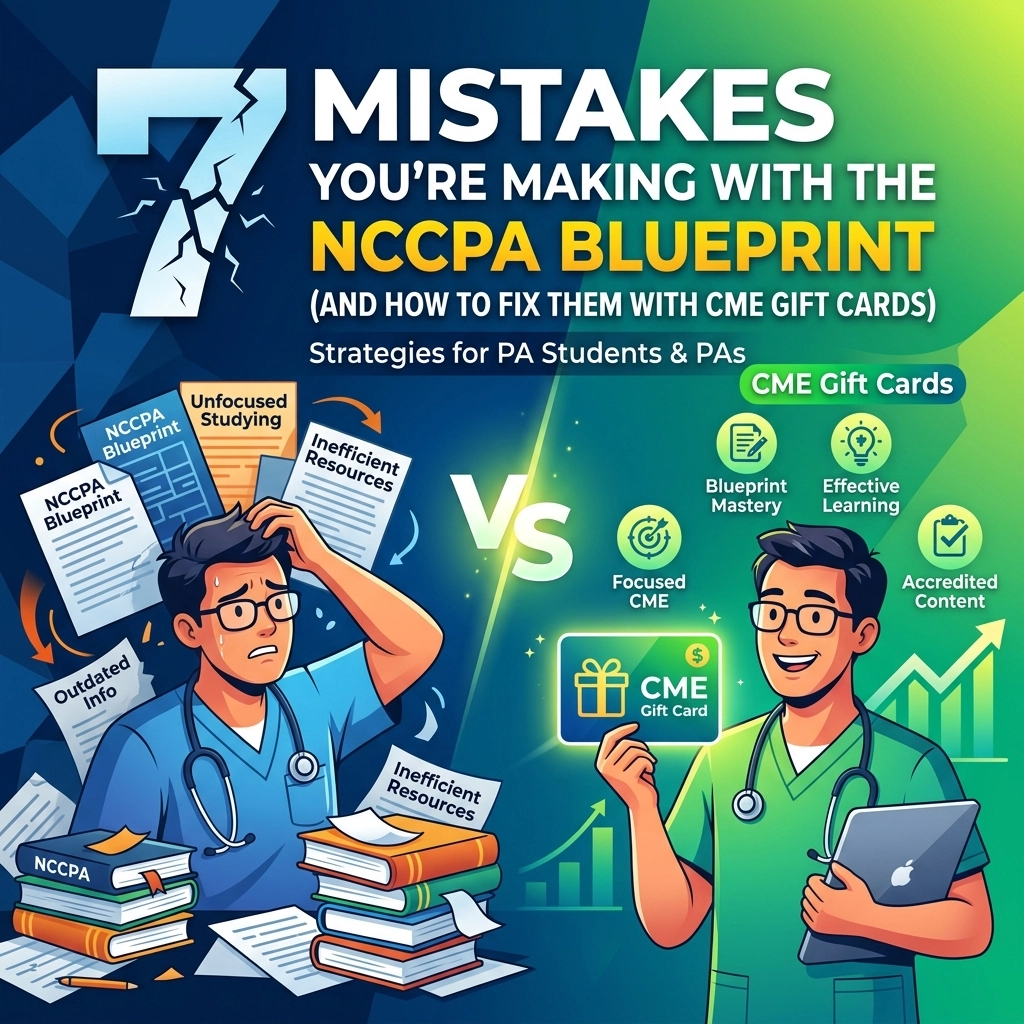
Let’s be honest: the NCCPA Blueprint is a beast. Whether you are a fresh graduate staring down the PANCE or a seasoned veteran prepping for the PANRE, that list of diseases and task areas can feel like a map where every road leads to a different cliff. You might think you know how to study, but there are nuanced traps within the NCCPA Blueprint that lead to wasted hours and, worse, a failing score.
At CME Review Courses, we see PAs make the same tactical errors every cycle. We’re going to break down the seven most common mistakes and show you how to streamline your preparation using a high-yield panre review course that clears the path for your 100 Category 1 AAPA credits.
Course Logistics:
- Price: $599 – $2,099 (Based on gift card selection)
- Access: 1 Year
- Deliverables: 100 Category 1 AAPA Credits
- Features: Comprehensive Blueprint coverage, Practice Questions, and optional cme gift cards.
1. Ignoring the Percentages (Weighting Matters)
The most common mistake is treating every topic on the NCCPA Blueprint as if it carries the same weight. If you spend three days mastering the intricacies of rare hematological disorders (3%) while only spending three hours on Cardiovascular System (13%), you are mathematically setting yourself up for failure.
The NCCPA is transparent about what they value. For the PANCE/PANRE, Cardiovascular, Pulmonary (10%), and GI (9%) make up the lion's share of the exam. Your study schedule must reflect this. A high-quality panre review course will force you to spend more time on high-yield topics like Cardiovascular health and less on the "zebras."
2. Focusing Only on "Diagnosis" and Missing the Task Areas
Many PAs study by looking at a disease and memorizing the "classic" presentation. However, the NCCPA Blueprint isn't just a list of diseases; it's a matrix of Task Areas.
The exam tests you on:
- History Taking & Physical Examination (16%)
- Using Diagnostic & Laboratory Studies (14%)
- Formulating Most Likely Diagnosis (18%)
- Health Maintenance (10%)
- Clinical Intervention (14%)
- Pharmaceutical Therapeutics (18%)
- Applying Basic Science Concepts (10%)
If you only focus on "Most Likely Diagnosis," you are ignoring 82% of the exam criteria. You need to know which lab to order first and which medication is contraindicated in specific patient populations.

3. Studying "Rare" Instead of "Routine"
The NCCPA Blueprint includes many conditions, but the exam focuses on what a PA should know for safe, entry-level, or general practice. PAs often get bogged down in tertiary care nuances that are rarely tested.
For example, in Infectious Disease, you are much more likely to be tested on the management of Community-Acquired Pneumonia or a UTI than you are on the specific staging of a rare parasitic infection. Stick to the routine presentations and first-line treatments outlined in your pance prep courses.
4. Relying on Outdated Guidelines
Medical guidelines change faster than the NCCPA updates their question bank, but only slightly. If you are using a textbook from 2020, you’re likely getting the hypertension (JNC 8 vs. ACC/AHA) or asthma guidelines (GINA) wrong.
Our panre review course is updated to ensure you are looking at the current evidence-based standards that the NCCPA expects. When you earn your 100 Category 1 AAPA credits with us, you’re getting the most recent clinical data available.
5. Neglecting the "Health Maintenance" Category
This is 10% of your exam. It covers immunizations, screening recommendations (USPSTF), and primary prevention. This is often the easiest 10% to get right, yet it’s the most neglected. Mistaking when to start colonoscopy screening or the schedule for the shingles vaccine can be the difference between a pass and a fail.
6. Wasting the CME Budget on "Just" a Course
Many employers provide a CME allowance that is "use it or lose it." A major mistake is simply buying a basic course and leaving money on the table.
At CME Review Courses, we allow you to maximize your budget. You can choose to add an Amazon or Apple Gift Card add-on ranging from $100 to $1500 to your purchase. Please note: these gift cards are NOT free gifts. They are added to the total cost of your course package, allowing you to utilize your professional development funds effectively while receiving your 100 hours of Category 1 AAPA credit. This is a smart way to get your cme gift cards while fulfilling your certification requirements.

7. Poor Practice Question Strategy
Reading through a review book or watching videos is passive learning. The mistake is not doing enough practice questions early in the process. You need to train your brain to recognize the "buzzwords" and the "distractors" that the NCCPA Blueprint utilizes.
Clinical Assessment: Internal Medicine & Cardiology
Let's put your knowledge to the test with high-yield clinical vignettes similar to what you’ll find in our pance prep courses.
Question 1
Your patient is a 68-year-old male with a history of hypertension and DM2 who presents to the clinic for a routine follow-up. He reports recent onset of "fluttering" in his chest and occasional lightheadedness. His HR is 114 bpm, BP is 132/84 mmHg, and SaO2 is 98% on room air. An ECG is performed, showing an irregularly irregular rhythm without discernible P waves. What is the most appropriate next step in the management of this patient's stroke risk?
A) Start Aspirin 81 mg daily
B) Calculate CHADS2-VASc score
C) Immediate cardioversion
D) Start Clopidogrel
Answer: B. Calculate CHADS2-VASc score.
Explanation: The patient is in Atrial Fibrillation. The first step in managing stroke risk in non-valvular A-fib is to risk-stratify the patient using the CHADS2-VASc score. Aspirin (Choice A) is no longer recommended as monotherapy for stroke prevention in A-fib. Immediate cardioversion (Choice C) is reserved for unstable patients (e.g., hypotension, acute heart failure). Clopidogrel (Choice D) is not the standard of care for stroke prevention in A-fib.
Question 2
Your patient is a 45-year-old female presenting with a 2-day history of sharp chest pain that is worse when lying flat and relieved by leaning forward. On physical exam, a high-pitched, scratching sound is heard at the left lower sternal border. Which of the following is the first-line pharmaceutical therapeutic intervention?
A) Prednisone
B) Colchicine and Ibuprofen
C) Nitroglycerin
D) Heparin
Answer: B. Colchicine and Ibuprofen.
Explanation: The presentation is classic for acute pericarditis (pleuritic chest pain, relief when leaning forward, and a pericardial friction rub). First-line treatment involves NSAIDs (like Ibuprofen or Indomethacin) plus Colchicine to reduce recurrence. Prednisone (Choice A) is a second-line treatment reserved for those who fail or have contraindications to NSAIDs. Nitroglycerin (Choice C) is for ischemic pain, and Heparin (Choice D) is contraindicated as it may lead to hemorrhagic pericardial effusion.

Clinical Assessment: Pulmonary & Emergency Medicine
Question 3
Your patient is a 24-year-old male who was involved in a motor vehicle collision (MVC). He is complaining of severe shortness of breath and right-sided chest pain. On exam, you note decreased breath sounds on the right side and tracheal deviation to the left. His BP is 88/56 mmHg and HR is 130 bpm. What is the most immediate intervention required?
A) Chest X-ray
B) Needle thoracostomy
C) Tube thoracostomy (Chest tube)
D) Endotracheal intubation
Answer: B. Needle thoracostomy.
Explanation: This patient has clinical signs of a tension pneumothorax (hypotension, tachycardia, tracheal deviation, and decreased breath sounds). This is a clinical diagnosis that requires immediate decompression with a needle thoracostomy (usually in the 2nd intercostal space, midclavicular line or 4th/5th intercostal space, anterior axillary line) before obtaining a chest X-ray (Choice A). A tube thoracostomy (Choice C) follows the needle decompression. Intubation (Choice D) will not fix the underlying obstructive shock.
Why Choose CME Review Courses for Your NCCPA Prep?
Studying the NCCPA Blueprint doesn't have to be a guessing game. When you choose our PA-CME packages, you aren't just getting a study guide. You are getting a system designed to help you pass while maximizing your professional benefits.
- 100 Category 1 AAPA Credits: Our panre review course provides the full 100 hours required for your cycle in one comprehensive package.
- Flexible Study: Access your materials anywhere, anytime. We focus on the high-yield Pulmonary and GI blueprints that make up the bulk of your exam.
- CME Gift Cards: Use your employer's CME allowance to its full potential. By adding an Amazon or Apple gift card add-on ($100-$1500) to your purchase, you can upgrade your tech or gear while you study. Remember, these are not free gifts: they are a paid component of your specialized CME package.

Don't let the 7 mistakes ruin your study cycle. Focus on the weighting, master the task areas, and use the resources that give you the best return on your time and money. Whether you need a PANCE prep course or a PANRE-LA supplement, we have the clinical expertise to guide you.
Start your review today and secure your 100 Category 1 AAPA credits.