Course price: $499.99
Access: 30 months
CME: 100 hours of Category 1 AAPA credit through the PANRE Review Course
Included: 2,500+ practice questions, 3 full-length mock exams, teaching explanations, review content, and downloadable slides
Preparing for the PANRE is easier when your study strategy and CME strategy work together. Many physician assistants spend their CME allowance on several disconnected products: one resource for exam preparation, another for Category 1 credit, and additional materials for practice questions.
That approach can waste both money and study time.
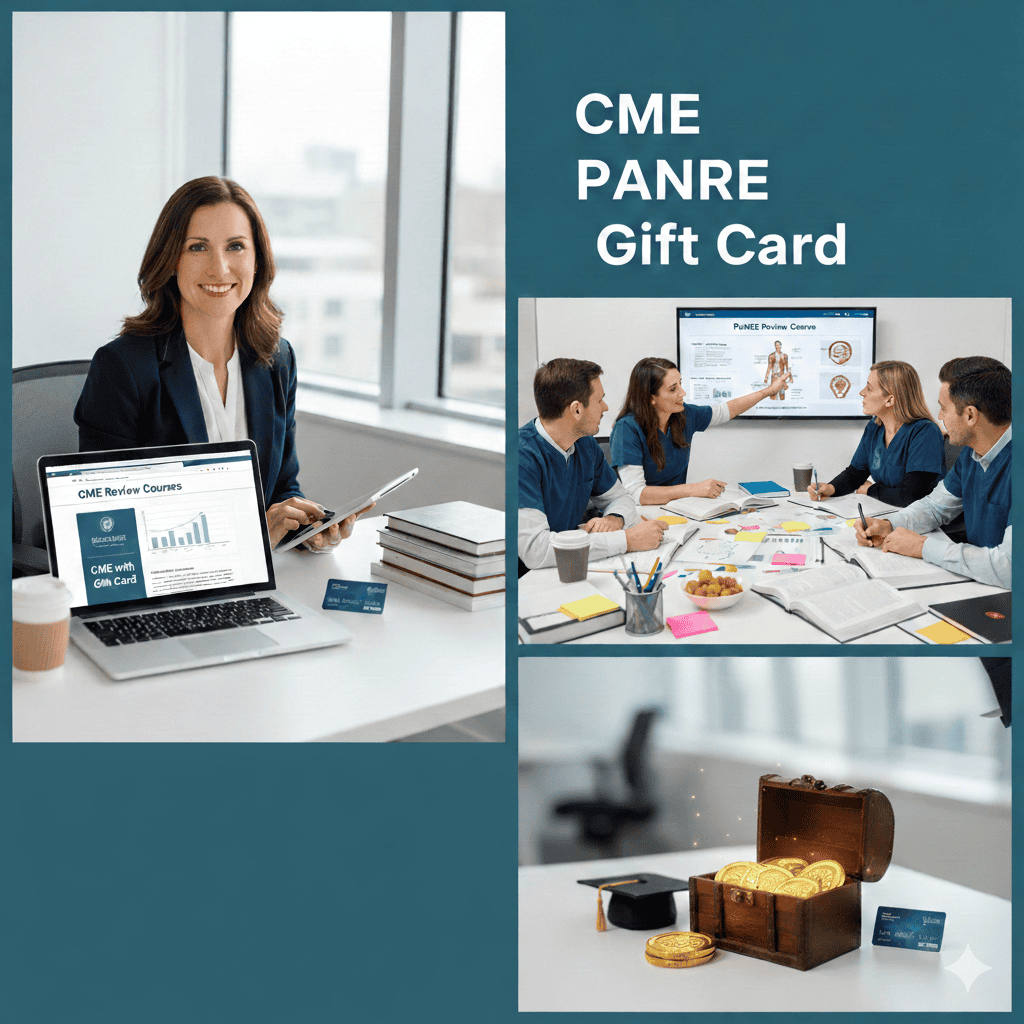
The PANRE Review Course from CME Review Courses combines PANRE preparation with 100 hours of Category 1 AAPA credit. Optional Amazon and Apple Gift Card add-ons from $100 to $1,500 are available with the purchase. These are paid add-ons: not free gifts or discounts: and the selected amount is added to the total package price.
Mistake 1: Using PANCE Prep Courses as Your Main PANRE Strategy
PANCE prep courses are not automatically appropriate for PANRE preparation.
The PANCE and PANRE evaluate broad medical knowledge, but they serve different points in a PA’s career. PANCE preparation is generally designed for students and new graduates entering practice. PANRE preparation is intended for practicing PAs who are maintaining certification and may have developed a narrower clinical focus.
Your daily work may center on emergency medicine, orthopedics, dermatology, psychiatry, or hospital medicine. The PANRE still requires broad knowledge across multiple organ systems and clinical tasks.
A focused PANRE strategy should be organized around the current NCCPA PANRE/PANRE-LA Content Blueprint. Use your baseline performance to identify gaps in areas outside your usual practice setting, including:
- Cardiology
- Pulmonary medicine
- Endocrinology
- Infectious disease
- Neurology
- Renal and genitourinary medicine
- Psychiatry
- Reproductive health
Buying a PANCE-focused product and hoping it will cover your recertification needs may force you to purchase another resource later. That can result in duplicate spending without adding meaningful value.
Mistake 2: Relying on Passive Review
Reading and watching alone do not demonstrate exam readiness.
Reviewing slides, highlighting notes, and watching lectures can improve familiarity with a topic. However, the PANRE requires active retrieval, interpretation of clinical information, and selection of the best next step under time constraints.
Use questions throughout your preparation rather than waiting until the final week. A practical approach is:
- Answer a question before reviewing the explanation.
- Identify the specific knowledge gap behind each incorrect answer.
- Record missed topics by organ system.
- Revisit those topics after a delay.
- Explain why the distractors are incorrect.
A question bank is most useful when the explanations teach you how to recognize the diagnosis and apply the management principle. The PANRE Review Course includes 2,500+ board-style practice questions with detailed explanations, allowing you to make active recall the center of your study plan.

Passive review also creates a budget problem. If you buy a lecture-only product and later need a separate question bank, your CME allowance is supporting multiple incomplete solutions. A comprehensive course may be more efficient when it combines review content, practice questions, and CME credit in one package.
Mistake 3: Skipping Full-Length Practice Exams
Short question blocks do not fully test pacing, concentration, or decision-making under exam conditions.
A long examination can expose problems that do not appear during 10- or 20-question quizzes. You may know the content but spend too long on unfamiliar questions, change correct answers, or lose concentration during the final portion of the exam.
Schedule full-length practice exams before your test date. Use the results to evaluate:
- Average time per question
- Performance during the final third of the exam
- Organ systems producing repeated errors
- Questions that required excessive reconsideration
- Whether you are finishing with adequate time
The PANRE Review Course includes 3 full-length mock exams, each containing 240 questions. Complete the first exam early enough to change your study plan. Use the remaining exams to measure whether targeted review is improving your performance.
If you want a separate question-focused resource, the PANRE/PANRE-LA Review Exams include three 240-question practice exams. This is separate from the full PANRE Review Course that provides 100 hours of Category 1 AAPA credit.
Mistake 4: Studying Every Topic Equally
Your study time should reflect both exam emphasis and your individual weaknesses.
Reviewing every subject for the same amount of time may feel thorough, but it is not an efficient use of a limited schedule. Start with the NCCPA Content Blueprint and then compare it with your diagnostic performance.
For example, if your cardiovascular and pulmonary scores are weak, those areas deserve more attention than a topic in which you are consistently performing well. You should still review lower-performing categories, but your schedule should prioritize the content most likely to improve your overall result.
Use this process:
- Complete an initial diagnostic question block.
- Sort missed questions by system.
- Compare your errors with the NCCPA Content Blueprint.
- Prioritize high-weight areas with low performance.
- Reassess after one to two weeks.
This prevents a common error: spending most of your preparation time on familiar topics because they are easier or more interesting to review.
A PANRE-specific course can help organize this process by separating content into system-based modules. That structure allows you to study broadly while still returning to the areas where you need the most improvement.
Mistake 5: Purchasing Exam Preparation and CME Separately
The most expensive mistake may be treating PANRE preparation and CME fulfillment as unrelated purchases.
NCCPA certification maintenance requires 100 CME credits during each two-year cycle, including at least 50 Category 1 credits. Review the current NCCPA certification maintenance requirements and confirm your personal cycle requirements before enrolling.
The PANRE Review Course provides 100 hours of Category 1 AAPA credit while you prepare for recertification. That can consolidate a significant portion of your CME planning into one exam-relevant activity instead of requiring a separate purchase for generic CME.
The course includes:
- 100 hours of Category 1 AAPA credit
- 2,500+ PANRE practice questions
- 3 full-length mock exams
- Content covering the major NCCPA PANRE systems
- Teaching explanations and downloadable slides
- 30 months of access
- Online, self-paced study
You can also select an optional paid add-on through the CME with Gift Card package:
- Amazon Gift Card options from $100 to $1,500
- Apple Gift Card options from $100 to $1,500
- The gift card amount is added to the course price
- The add-on is not free and is not automatically included
- Gift cards are sent by email after processing
Before using employer-provided CME funds, review your organization’s reimbursement rules. Some employers may have restrictions regarding gift cards or bundled educational purchases. The add-on should be selected only when it complies with your approved CME policy.

PANRE Practice Question
Your patient is a 68-year-old man with COPD and hypertension who presents with fever, productive cough, and progressive dyspnea. He is confused and appears acutely ill. Vital signs are T 39.2°C, HR 124/min, RR 30/min, BP 84/50 mmHg, and SaO2 88% on room air. Chest radiograph shows a right lower-lobe infiltrate. Blood cultures are obtained, broad-spectrum antibiotics are administered, and 30 mL/kg of IV crystalloid is given. His MAP remains 58 mmHg.
Which of the following is the most appropriate next step?
A. Administer IV furosemide
B. Begin norepinephrine infusion
C. Administer IV sodium bicarbonate
D. Start dopamine as first-line vasopressor therapy
E. Order CT angiography of the chest before further treatment
Correct answer: B. Begin norepinephrine infusion
Norepinephrine is the first-line vasopressor for septic shock with persistent hypotension after initial fluid resuscitation. This patient has presumed pneumonia-associated septic shock, altered mental status, and an inadequate MAP despite appropriate crystalloid administration.
Furosemide may worsen intravascular depletion. Sodium bicarbonate is not routine treatment for lactic acidosis in septic shock. Dopamine is associated with more arrhythmias and is not preferred when norepinephrine is available. CT angiography would delay treatment and is not indicated based on the current presentation.
The practical sequence is to obtain cultures when this does not delay therapy, administer appropriate antibiotics, provide initial crystalloid, and start norepinephrine when hypotension persists.
A More Efficient Way to Use Your CME Budget
Avoiding these five mistakes can make your PANRE preparation more focused:
- Choose PANRE-specific preparation instead of relying only on PANCE prep courses.
- Use active recall and question-based review.
- Complete full-length practice exams.
- Prioritize high-weight content and weak organ systems.
- Select a course that supports both exam preparation and CME requirements.
The PANRE Review Course offers 100 hours of Category 1 AAPA credit, 30 months of access, more than 2,500 practice questions, and three full-length mock exams for $499.99.
Optional cme gift cards from Amazon or Apple can be added in amounts from $100 to $1,500. These are paid add-ons, not free gifts. Check your employer’s CME policy before purchase and select an amount that fits your approved budget.
For additional planning information, review the CME Review Courses FAQ and the company’s PANRE recertification resources.
About the Author
Jeremy Boroff, MPAS, PA-C, is a practicing Emergency Medicine physician assistant with 24 years of clinical experience. He also has seven years of experience as a Registered Respiratory Therapist. Jeremy is an author, PA educator, CME developer, and founder of CME Review Courses. He creates PANRE, PANCE, EOR, and specialty review content focused on practical clinical reasoning and efficient exam preparation.