
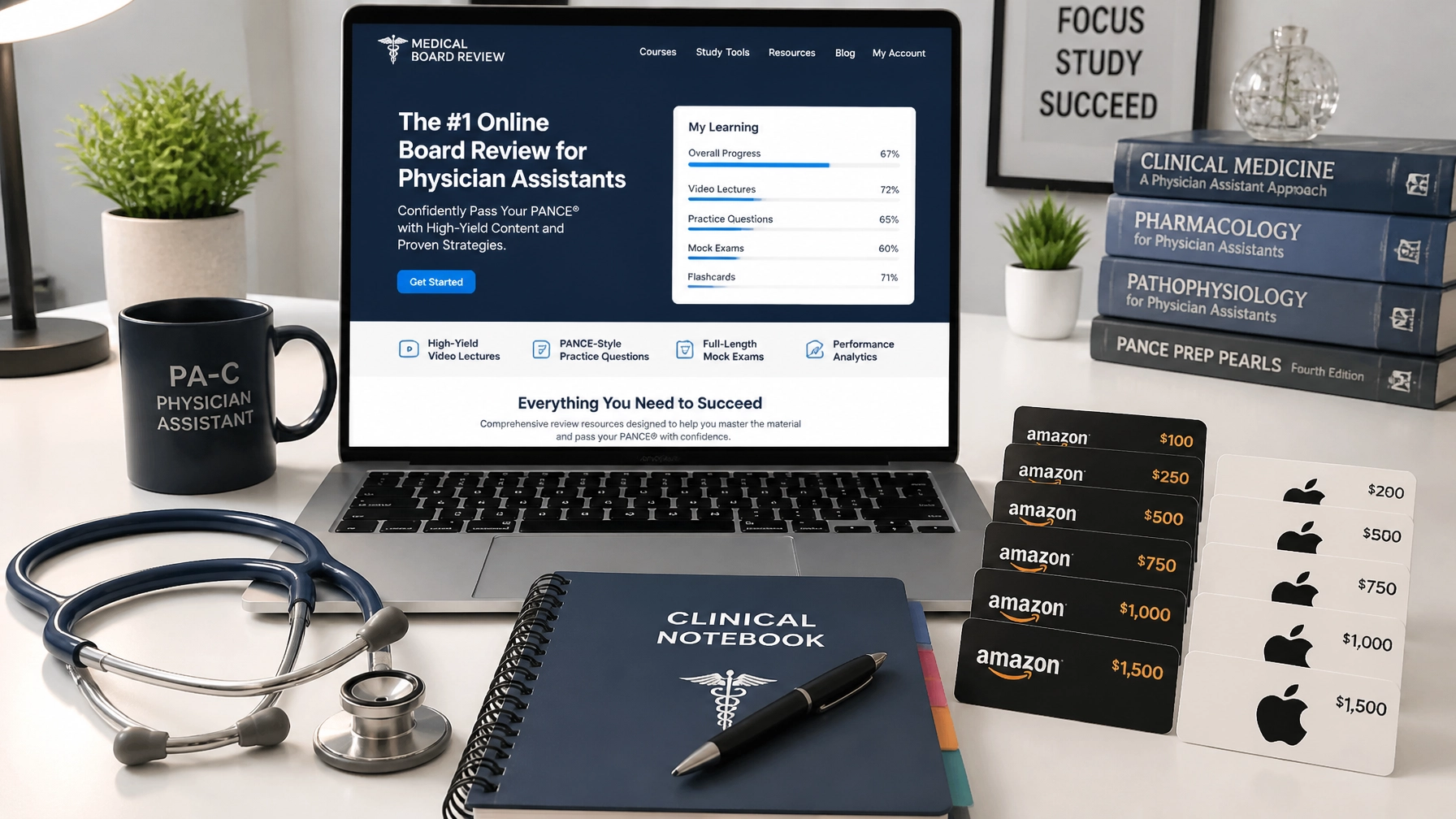
Price: $399.99 (Base Course Price)
Duration of Access: 30 Months
Quantifiable Deliverables: 100 Category 1 AAPA Credits (PANRE Review), 12 Category 1 AAPA Credits (Pharmacology), 720 Practice Questions
Physician assistants (PAs) often face the challenge of exhausting their annual CME allowance before the calendar year ends or, conversely, leaving thousands of dollars in employer-provided funds on the table. Maximizing your professional development budget requires a strategic approach that pairs high-quality board review with practical clinical enrichment tools.
At CME Review Courses, we provide an efficient mechanism to utilize your full stipend by offering Amazon and Apple Gift Card add-ons ranging from $100 to $1,500. These are not "free gifts"; they are integrated components of a comprehensive CME package that allows you to customize your total purchase price to match your specific employer allowance.
1. Match Your Total Purchase to Your Exact CME Stipend
Most healthcare institutions provide a fixed annual CME allowance, often ranging from $1,500 to $2,500. If you purchase a standard panre review course for $399.99, you may have over $1,000 in benefits remaining that will not carry over to the next year.
By utilizing the gift card add-on feature, you can increase the total value of your invoice to ensure 100% of your stipend is utilized. For example, if your budget is $2,000, you can select the PANRE/PANRE-LA Review Exams ($399.99) and add a $1,500 Amazon or Apple Gift Card. Your total transaction will reflect the educational investment, allowing you to secure the cme gift cards needed to purchase additional clinical resources throughout the year.

2. Upgrade Your Clinical Workspace and Reference Library
The "add-on" model is designed for PAs who need more than just credits. When you add an Amazon Gift Card to your pance prep courses or PANRE review, you gain the ability to acquire the physical tools necessary for daily practice.
PAs frequently use these add-ons to purchase:
- Medical Equipment: High-end stethoscopes, reflex hammers, or portable pulse oximeters.
- Hardware: iPads or tablets used for EMR documentation and mobile clinical references.
- Reference Texts: Hardcover copies of the current Harrison's Principles of Internal Medicine or specialty-specific surgical atlases.
This strategy ensures that your CME budget isn't just a "box-ticking" exercise for the NCCPA, but a meaningful investment in your clinical infrastructure.
3. Combine Credits for Comprehensive Recertification
The most efficient way to maintain certification is to bundle high-yield credit courses. The PANRE Review Course at CME Review Courses offers 100 hours of AAPA Category 1 credit, which is a significant portion of the 100-hour requirement every two years for PAs.
When you pair this with our Pharmacology Review Course, which provides 12 hours of Category 1 AAPA credit, you ensure you are meeting both general and prescribing-specific requirements. Both courses allow for gift card add-ons, meaning you can stack these purchases to reach higher budget thresholds while securing the most rigorous exam preparation available.

Clinical Assessment: Practice Questions
Question 1
Your patient is a 64-year-old male presenting with a 2-hour history of sudden-onset, "tearing" chest pain that radiates to his back between the scapulae. His medical history is significant for long-standing, poorly controlled hypertension. On physical exam, his HR is 110 bpm, and blood pressure is 180/105 mmHg in the right arm and 155/90 mmHg in the left arm. A new Grade II/VI diastolic murmur is noted at the right sternal border. Which of the following is the most appropriate initial diagnostic study?
A. Transesophageal echocardiogram (TEE)
B. Computed tomography angiography (CTA)
C. Transthoracic echocardiogram (TTE)
D. Magnetic resonance angiography (MRA)
E. Chest X-ray (CXR)
Correct Answer: B. Computed tomography angiography (CTA)
Explanation: The clinical presentation of sudden, tearing chest pain radiating to the back, combined with a blood pressure discrepancy between arms and a new aortic regurgitation murmur, is highly suggestive of an acute aortic dissection. CTA is the preferred initial diagnostic test in hemodynamically stable patients due to its high sensitivity, specificity, and rapid availability. While TEE (Choice A) is highly accurate and preferred for hemodynamically unstable patients or those with renal failure, CTA is the standard for initial assessment in most stable clinical settings. CXR (Choice E) may show a widened mediastinum but is neither sensitive nor specific enough for diagnosis. MRA (Choice D) is highly accurate but too time-consuming in an acute setting.
Question 2
Your patient is a 28-year-old female presenting with a 3-day history of lower abdominal pain, dyspareunia, and increased vaginal discharge. She is sexually active with a new partner. Vital signs show a temperature of 101.2°F (38.4°C). On pelvic examination, there is significant cervical motion tenderness (chandelier sign) and adnexal tenderness. A pregnancy test is negative. What is the most appropriate outpatient antibiotic regimen for this patient?
A. Azithromycin 1g orally once
B. Ceftriaxone 500mg IM once + Doxycycline 100mg BID for 14 days + Metronidazole 500mg BID for 14 days
C. Ciprofloxacin 500mg BID for 7 days
D. Ceftriaxone 250mg IM once + Azithromycin 1g orally once
E. Doxycycline 100mg BID for 10 days
Correct Answer: B. Ceftriaxone 500mg IM once + Doxycycline 100mg BID for 14 days + Metronidazole 500mg BID for 14 days
Explanation: This patient meets the clinical criteria for Pelvic Inflammatory Disease (PID). The current CDC-recommended outpatient regimen is Ceftriaxone 500mg IM (for patients <150kg) to cover N. gonorrhoeae, plus Doxycycline 100mg BID for 14 days to cover C. trachomatis. Metronidazole is added to provide anaerobic coverage, which is increasingly recommended in the setting of PID to prevent long-term sequelae like tubo-ovarian abscesses or infertility. Azithromycin alone (Choice A) is insufficient for PID. Ciprofloxacin (Choice C) is no longer recommended due to high resistance rates in N. gonorrhoeae.
Maximize Your Education Today
The 720 practice questions included in our PANRE Review are written to match the NCCPA Blueprint exactly. With a 5-answer multiple-choice format, they provide the most realistic simulation of the actual exam. Whether you are prepping for the traditional PANRE or the PANRE-LA, utilizing your CME budget efficiently ensures you have the resources needed to pass.

Invest in your career by choosing a package that respects both your clinical education needs and your professional budget requirements.
