Course price: $499.99. Access: 30 months. Practice: 1,200+ questions in five 240-question exams. CME: up to 100 AAPA Category 1 credits through the PANRE Clinical Review Module.
A PANRE plan can fall behind for reasons that have little to do with clinical knowledge. Delaying your application, leaving CME until the end, or failing to check your credit requirements can create avoidable timeline pressure.
A practical fix is to coordinate your exam schedule, study plan, and CME completion from the start. Here are six timeline and logistics mistakes to watch for, and how to avoid them.
1. Waiting until the recertification deadline is close
The traditional PANRE is available during the ninth or tenth year of a PA-C certification-maintenance cycle. Waiting until late in the cycle to confirm eligibility or apply can narrow your options. NCCPA notes that late applications may result in a testing window shorter than 180 days. Your individual authorization and testing window, not a general study calendar, determine your deadline.
How to avoid it: Check your certification timeline and PANRE eligibility in your NCCPA Portal well in advance. Review NCCPA key dates and the PANRE policies and authorization document, then follow the dates in your authorization notice.
As of October 12, 2026, the 2026 PANRE administration window ends December 18, 2026. If you are applying or scheduling late in the year, do not assume you have a full 180 days. Confirm your own dates directly with NCCPA and Pearson VUE.
2. Treating CME as something to do after studying
Exam preparation and CME requirements can compete for the same limited weeks. If you postpone all CME until after your last practice exam, you may be left completing course requirements while also managing a test date.
How to avoid it: Choose a course that connects your review work with CME completion, then set milestones for both. The PANRE Review Course offers 30 months of access, so you can plan your study and credit completion around your own schedule. The PANRE Clinical Review Module offers up to 100 AAPA Category 1 credits when you meet its completion requirements.
Important credit distinction: The 100 AAPA Category 1 credits apply to the PANRE Review Course’s PANRE Clinical Review Module only, not the Pharmacology Course. Credit is earned through participation and completion requirements, including passing the applicable exams and completing the evaluation. Claim only the credit you earn.
3. Not booking your exam window early enough
A study plan is less useful if the date you want is unavailable or does not fit within your authorized window. Waiting to schedule can force a rushed preparation period or require you to adjust work and personal commitments at short notice.
How to avoid it: Once NCCPA authorizes you, review your testing window and schedule with Pearson VUE promptly. Choose a date that gives you a realistic preparation period while leaving room to manage work, illness, or other disruptions. Avoid assuming that a preferred test-center date will remain available.
4. Starting without a baseline practice exam
Without an initial assessment, you may spend too much time reviewing familiar material and too little time on weaker areas. That can delay readiness and lead to repeatedly pushing your planned exam date back.
How to avoid it: Begin with a timed practice exam or a structured sample assessment. Record your score and the systems or task areas where you missed questions. Then use later exams to check whether targeted review is improving performance. The course’s five 240-question exams offer repeated opportunities to assess progress across the NCCPA Blueprint content.
5. Buying separate exam prep and unrelated CME without checking the fit
Purchasing one product for PANRE preparation and another for CME may mean managing separate logins, schedules, completion requirements, and budgets. It does not automatically cause a delay, but it can make it harder to keep the work coordinated.
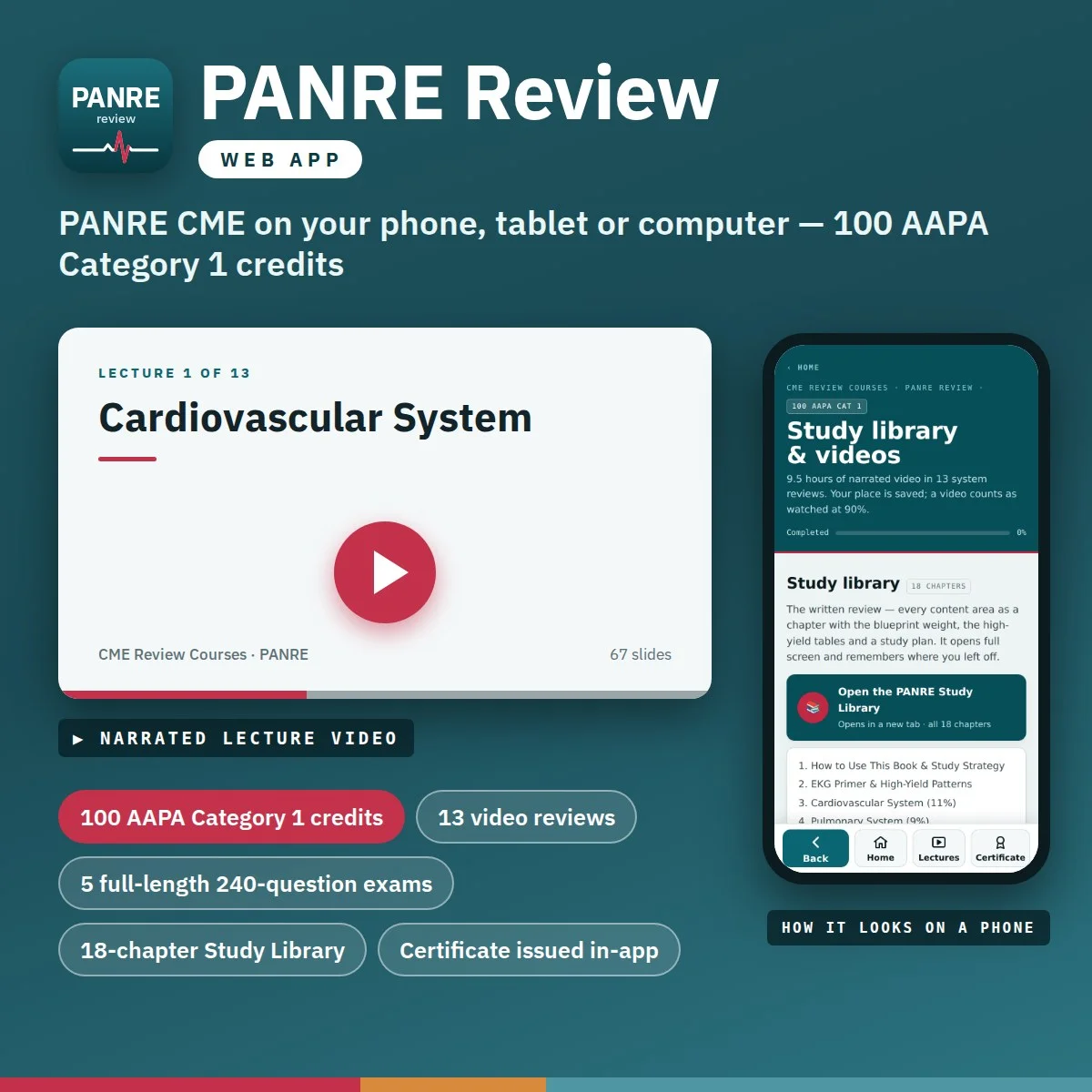
How to avoid it: Compare what each purchase actually delivers before checkout. The PANRE Review Course combines review materials with its PANRE Clinical Review Module, which provides the opportunity to earn up to 100 AAPA Category 1 credits. Its listed price is $499.99, with 30 months of access and 1,200+ practice questions in five 240-question exams. If you need both exam review and credit, putting them in one plan may simplify tracking.
6. Assuming a gift card is free, or assuming every course has the same credit
CME with gift cards can be a useful way to use an employer CME allowance, but the add-on is not a free bonus. The Amazon and Apple options are paid add-ons, priced from $100 to $1,500. They increase the total purchase price, so confirm your available allowance and employer policy before adding one.


How to avoid it: Check the course description and checkout total before you purchase. Confirm the credit type and which specific course activity awards it. In particular, the 100 AAPA Category 1 credits described here are tied to the PANRE Review Course’s PANRE Clinical Review Module; they do not apply to the Pharmacology Course. If you are an NP, check with your state board, because acceptance of AAPA Category 1 credit varies by state.
Board-style practice question
Your patient is a 64-year-old man with sudden-onset dyspnea and pleuritic chest pain two days after a total knee arthroplasty. HR 118/min, BP 126/78 mm Hg, RR 26/min, and SaO₂ 89% on room air. He is alert and has no active bleeding. What is the most appropriate next step?
A. Begin therapeutic anticoagulation for presumed pulmonary embolism
B. Obtain outpatient spirometry
C. Start oral antibiotics for community-acquired pneumonia
D. Reassure him and arrange follow-up in one week
Correct answer: A. Begin therapeutic anticoagulation for presumed pulmonary embolism.
This patient has acute hypoxemia and tachycardia after recent major orthopedic surgery, making PE a high-probability concern. He is hemodynamically stable, but his presentation requires urgent evaluation and management, not outpatient testing or delayed follow-up. Antibiotics are not indicated without evidence supporting infection. In practice, assess bleeding risk and follow local protocols for urgent PE workup and anticoagulation.
A more coordinated PANRE plan
Build a timeline that includes eligibility confirmation, exam scheduling, a baseline assessment, targeted review, and CME completion. Then check whether your chosen course matches the credit you need and whether any add-ons fit your budget.
The PANRE Review Course is $499.99, includes 30 months of access, and provides 1,200+ practice questions in five 240-question exams. Its PANRE Clinical Review Module is the activity that offers up to 100 AAPA Category 1 credits when completion requirements are met. Amazon and Apple gift cards can be added for an additional $100 to $1,500; these are paid add-ons, not free gifts.
- View the PANRE Review Course and paid CME gift card options
- Try the PANRE Review Course test drive
- Try PAtopia in your browser
- Get PAtopia on the iOS App Store
- Get PAtopia on Google Play
PAtopia is the platform for PANCE prep courses and EOR, PACKRAT, and EOC review. Check course details and exam requirements before purchase so your study materials, CME plan, and budget stay aligned.
About the author
Jeremy Boroff, MPAS, PA-C is an Emergency Medicine PA with 24 years of clinical experience. He is a PA educator, author, and CME developer.