



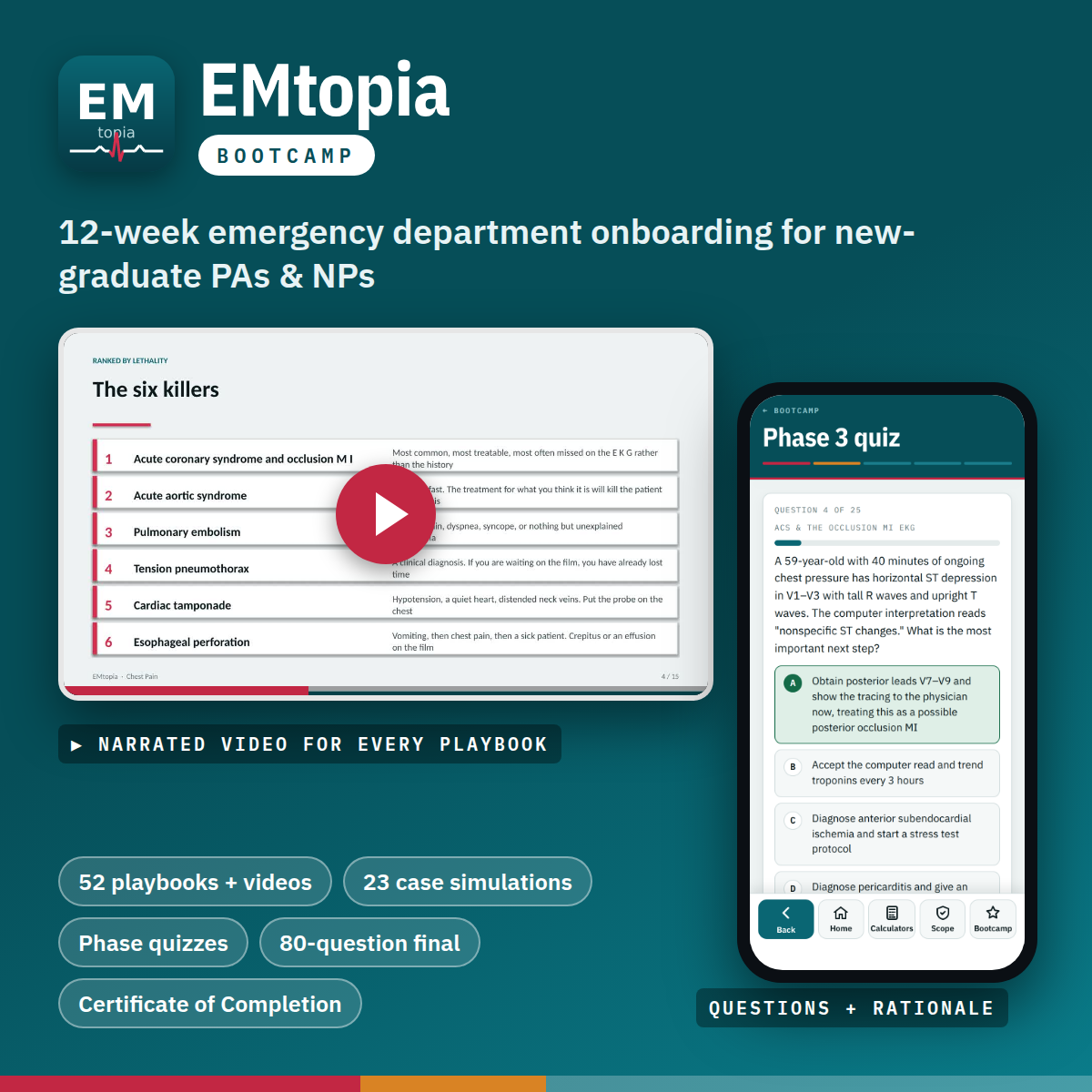
When a new PA or NP picks up a chart that says “chest pain,” the textbook knowledge is usually there. What is often missing is a way to organize the next hour. Which diagnosis do you rule out first? What has to happen in the first ten minutes? When is a normal troponin reassuring, and when is it simply early? Every EMtopia playbook is built to answer those questions in the same order, every time. Here is how that structure plays out for chest pain.
The first ten minutes
The playbook opens with actions, not a differential: an EKG read promptly after arrival, a monitor, vital signs including a look at both arms when the story fits, IV access, and aspirin when acute coronary syndrome is a real possibility and there is no contraindication. The point is to make the time-critical steps automatic, so a new clinician is not still taking the history when an STEMI is sitting on the EKG.
The can’t-miss list, ranked by lethality
Next comes the short list of diagnoses that kill: acute coronary syndrome, aortic dissection, pulmonary embolism, tension pneumothorax, pericardial tamponade, and esophageal rupture. Ranking them by lethality, not frequency, trains the habit experienced clinicians already have. You think about what can hurt the patient before you settle on what is most likely.
Key questions and red flags
The playbook lists the few history points that change management, such as onset, radiation to the back, exertional pattern, syncope, and risk factors for clot. It pairs them with red flags that should stop a new clinician in their tracks: tearing pain, a pulse or blood pressure differential, new neurologic findings, hypotension, or pain after forceful vomiting.
Order this, not that
Over-ordering is as much a problem for new clinicians as under-ordering. The playbook explains why a D-dimer should not be sent on everyone, how pretest probability decides whether PERC or Wells applies at all, and why a single early troponin does not end the conversation. It also covers when imaging for dissection needs to be discussed with the physician instead of reflexively ordered or reflexively skipped.
Risk tools and disposition
The relevant decision rules sit right in the playbook, alongside the working calculators in the app. The disposition section then turns the workup into a decision: who goes home with follow-up, who needs observation or admission, and who needs the physician at the bedside now.
Discharge, charting, and the physician call
Every playbook ends with the parts of the job new clinicians most often feel unprepared for. The discharge checklist includes a plain-language script with specific return precautions. The charting pearls show what a defensible note needs, including the dangerous diagnoses you considered and why you moved past them. The “when to call the physician” section removes the guesswork about when to escalate.
The Landmines section
This is the part new users tell us they read first. For chest pain it covers traps such as anchoring on reflux in a diabetic or older patient, treating a dissection as ACS and starting anticoagulation, discharging on a single troponin drawn too soon after symptom onset, and missing the atypical presentations that are more common in women and older adults.
Local to your department
Each playbook finishes with a local block where your director can add site-specific details: the chest pain pathway you use, how to reach cardiology, and what your department expects before discharge. The same structure repeats across all 52 EMtopia playbooks, and UCtopia uses it for the urgent care setting. By the second week, new clinicians know exactly where to look.
You can open sample playbooks in the free test drive and see the full layout for yourself.