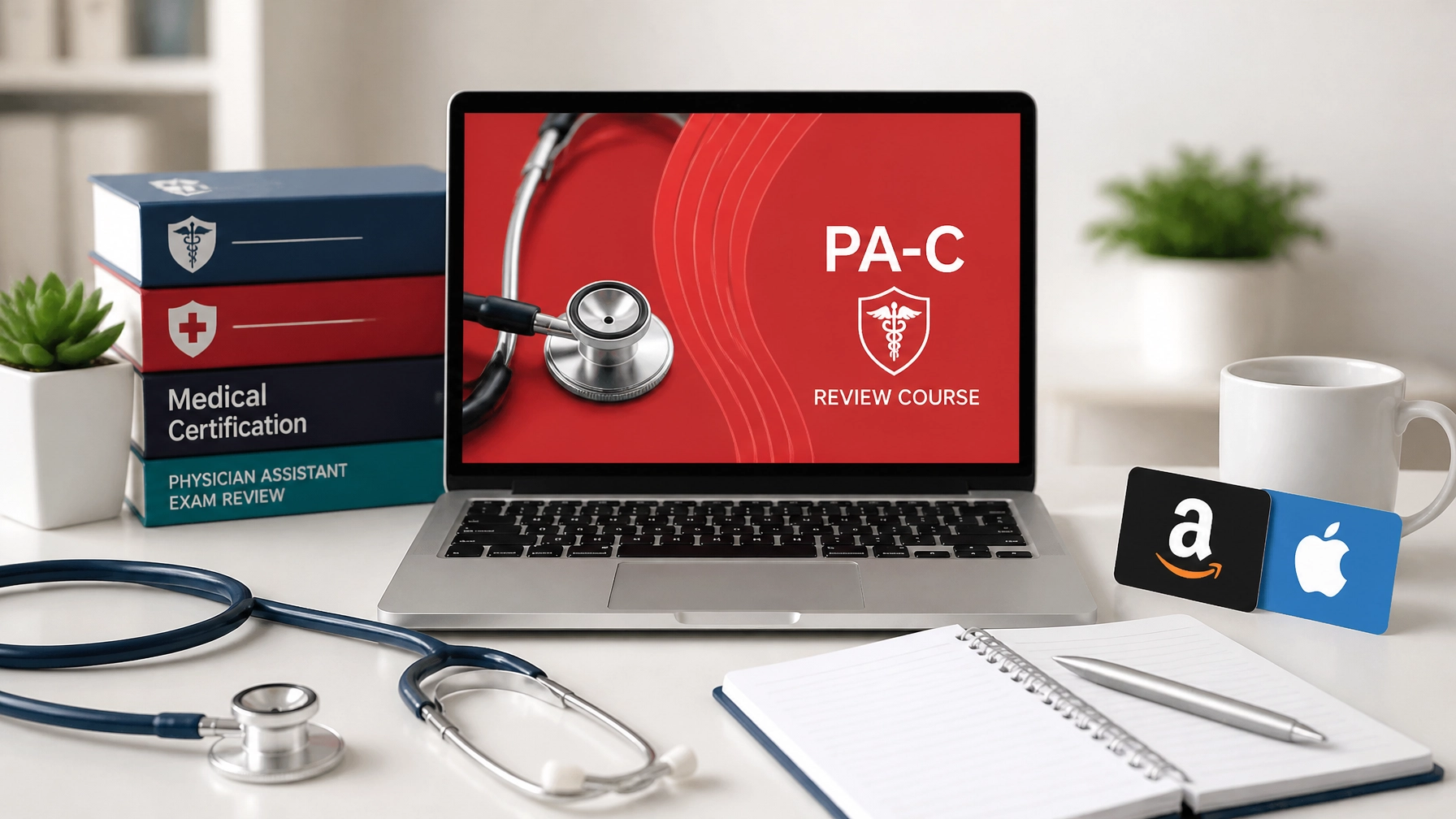
Course Name: PANRE Review Course
Price: $399.99 (Base Course)
Gift Card Add-Ons: $100 to $1,500 (Amazon or Apple)
Access Duration: 30 Months
Deliverables: 100 Hours of Category 1 AAPA CME Credit, Comprehensive Practice Exams, Subject-Specific Content.
Navigating the PANCE and PANRE certification cycles requires a strategic approach to both your time and your professional development budget. As a Physician Assistant, your Continuing Medical Education (CME) allowance is a tool meant to keep you at the forefront of clinical practice. However, many PAs find themselves scrambling at the end of a cycle to find a course that offers high-yield content while maximizing their financial resources.
At CME Review Courses, we provide a streamlined solution. Our panre review course is designed not just to help you pass your exam, but to ensure you are earning the 100 hours of AAPA Category 1 credit required for your certification maintenance. One of the most unique and requested features of our program is the ability to include cme gift cards as part of your purchase. By selecting an Amazon or Apple gift card add-on, you can integrate your educational needs with the tools you use daily.
Understanding the Gift Card Add-On: Not a Free Gift
It is essential to understand the structure of our packages. The Amazon and Apple gift cards, which range in value from $100 up to $1,500, are not free gifts. They are optional add-ons that are included in the total purchase price of your CME package.
When you select a gift card add-on, the value of that card is added to the base price of the panre review course. This allows you to utilize your CME budget efficiently by acquiring both top-tier clinical education and a gift card that can be used for further educational materials, hardware like an iPad for clinical work, or other professional resources.

Why 100 Category 1 AAPA Credits Matter
The NCCPA requires PAs to earn 100 CME credits every two years, at least 50 of which must be Category 1. Our comprehensive course offers exactly 100 hours of AAPA Category 1 credit, covering all major systems required for the PANRE. For many PAs, this single course satisfies the entire Category 1 requirement for the cycle, making it one of the most efficient pance prep courses available today.
While the primary audience for these credits is Physician Assistants, our content is highly valued across the medical spectrum. Internal Medicine Physicians frequently purchase our programs for the high-quality clinical review, though it should be noted that for physicians, these hours count as Category 2 CME. Nurse Practitioners also find significant value here, as AAPA Category 1 credit is often accepted by state nursing boards, though this varies by jurisdiction.
Specialty Focus: High-Yield Internal Medicine
Internal Medicine is a cornerstone of the PANRE. Understanding the nuances of chronic disease management and acute exacerbations is critical for success. Let’s look at a high-yield topic: Congestive Heart Failure (CHF) and EKG Interpretation.
In the clinical setting, you are often the first line of defense in diagnosing a CHF exacerbation. Your knowledge of pharmacological management: specifically the use of ACE inhibitors, beta-blockers, and diuretics: is tested rigorously on the PANRE. Our Internal Medicine Hospitalist content breaks down these protocols into manageable, actionable steps.

When reviewing cardiovascular health, the NCCPA Blueprint emphasizes the importance of diagnostic testing. An EKG is often your first tool. Recognizing the patterns of left ventricular hypertrophy (LVH) or the subtle signs of electrolyte imbalances (like the peaked T-waves of hyperkalemia) can be the difference between a correct diagnosis and a clinical error.
Efficient Learning with the Right Tools
Our panre review course content was written by physician assistants for physician assistants. We understand the specific pressures of the clinical environment. Whether you are studying Cardiovascular health or Gastrointestinal disorders, our modules are direct and focused on the information you need to pass.
With 30 months of access, you have the flexibility to review the material at your own pace. You aren't just buying a test-prep tool; you are investing in a clinical reference that you can return to long after your exam is over.

Clinical Practice Questions
Testing your knowledge is the most effective way to prepare for the PANRE. Below are practice vignettes modeled after the actual exam format.
Question 1
Your patient is a 64-year-old male with a history of hypertension and tobacco use who presents to the clinic complaining of worsening shortness of breath on exertion and a persistent cough that is worse when lying down. On physical exam, you note 2+ pitting edema in the lower extremities and jugular venous distention (JVD). Vitals: BP 155/92 mmHg, HR 88 bpm, SaO2 94% on room air. An echocardiogram reveals an ejection fraction (EF) of 35%. Which of the following is the most appropriate initial pharmacological intervention for long-term mortality benefit in this patient?
A. Furosemide (Lasix)
B. Lisinopril (Prinivil)
C. Digoxin (Lanoxin)
D. Amlodipine (Norvasc)
Explanation:
The correct answer is B. Lisinopril (Prinivil). ACE inhibitors are a first-line therapy for Heart Failure with Reduced Ejection Fraction (HFrEF) because they have been proven to provide a mortality benefit by reducing afterload and inhibiting cardiac remodeling. While Furosemide (Choice A) is excellent for managing the patient's fluid overload (edema, JVD), it does not provide a long-term mortality benefit. Digoxin (Choice C) may help with symptom management in advanced failure but does not improve survival. Amlodipine (Choice D), a calcium channel blocker, is generally not used for heart failure management and can sometimes worsen edema.
Question 2
Your patient is a 45-year-old female who presents with a 2-day history of burning epigastric pain that is partially relieved by eating. She denies any weight loss, dysphagia, or blood in her stool. She has no significant past medical history and takes no regular medications. You suspect Peptic Ulcer Disease (PUD). What is the most appropriate next step in the management of this patient?
A. Immediate referral for Upper Endoscopy (EGD)
B. Urea Breath Test for H. pylori
C. Start a 2-week course of Clarithromycin, Amoxicillin, and Omeprazole
D. Abdominal CT with oral contrast
Explanation:
The correct answer is B. Urea Breath Test for H. pylori. In a young patient without "alarm symptoms" (weight loss, dysphagia, anemia, melena), the "test and treat" strategy for H. pylori is the standard of care. EGD (Choice A) is reserved for older patients (usually >60) or those with alarm symptoms. Triple therapy (Choice C) should only be initiated after a positive test result to avoid contributing to antibiotic resistance. An abdominal CT (Choice D) is not the primary diagnostic tool for intraluminal gastric pathology like PUD.
Question 3
Your patient is a 28-year-old female presenting with acute onset of right lower quadrant (RLQ) abdominal pain, nausea, and a low-grade fever of 100.2°F. On exam, she has positive rebound tenderness at McBurney's point. Her last menstrual period was 2 weeks ago. Vitals: BP 120/80 mmHg, HR 105 bpm. What is the most essential laboratory test to perform first?
A. White Blood Cell (WBC) count
B. Serum Amylase and Lipase
C. Urine Pregnancy Test (hCG)
D. Urinalysis
Explanation:
The correct answer is C. Urine Pregnancy Test (hCG). In any woman of childbearing age presenting with lower abdominal pain, pregnancy: specifically ectopic pregnancy: must be ruled out immediately before proceeding with imaging like CT or surgery. While a WBC count (Choice A) may show leukocytosis in appendicitis, it is non-specific. Amylase/Lipase (Choice B) are used for suspected pancreatitis, and Urinalysis (Choice D) may help rule out a UTI, but the clinical priority is identifying pregnancy status for both diagnostic and safety reasons.
Maximize Your Professional Development
Preparing for the PANRE doesn't have to be a drain on your resources. By choosing a PANRE Review Course that includes cme gift cards, you are making a smart financial and professional decision.
Whether you need to focus on Neurology, Pulmonary, or Emergency Medicine, our modules provide the depth and clarity required for the modern PA. Don't leave your certification to chance: invest in a course that offers the credits you need and the value you deserve.
For more information on our specific modules and to view our full library of pance prep courses, visit our Product Gallery.