

For the hospitalist Physician Assistant, time is the most valuable commodity. Balancing high-acuity patient loads, rapid admissions, and complex discharge planning leaves little room for inefficient board preparation. Whether you are prepping for the traditional PANRE or navigating the PANRE-LA, you need a high-yield, streamlined solution that respects your clinical expertise while ensuring you meet the NCCPA standards.
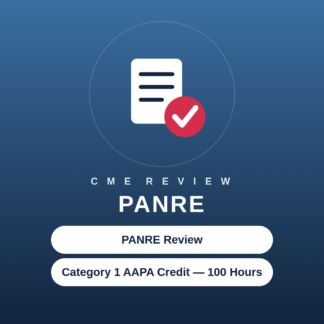
The PANRE Review Course from CME Review Courses is designed specifically for this purpose. It provides a comprehensive review of internal medicine and other critical specialties, while allowing you to earn 100 hours of AAPA Category 1 CME credit. This is not just a study tool; it is a strategic way to maximize your CME budget and your time.
Course Overview and Deliverables
Course Title: PANRE Review Course
Credit: 100 Hours of AAPA Category 1 CME Credit
Access Duration: 30 Months
Quantifiable Deliverables: Over 1,000 board-style practice questions, comprehensive digital and physical study materials, and deep-dive clinical content.
Special Feature: CME gift cards add-on options from $100 to $1500.
This course is built by PAs for PAs. While the content is primarily focused on the NCCPA blueprint for physician assistants, it is highly valuable for internal medicine physicians, nurse practitioners, and CRNAs. Physicians can claim this as Category 2 CME, and NPs should check their state regulations regarding the acceptance of AAPA Category 1 credits.
Maximize Your CME Budget with Gift Card Add-Ons
One of the most efficient ways to utilize your employer-provided CME funds is through our cme gift cards program. When you purchase the PANRE Review Course, you have the option to add an Amazon or Apple Gift Card to your order.

Important Note: These gift cards are NOT free gifts. They are add-ons that you choose to include in your purchase price. You can add a gift card in denominations ranging from $100 to $1500. This allows you to enrich your professional library, upgrade your clinical hardware, or purchase additional educational resources using your CME allowance. It is a pragmatic solution for the busy hospitalist who needs to make every dollar count.
Clinical Vignettes for the Hospitalist
The following clinical vignettes are designed to mimic the style and complexity of the questions you will encounter in our pance prep courses and the PANRE exam. Use these to test your knowledge across the internal medicine spectrum.
Case 1: Cardiology – NSTEMI Management
Your patient is a 68-year-old male with a history of HTN, HLD, and T2DM who presents with 3 hours of substernal pressure and diaphoresis. Vitals: BP 158/92, HR 98, RR 18, SpO2 96% on room air. ECG shows 2 mm ST depressions in leads V4–V6. Troponin I is elevated. He already took 325 mg aspirin at home.
Which of the following is the most appropriate next step in management?
A. Start IV thrombolytic therapy
B. Administer sublingual nitroglycerin and begin IV heparin
C. Schedule outpatient stress test within 72 hours
D. Start high-dose oral diltiazem and observe
Correct Answer: B. Administer sublingual nitroglycerin and begin IV heparin
Explanation: In the setting of an NSTEMI (elevated troponins + ST depression), management focuses on anti-ischemic therapy and anticoagulation. Sublingual nitroglycerin helps with chest pain, and IV heparin (or LMWH) is indicated to prevent further thrombus formation. Thrombolytics (Choice A) are indicated for STEMI when PCI is unavailable, not NSTEMI. Outpatient testing (Choice C) is inappropriate for an acute coronary syndrome.
Case 2: Pulmonology – Acute Pulmonary Embolism
Your patient is a 52-year-old woman postoperative day 2 from a total knee replacement. She develops sudden pleuritic chest pain and dyspnea. Vitals: HR 118, BP 128/76, RR 26, SpO2 90% on 2L NC. Lungs are clear. ECG shows sinus tachycardia. CXR is normal.
What is the most appropriate diagnostic test?
A. D-dimer level
B. CT pulmonary angiography
C. Ventilation-perfusion (V/Q) scan as first-line
D. Lower extremity venous Doppler ultrasound only
Correct Answer: B. CT pulmonary angiography
Explanation: This patient has a high pretest probability for PE (tachycardia, recent major surgery, sudden dyspnea). When the Wells Score indicates a moderate to high probability, the next step is definitive imaging with CT pulmonary angiography. A D-dimer (Choice A) is only useful for ruling out PE in patients with a low pretest probability.
Case 3: Endocrine – Diabetic Ketoacidosis (DKA)
Your patient is a 24-year-old woman with Type 1 DM presenting with abdominal pain and vomiting. She missed her insulin for three days. Vitals: BP 98/60, HR 120, RR 30. Labs: Glucose 510 mg/dL, Na 130, K 5.5, HCO3 12, anion gap 24.
Which of the following is the most appropriate initial treatment?
A. Start IV insulin bolus immediately
B. Begin aggressive IV normal saline and recheck potassium
C. Give IV sodium bicarbonate
D. Administer long-acting subcutaneous insulin only
Correct Answer: B. Begin aggressive IV normal saline and recheck potassium
Explanation: The priority in DKA is fluid resuscitation to address the profound volume depletion. While insulin is necessary to close the anion gap, starting it before ensuring adequate potassium levels or during severe hypotension can be dangerous. Saline should be initiated first. Bicarbonate (Choice C) is typically reserved for a pH < 6.9.

Case 4: Gastroenterology – Variceal Bleed
Your patient is a 64-year-old male with cirrhosis presenting with hematemesis and melena. Vitals: BP 90/56, HR 112. He appears pale and diaphoretic. Hb is 7.2 g/dL.
Which inpatient intervention is most appropriate to perform next?
A. Schedule elective endoscopy for tomorrow morning
B. Start IV proton pump inhibitor only
C. Begin volume resuscitation, IV octreotide, and arrange emergent endoscopy
D. Discharge after observation and start oral iron
Correct Answer: C. Begin volume resuscitation, IV octreotide, and arrange emergent endoscopy
Explanation: An unstable patient with a suspected variceal bleed requires aggressive resuscitation, IV octreotide to reduce portal pressure, and emergent GI consultation for endoscopy. PPIs (Choice B) are used for peptic ulcers but octreotide is specific for variceal management. Delaying endoscopy (Choice A) increases mortality in active bleeds.
Case 5: Infectious Disease – Hospital-Acquired Pneumonia (HAP)
Your patient is a 70-year-old male hospitalized for 6 days following a stroke. He develops a fever of 38.9°C, productive cough, and a new RLL infiltrate on CXR.
What is the most appropriate empiric antibiotic regimen?
A. Ceftriaxone + azithromycin
B. Piperacillin-tazobactam ± vancomycin
C. Amoxicillin–clavulanate alone
D. Levofloxacin oral therapy only
Correct Answer: B. Piperacillin-tazobactam ± vancomycin
Explanation: Because the pneumonia developed more than 48 hours after admission, it is classified as HAP. Empiric therapy must cover Pseudomonas and other gram-negative rods, along with MRSA coverage if risk factors are present. Choice A is standard for community-acquired pneumonia, not HAP.
Case 6: Renal – Acute Kidney Injury (AKI)
Your patient is a 78-year-old woman with CHF presenting with diarrhea and poor oral intake. Vitals: BP 92/60. Labs: BUN 48, Cr 1.9 (baseline 0.9), urine Na 8 mEq/L, FeNa 0.5%.
What is the most likely cause of her AKI?
A. Acute tubular necrosis (ATN)
B. Pre-renal azotemia due to volume depletion
C. Acute interstitial nephritis
D. Post-renal obstruction
Correct Answer: B. Pre-renal azotemia due to volume depletion
Explanation: A FeNa < 1% and a low urine sodium (< 20 mEq/L) are classic indicators of a **pre-renal** etiology, where the kidneys are structurally intact but hypoperfused. In ATN (Choice A), the FeNa is typically > 2% due to the kidneys' inability to reabsorb sodium.
Case 7: Cardiology – New-Onset Atrial Fibrillation
Your patient is a 76-year-old woman hospitalized for pneumonia who develops new-onset atrial fibrillation with RVR. HR is 145, BP 118/70. She is asymptomatic and alert.
Which is the most appropriate immediate management?
A. Immediate electrical cardioversion
B. Start IV heparin and schedule TEE-guided cardioversion
C. Rate control with IV diltiazem or beta-blocker and initiate anticoagulation
D. No treatment is necessary
Correct Answer: C. Rate control with IV diltiazem or beta-blocker and initiate anticoagulation
Explanation: In a hemodynamically stable patient with AF with RVR, the goal is rate control and thromboembolism prevention. Cardioversion (Choice A) is only required urgently if the patient is unstable (e.g., hypotension, pulmonary edema).
Case 8: Neurology – Hospital Delirium
Your patient is an 82-year-old male on post-op day 3 from a hip repair. He was cognitively intact at admission but is now agitated, pulling at lines, and seeing "bugs on the wall." His symptoms fluctuate throughout the day.
What is the most likely diagnosis?
A. Dementia
B. Delirium
C. Psychosis
D. Depression
Correct Answer: B. Delirium
Explanation: The acute onset, fluctuating consciousness, and inattention are pathognomonic for delirium. The most important next step is identifying the underlying cause (infection, meds, electrolyte imbalance). Dementia (Choice A) is a chronic, progressive decline, not an acute change.
Why Choose CME Review Courses?
Preparation for the PANRE shouldn't feel like a second job. Our panre review course breaks down complex hospitalist topics into digestible, high-yield modules. By using our program, you ensure that you are studying the right material while earning the necessary 100 hours of AAPA Category 1 credit.

Whether you are looking for pance prep courses to brush up on fundamentals or a focused review of Internal Medicine Hospitalist content, we provide the tools you need to succeed. Don't forget to explore the Amazon and Apple Gift Card add-ons during checkout to get the most value from your CME allowance.
View the PANRE Review Course and Gift Card Add-On Options Here