The landscape of professional development for Physician Assistants is shifting. Gone are the days when the only way to earn substantial credits was by booking a flight to a crowded conference center. Today, efficiency is the priority. You need high-yield clinical information that directly impacts your practice and your ability to pass the PANRE or PANCE.
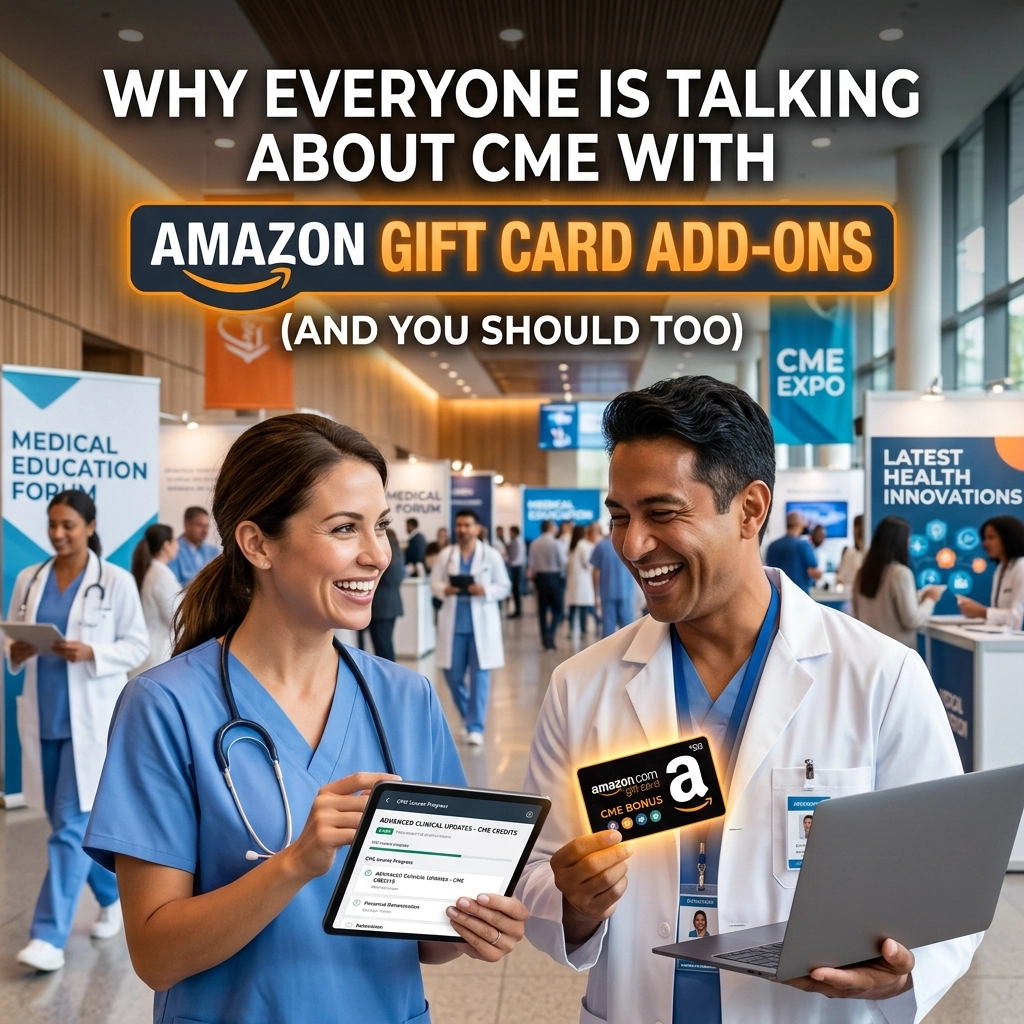
Lately, the conversation in breakrooms and professional forums has centered on a specific model: cme gift cards. Specifically, clinicians are looking for ways to maximize their employer-provided CME allowance. By utilizing a panre review course that offers cme with gift card add-ons, you can fulfill your educational requirements while simultaneously acquiring the tools you need for your daily practice.
The Value of the Add-On Model
It is essential to understand how this works at CME Review Courses. When you purchase a course, you have the option to include an Amazon or Apple Gift Card add-on. These range in value from $100 to $1,500.
A common misconception is that these are "free gifts." They are not. These are intentional add-ons that you choose to include in your total purchase price. This allows you to utilize your full CME stipend to get both the high-quality pance prep courses you need and a gift card that can be used to purchase medical equipment, reference books, or updated technology for your clinic.

Earning 100 Category 1 AAPA Credits
For those preparing for the PANRE or the PANRE-LA, the most critical deliverable is the credit hour. Our PANRE Review Course is specifically designed to provide 100 Category 1 AAPA credits. This is a significant portion of your cycle requirements, delivered in a format that focuses on the NCCPA Blueprint.
When you are looking at panre review course options, the density of the credits matters. Earning 100 credits in a single, comprehensive program saves you the logistical headache of tracking dozens of smaller certificates from various sources. It ensures that your time is spent on high-yield clinical pearls rather than administrative tasks.
Emergency Medicine Focus: Clinical Vignettes
To stay sharp for your boards and your daily shifts, let’s look at how we approach clinical content. In the Emergency Medicine End of Rotation Review, we focus on rapid identification and stabilization.
Scenario 1
Your patient is a 54-year-old male presenting to the ED with acute onset of "tearing" chest pain that radiates to the back. His PMH includes uncontrolled hypertension. On physical exam, his BP is 190/110 mmHg in the right arm and 160/95 mmHg in the left arm. His HR is 105 bpm.
Question 1: What is the most appropriate initial diagnostic study to confirm the suspected diagnosis in a hemodynamically stable patient?
A) Chest X-ray
B) Transthoracic Echocardiogram (TTE)
C) CT Angiography (CTA) of the chest and abdomen
D) Magnetic Resonance Angiography (MRA)
Answer: C) CT Angiography (CTA) of the chest and abdomen.
CTA is the gold standard for diagnosing an aortic dissection in stable patients due to its high sensitivity and specificity. It provides detailed anatomical information necessary for surgical planning. While a Chest X-ray might show a widened mediastinum, it is not diagnostic. MRA is highly accurate but often impractical in an acute ED setting due to the time required and monitoring difficulties.

Scenario 2
Your patient is a 28-year-old female complaining of sudden onset shortness of breath and pleuritic chest pain. She recently returned from a cross-country flight. She takes oral contraceptive pills. Her HR is 112 bpm, RR is 24/min, and SaO2 is 92% on room air. Her calves are non-tender and symmetric.
Question 2: According to the Wells Criteria, what is the next best step in management?
A) Order a D-dimer
B) Perform a Bedside Ultrasound (POCUS) of the lower extremities
C) Order a CTA of the chest
D) Administer 325mg of Aspirin
Answer: C) Order a CTA of the chest.
This patient has a high clinical suspicion for Pulmonary Embolism (PE) based on risk factors (OCPs, recent immobilization) and clinical signs (tachycardia, tachypnea). In patients with a high pre-test probability (Wells Score > 4 or 6 depending on the version used), a D-dimer is not sufficient to rule out PE because a negative result would not outweigh the clinical suspicion. Immediate imaging with CTA is indicated.
Why PAs Choose Our PANCE Prep Courses
The core of our curriculum is built around the NCCPA Blueprint. We don't believe in teaching "fluff." We focus on the high-probability topics that are guaranteed to appear on your exams. Whether you are a student preparing for the initial PANCE or a seasoned PA-C tackling the PANRE, our courses are designed to respect your time.

Using cme gift cards to purchase these courses allows you to stay current with medical literature. For example, if you add a $500 Amazon gift card to your PA-CME purchase, you can use that card to buy the latest edition of Harrison’s Principles of Internal Medicine or a high-quality Littmann stethoscope. This integration of education and equipment is why the "CME with gift card" model has become the standard for modern clinicians.
Logistics and Deliverables
When you invest in your education, you need to know exactly what you are getting. Here are the hard facts for our premier offering:
- Course Title: PANRE Review Course
- Price: $600.00 – $2,100.00 (Depending on Gift Card Add-on)
- Credits: 100 Category 1 AAPA Credits
- Access Duration: 1 Year of Unlimited Access
- Deliverables: Comprehensive Video Modules, Practice Exams, and over 1,000 High-Yield Questions
- Gift Card Options: $100 to $1,500 Amazon or Apple Add-ons Available
Psychiatry and Behavioral Health Review
In addition to Emergency Medicine, our pance prep courses cover the heavy hitters like Psychiatry. Mental health makes up a significant portion of the NCCPA Blueprint.
Scenario 3
Your patient is a 19-year-old male college student brought in by his roommates. They report he hasn't slept in four days, is talking a "mile a minute," and recently spent his entire semester's tuition on a new motorcycle he doesn't know how to ride. On exam, he is irritable, distractible, and exhibits pressured speech. He denies any history of drug use.
Question 3: What is the most appropriate first-line pharmacologic treatment for this patient's acute presentation?
A) Sertraline
B) Lithium or Valproate
C) Alprazolam
D) Haloperidol monotherapy
Answer: B) Lithium or Valproate.
This patient is experiencing a manic episode, hallmark of Bipolar I Disorder. Mood stabilizers like Lithium or Valproate (often in combination with an atypical antipsychotic for acute agitation) are first-line. SSRIs like Sertraline should be avoided as they can precipitate or worsen a manic switch.

Maximizing Your CME Budget
Every year, many PAs leave thousands of dollars of CME money on the table because they can't find a program that fits their schedule or their needs. By choosing CME Review Courses, you are ensuring that your professional development funds are used to their maximum potential.
The flexibility of our platform allows you to study at your own pace. If you are working in Family Medicine but want to brush up on your acute care skills, our Emergency Medicine modules provide the specific, actionable data you need.
Remember, when you select the cme gift cards option, you are making a strategic decision for your career. You are getting the 100 Category 1 AAPA credits required for the PANRE Review Course, the clinical knowledge to improve patient outcomes, and the financial flexibility of an Amazon or Apple add-on to keep your practice running with the latest tools.
Don't let your CME allowance expire without getting the most out of it. Join the thousands of PAs who have switched to our high-yield, credit-dense review courses.

Final Clinical Thought
As you prepare for your next exam or your next shift, remember that diagnostic excellence comes from a solid foundation in the NCCPA Blueprint. Whether it's identifying a silent MI or managing a complex psychiatric crisis, the information contained in our pance prep courses is designed to be your primary resource. Invest in yourself, earn your credits, and get the add-ons that make your professional life easier.
