Course Overview and Logistical Details
- Price: $499.99 for the PANRE Review Course without a gift card add-on
- Access: 30 months from purchase
- Deliverables: More than 2,500 board-style practice questions, five full-length 240-question practice exams, detailed rationales, cited references, and a complete study library
- CME: Up to 100 hours of AAPA Category 1 CME through the PANRE Review Course
- Format: Online, self-paced, and mobile-friendly
The 100 hours of Category 1 AAPA credit apply specifically to the PANRE Review Course. They do not apply to the Pharmacology Course. The Pharmacology Course is a separate CME activity with its own credit amount.
For current NCCPA requirements, PAs must complete the required CME during each two-year certification maintenance cycle and pass either the traditional PANRE or PANRE-LA by the end of the 10-year cycle. The NCCPA maintains the official requirements, timelines, and application rules, so review its Maintain Certification page before selecting an exam pathway.
PANRE-LA vs Traditional PANRE: What Is the Difference?
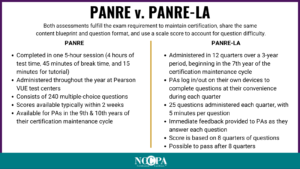
Both assessments are based on the same NCCPA Blueprint and evaluate core medical knowledge relevant to clinically practicing PAs. The main difference is how and when you demonstrate that knowledge.
Traditional PANRE
The traditional PANRE is a proctored, closed-book examination completed at a Pearson VUE test center.
Key features include:
- Available during the ninth or 10th year of the certification maintenance cycle
- Four blocks of 60 questions
- Sixty minutes for each question block
- Four hours of testing time, with additional time for breaks and the tutorial
- One concentrated testing appointment
- Printed or online reference materials are not permitted
- A $350 application fee
This path is appropriate if you prefer to prepare for one defined exam date and complete the requirement in a single testing session. It also allows you to control your preparation timeline rather than answering questions every quarter.
The tradeoff is concentration. You must retain and apply a broad range of clinical information under time pressure. Your preparation should include timed blocks, mixed-organ-system questions, and full-length practice examinations.
PANRE-LA
PANRE-LA is a longitudinal assessment completed online through the NCCPA portal.
Key features include:
- Application during the sixth year of the certification maintenance cycle
- Participation beginning in the seventh year
- Twenty-five questions each quarter
- Five minutes to answer each question
- Open-book access to printed or online references
- A minimum of eight completed quarters and up to 12 total quarters
- Final scoring based on your best eight quarters
- Immediate feedback, explanations, references, and performance information
- A $350 application fee
PANRE-LA is designed to distribute assessment and learning across multiple quarters. It may fit your practice pattern if you prefer shorter study encounters, ongoing feedback, and the ability to use references while answering questions.
However, open-book does not mean unprepared. You still need to recognize the likely diagnosis, identify the appropriate next step, and use references efficiently. Spending several minutes searching for basic information is not an effective longitudinal strategy.
NCCPA also states that participants receive Category 1 Self-Assessment CME for completed PANRE-LA quarters. That credit is separate from the 100 hours of AAPA Category 1 CME available through the CME Review Courses PANRE Review Course.
Which Path Fits Your Study Style?
Choose the traditional PANRE if you:
- Perform well during a single structured examination
- Prefer a defined preparation window
- Want to complete the exam requirement in one appointment
- Can reliably schedule several weeks or months of dedicated review
- Prefer closed-book testing conditions
Choose PANRE-LA if you:
- Prefer smaller, recurring assessment blocks
- Value immediate explanations and references
- Want assessment integrated into a longer learning process
- Can maintain quarterly participation
- Prefer completing questions from home or another compatible location
Neither option removes the need for systematic review. PANRE-LA changes the timing and environment of the assessment, but you are still responsible for core content across the NCCPA Blueprint.
Daily CME Tip: Separate Exam Preparation From CME Tracking
Do not wait until the end of your certification cycle to determine whether your CME record is complete. Review your NCCPA account, identify your current two-year cycle, and calculate how many credits remain.
The PANRE Review Course can combine two tasks:
- Structured preparation for the PANRE or PANRE-LA
- Completion of up to 100 hours of AAPA Category 1 CME
The course includes five full-length practice examinations with 240 questions each, for 1,200 full-length exam questions. It also includes more than 2,500 total board-style questions across the content areas tested on the NCCPA Blueprint.
Use the course diagnostically. Start with a mixed question set, review missed questions by organ system, and then create a weekly plan around your lowest-performing areas. For PANRE preparation, schedule timed blocks. For PANRE-LA preparation, focus on consistent quarterly review and efficient use of references.
Understanding CME With Amazon and Apple Gift Card Add-Ons
CME Review Courses offers optional cme gift cards with eligible CME purchases. Amazon and Apple gift card add-ons range from $100 to $1,500.
These are paid add-ons, not free gifts. The gift card amount is added to the total purchase price at checkout. You can select an Amazon or Apple option, choose the available amount, or purchase the CME course without a gift card.
Gift card add-ons may help you use an employer-provided CME allowance for educational technology, clinical references, or other professional tools. However, you should review your employer’s CME policy before purchasing. The add-on is separate from the educational value of the course and does not increase the number of CME credits awarded.

The PANRE Review Course with Gift Card provides 30 months of access and up to 100 hours of AAPA Category 1 CME after completing the required course content, post-test, and evaluation. Gift cards are processed separately and are emailed according to the product’s stated fulfillment terms.
Physicians may use the clinical review content as professional education, but AAPA Category 1 credit does not automatically function as Category 1 physician CME. Physicians should verify how their applicable organization or certifying body classifies the activity. Nurse practitioners should also confirm whether their state board or employer accepts AAPA Category 1 credit.
Clinical Practice Question
Your patient is a 58-year-old man with hypertension and type 2 diabetes who presents with sudden-onset, tearing chest pain radiating to the back. BP is 180/100 mm Hg in the right arm and 140/85 mm Hg in the left arm. HR is 95/min, RR is 22/min, and SaO₂ is 98% on room air. You hear a diastolic decrescendo murmur along the left sternal border. ECG shows sinus rhythm with LVH.
Which diagnostic study is most appropriate to confirm the suspected diagnosis in this hemodynamically stable patient?
A. Transthoracic echocardiography
B. CT angiography of the chest with IV contrast
C. Chest radiography
D. Magnetic resonance angiography
Answer and Explanation
Correct answer: B. CT angiography of the chest with IV contrast.
CTA is the preferred initial imaging study for suspected acute aortic dissection in a hemodynamically stable patient. It is rapid, widely available, and accurately identifies the intimal flap and true and false lumens.
TTE may be useful at the bedside, particularly in an unstable patient, but it has limited visualization of the descending thoracic aorta. CXR can show mediastinal widening but cannot confirm or exclude dissection. MRA is accurate but slower and less practical for an acute emergency evaluation.
Begin immediate anti-impulse therapy while arranging imaging. IV beta-blockade, such as esmolol or labetalol, is used to reduce HR and aortic wall stress. Do not delay definitive imaging for a nonspecific screening test.
Study Tip: Use Short, Repeated Question Blocks
Whether you select PANRE or PANRE-LA, daily practice is more effective when it is specific and repeatable.
Complete one 20- to 30-question block. Review every missed question. Record the clinical concept tested, not simply the correct letter. Then revisit the same topic several days later using a different question set.
For additional practice, use the PAtopia web version, or study from the PAtopia iOS app or PAtopia Android app. Although PAtopia is primarily designed for PA students preparing for PANCE and EOR examinations, its structured question-based format can support ongoing review of core medical concepts.
Final Takeaway
The traditional PANRE and PANRE-LA assess the same broad clinical foundation but require different preparation strategies.
- Traditional PANRE is a single, proctored, closed-book examination.
- PANRE-LA is a quarterly, online, open-book longitudinal assessment.
- Both require continued CME.
- The PANRE Review Course provides up to 100 hours of AAPA Category 1 CME specifically through its PANRE Clinical Review Module.
- Optional Amazon and Apple cme gift cards range from $100 to $1,500 and are paid add-ons, not free gifts.
- The course costs $499.99 without a gift card add-on and includes 30 months of access.
Review your NCCPA timeline first. Then select the assessment format that matches your study habits, work schedule, and tolerance for either one concentrated examination or recurring quarterly participation.
About the Author
Jeremy Boroff, MPAS, PA-C, has 24 years of Emergency Medicine experience and has worked as a PA educator, author, and CME developer. He is the founder of CME Review Courses and creates PANRE, PANCE, EOR, and specialty CME review materials for practicing clinicians and PA students.
This article is for educational purposes. Confirm current examination requirements, CME policies, and credit eligibility with NCCPA, AAPA, your employer, and the applicable licensing board.